Site map, Key document links, Climate & Environment Glossary

Site Map
- Start Here (Home Page)
- Mitigation
- Adaptation
- Strategic Adaptation
- Seasonal Preparedness
- Seasonal Calendars & Outlooks for:
- Acting Ahead
- Environmental Degradation
- Knowledge Generation
- link: MSF LuxOR
- Public Voice
- Communication: Life on the Levee
- Advocacy: Lancet Countdowns
- Site Map & Documents (current page)
- Site Map, Document Lists, Glossary
- Site Map, Document Lists, Glossary
- CEH Contacts & Events
Mitigation Document List
- Mitigation
- Carbon Framework
- The Environmental Impact Toolkit Template 2024
- Classification Summary - Environmental Impact Toolkit
- Paper Vs Digital
- Carbon Methodology Definition
- Carbon Footprint Report FINAL_MSF US NY Partner Section
- MSF EA Carbon Footprint Report 2023
- MSF SA Carbon Footprint Report 2023
- Travel
- Energy Transition
- Passive Design Guide
- PACEmaker intersectional_English
- PACEmaker intersectional_French
- PACEmaker intersectional Spanish (coming soon)
- Medical Activities
- Supply Chain
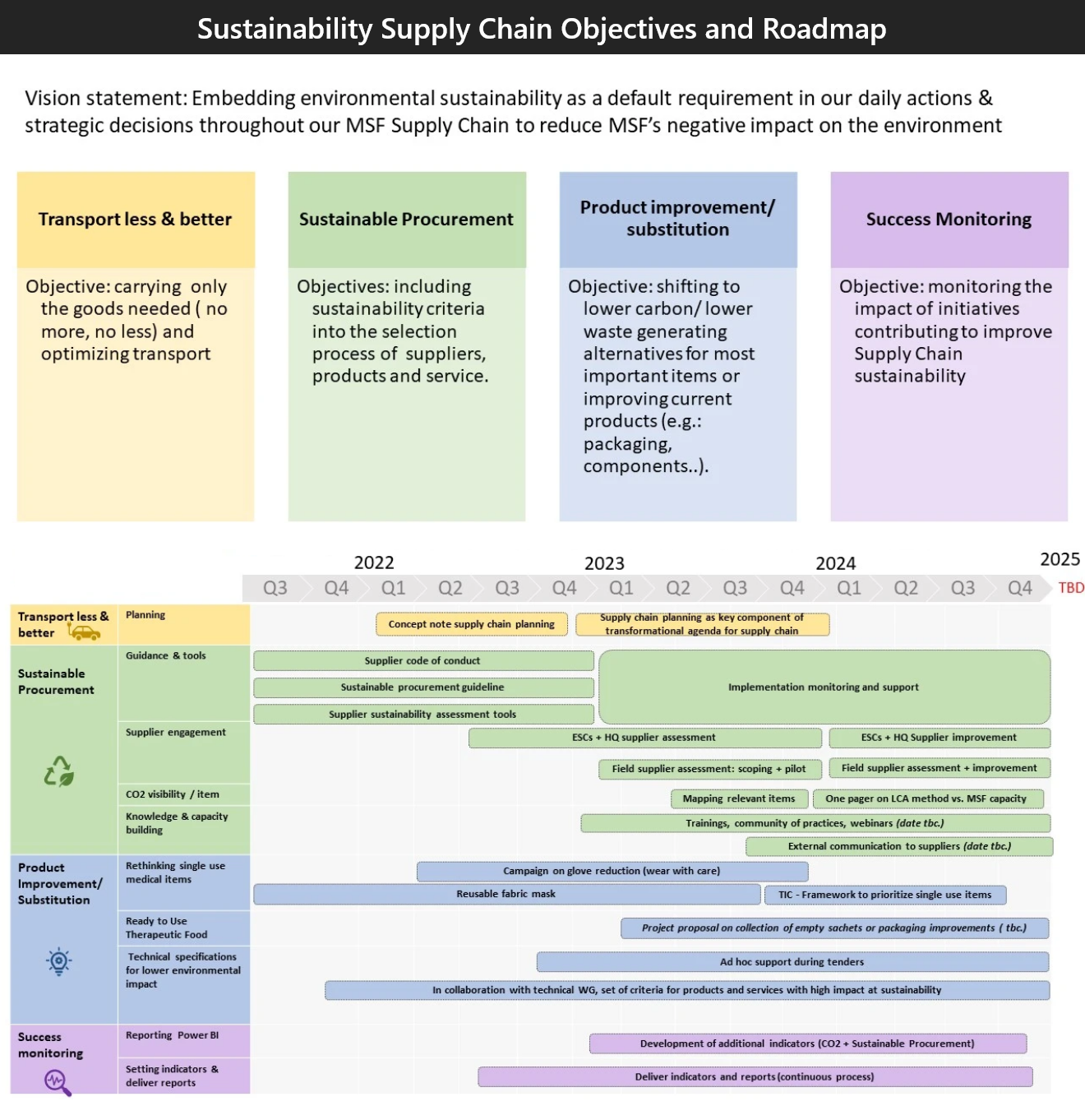
- Sustainable Supply Chain Objectives and Roadmap (Infographic)
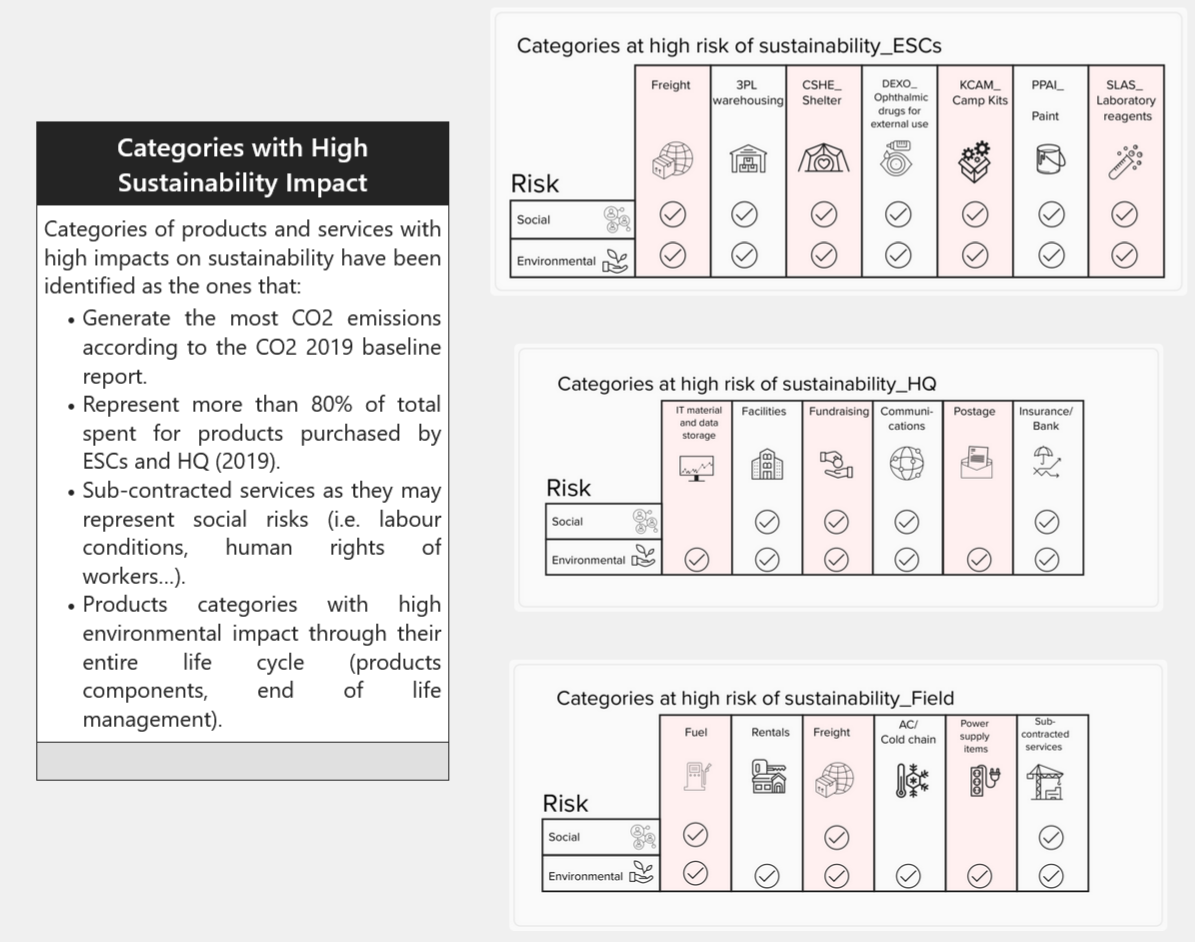
- Categories with High Sustainability Impact (Infographic)
- Implemented Approach (Infographic)
- Sustainable Procurement Animation: English | French | Spanish
- SharePoint folder with Sustainable procurement package
- MSPP Webinar #20: "Sustainable Procurement" (Microsoft Stream link)
- C02eq Freight Emissions Tool (SharePoint link)
- Climate Smart - SCPM International Report (SharePoint link)
- Education & Change Management
- Video: Sustainable Procurement at MSF
- Video: Travel Less, Travel Better
- MSF Carbon Travel App
- Air Travel Decision Tree
- CEH Training Workshop Package
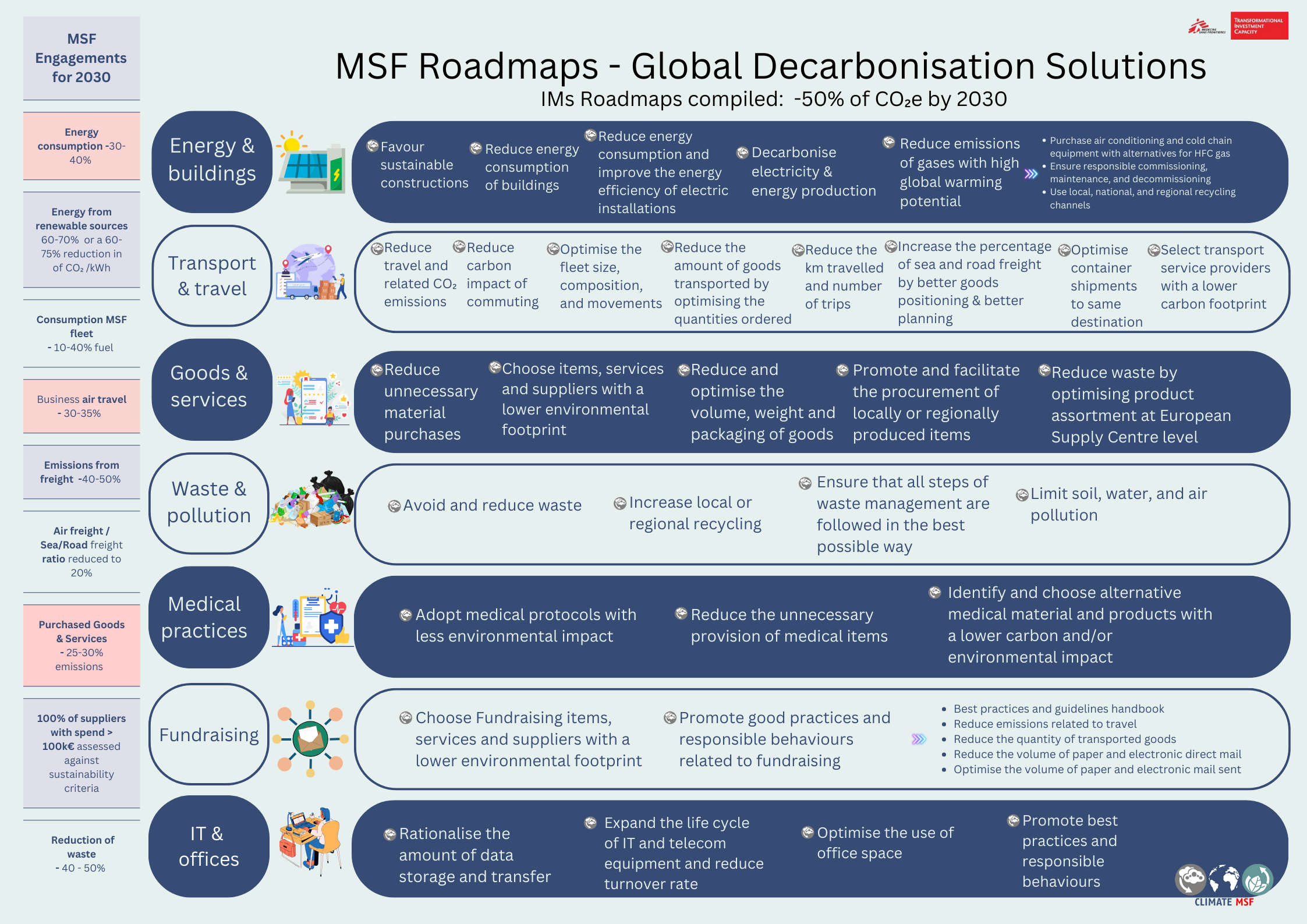
- MSF Roadmaps - Global Decarbonisation Solutions
- Powerpoint: Decarbonisation Fact Sheet - Energy & Building
- Powerpoint: Decarbonisation Fact Sheet - Goods & Services
- Powerpoint: Decarbonisation Fact Sheet - Goods & Transport
- Powerpoint: Decarbonisation Fact Sheet - IT & Digital
- Powerpoint: Decarbonisation Fact Sheet - Medical Practices
- Powerpoint: Decarbonisation Fact Sheet - Waste & Pollution
- Powerpoint: Behaviour Change Poster - AC Keep it cool
- Powerpoint: Behaviour Change Poster - AC
- Powerpoint: Behaviour Change Poster - Mind your Printing
- Powerpoint: Behaviour Change Poster - Computer to Sleep
- Powerpoint: Behaviour Change Poster - Save Energy
- Powerpoint: Behaviour Change Poster - Think Before Printing
- Powerpoint: Behaviour Change Poster - Turn off Lights
- Powerpoint: Behaviour Change Poster - Turn off the Tap
- Powerpoint: Behaviour Change Poster - Waste Separation
- MSF Climate & Environment Roadmaps:
- Partner Sections Roadmap Toolkit
- Roadmap Template
- Implementation Guidance
- List of Mitigation Actions identified by 6 Partner Sections
- Partner Sections Roadmap Infographic
- The MSF Climate & Environment Mitigation Roadmap 2024
- OCB Environmental Roadmap
- OCG Climate Environmental Roadmap
- OCP Environmental Roadmap
- OCA EI Roadmap
- OCBA CEH Roadmap
- Feuille de Route MSF Logistique - MSF Supply (FR)
- Climate and Environment Roadmap - MSF Supply (EN)
- MSF CAMINO Green Action Plan
- MSF Denmark Environmental Roadmap
- MSF Sweden Environmental Roadmap
- Carbon Framework

Adaptation Document List
- Overview:
- Seasonal Preparedness
- Preparedness Products
- Seasonal Outlook User Guide
- Central America
- Seasonal Calendars (Spanish)
- Seasonal Outlooks:
- August to October 2024 (Spanish)
- August to October 2024 (English)
- Central Africa
- Seasonal Calendar (French)
- Seasonal Overview 2025 (French)
- Seasonal Outlooks:
- March to May 2025 (French)
- Eastern Africa
- Seasonal Calendars (English)
- Seasonal Outlooks:
- March to May 2025 (English)
- October to December 2024 (English)
- Southern Africa
- Seasonal Calendars (English)
- Seasonal Outlooks:
- December 2024 to February 2025 (English)
- Western Africa
- Seasonal Calendars (English)
- Seasonal Outlooks:
- October to December 2024 (English)
- October to December 2024 (English)
- Acting Ahead
- Environmental Degradation
- Knowledge Generation
- link to: MSF LuxOR
Glossary of Terms
| TERM | DEFINITION | RELEVANCE TO MSF |
| Adaptation | The process of adjustment in systems, processes, practices and structures to actual or expected climate and its effects, in order to moderate harm or exploit beneficial opportunities. (IPCC 2022) | “By adapting strategies and including climate and the environment as variables of MSF’s action could contribute to a better adapted operational strategy and response” (OCB, 2022). “Adapting involves taking deliberate measures to adjust and prepare for anticipated or observed climate change and environmental degradation impacts. Adaptation efforts aim to address the underlying causes of vulnerability and build capacity to withstand and recover from climate-related impacts. For instance, adapting in emergency medical humanitarian assistance could involve establishing early warning systems, improving disaster response protocols, and training healthcare workers on climate-resilient healthcare practices. Adaptation entails more proactive and long-term measures to adjust and modify systems and practices in order to reduce vulnerability and increase resilience to climate change. This level of adaptation involves incorporating climate considerations into decision-making processes, implementing climate-responsive policies and strategies, and adopting technologies and practices that are better suited to changing conditions.” (HACE, 2023) |
| Anticipatory action | Anticipatory action is an approach in which humanitarian actors implement “actions to prevent or mitigate potential disaster impacts before a shock or before acute impacts are felt” (IFRC 2020 p. 351). Although operationalization depends on the implementing organization, anticipatory action programs share three common features: 1. Time factor: Actions happen in advance of a disaster (both actions, and who will implement them, are defined in advance) ; | Anticipatory action is an approach and a tool within adaptation that can help MSF develop formalised plans to release emergency funds to activate pre-agreed activities based on information (a weather forecast or other) that suggests negative health impacts may occur. Anticipatory action may not be appropriate in all locations and for all potential negative health impacts. The development of anticipatory action programmes relies on a rigorous analysis of the link between forecastable events and negative outcomes, as well as evidence that early actions would help to prevent or reduce negative impacts. |
| Anticipatory mindset | A mindset which is proactively identifying risks and thinking of ways to reduce and prevent risk. This may entail horizon scanning, the development of contingency plans, the establishment of roles and responsibilities during scenario planning (defined by author) | This may require fostering and encouraging behaviour change within MSF Missions to recognise that a pro-active approach to climate-related risks is beneficial to patients and that MSF operations can retain their emergency humanitarian mandate, whilst strengthening a pro-active assessment of climate-related risks. |
| Climate | “In a narrow sense, climate is usually defined as the average weather -or more rigorously, as the statistical description in terms of the mean and variability of relevant quantities- over a period of time ranging from months to thousands or millions of years. The classical period for averaging these variables is 30 years, as defined by the World Meteorological Organization (WMO). The relevant quantities are most often surface variables such as temperature, precipitation and wind. Climate in a wider sense is the state, including a statistical description, of the climate system.” (IPCC 2022) | Climate is the description of how weather patterns tend to behave in a specific area over a long period of time (usually 30 years or more). Understanding these terms are important for knowledge and awareness and improving the climate literacy of MSF staff. |
| Climate change | Anthropogenic climate change refers to long-term shifts in temperatures and weather patterns as a result of the emissions of greenhouse gases (notably carbon dioxide and methane) over the past 200 years (UN) | Understanding these terms are important for knowledge and awareness and improving the climate literacy of MSF staff. |
| Climate risk | “Climate related risks are created by a range of hazards. Some are slow in their onset (such as changes in temperature and precipitation leading to droughts, or agricultural losses), while others happen more suddenly (such as tropical storms and floods)” (UNFCCC) | |
| Climate-smart | Being climate-smart is making use of available climate and weather information – short-term weather, seasonal forecasts and long-term climate projections – during design and implementation. In doing so, programmes and operations ensure that, at a minimum, they do not place people at increased risk in the future, considering likely new climate extremes and growing vulnerabilities; and, where possible, empower communities to anticipate, absorb and adapt to climate shocks and long-term changes (IFRC and Climate Centre, 2023) | This may require training of staff so they can use climate information in their decision-making, and it also necessitates additional assessments of projects to ensure that the principle of “do no harm” holds true in the present and the future. |
| Climate variability | Climate variability refers to variations in the mean state and other statistics (such as standard deviations, the occurrence of extremes, etc.) of the climate at all spatial and temporal scales beyond that of individual weather events. (IPCC 2012) | Climate variability describes the way aspects of climate (temperature, humidity, precipitation) differ from average patterns over time and space. Typically, this is a natural process and includes phenomena such as the El Nino Southern Oscillation (ENSO). Climate variability is likely to be impacted by climate change, as more climatic extremes may be expected at certain times in certain locations. Understanding these terms are important for knowledge and awareness and improving the climate literacy of MSF staff. |
| Disaster | A serious disruption of the functioning of a community or a society involving widespread human, material, economic or environmental losses and impacts, which exceeds the ability of the affected community or society to cope using its own resources. (UNDRR Terminology) | |
| Disaster Risk Reduction | The substantial reduction of disaster risk and losses in lives, livelihoods and health and in the economic, physical, social, cultural and environmental assets of persons, businesses, communities and countries” (UNDRR Terminology). Denotes both a policy goal or objective, and the strategic and instrumental measures employed for anticipating future disaster risk; reducing existing exposure, hazard or vulnerability; and improving resilience. (IPCC 2022) | |
| Early Action | Anticipatory action is the overall approach that links early warnings to early actions. Early actions are the set of actions implemented based on the early warning that aim to prevent or reduce the impacts of a hazardous event before they fully unfold predicated on a forecast or credible risk analysis of when and where a hazardous event will occur. (REAP Glossary of Early Action Terms, 2022) | Early actions are not necessarily a new type of action, they include well-established interventions for which there is evidence that their use ahead of a forecasted hazard would help mitigation or prevent negative impacts. |
| Early Response | Early Response refers to actions that are undertaken right after a disaster occurs. Anticipatory (or early) action is different from ‘early response’ insofar as the former begins before the hazard and/or threat strikes whereas the latter begins after it has struck. In contrast to anticipatory action, early response is based on an evidenced hazard/threat and observable rather than forecasted needs and does not require pre-agreed implementation plans. (DG ECHO Guidance Note Disaster Preparedness) | There is an ongoing debate as to whether actions done once a case of a disease has emerged (or cases have increased) should be called “early actions”, or “on time actions/early response” as they are not technically being implemented before the emergence of the hazard. Nevertheless, they are being carried out before the majority of the impacts have been felt and may be implemented much sooner than typical responses are implemented. |
| Early Warning System | An integrated system of hazard monitoring, forecasting and prediction, disaster risk assessment, communication and preparedness activities systems and processes that enables individuals, communities, governments, businesses and others to take timely action to reduce disaster risks in advance of hazardous events (UNDRR, 2015)” | It is important to note the difference between an early warning (provision of information which can inform action) and an early warning system (EWS) which is a system that ensures the provision of information leads to action, wherein actors have clear roles and responsibilities defined. And EWS comprises four main components: (i) risk knowledge, (ii) monitoring and warning services, (iii) dissemination and communication and (iv) response capability. |
| Environmental Degradation | A general term for the deterioration of the natural environment and pollution as a result of human activities. It includes reduced air, water, and soil quality, the destruction of ecosystems and habitats, and the extinction of wildlife. (HACE 2023) | According to UNDRR terminology, “many of the processes and phenomena that fall into this category may be termed drivers of hazard and risk rather than hazards in themselves, such as soil degradation, deforestation, loss of biodiversity, salinization and sea-level rise.” (UNDRR) |
| Forecast | A statement of expected meteorological and environmental conditions for a specified time or period, and for a specified area. Forecasts are often divided into short-term weather forecasts (less than 10 days), sub-seasonal forecasts (20-40 days) and seasonal forecasts (3-6 months).” (FbF Manual Glossary of Terms)” | Forecast information could be mainstreamed into MSF processes to support decision-making. It is important to analyse the skill (i.e. accuracy) of weather forecasts in different locations, this may require the support of technical specialists. |
| Hazard | A process, phenomenon or human activity that may cause loss of life, injury or other health impacts, property damage, social and economic disruption or environmental degradation. (UNDRR) | MSF Missions are likely to face several hazards that can threaten operations. These may be hydro-meteorological or geophysical hazards, ‘natural hazards’, such as floods, drought, heat waves, earthquakes. Environmental hazards may include biological, chemical, and natural hazards, and can be created by environmental degradation. Conflict is not typically considered a hazard. |
| Lead time | The time from when the forecast is issued until the occurrence of the event that is forecasted to happen. E.g. a forecast issued on Monday for a storm to make landfall on Friday has a 4-day lead time. (FbF Manual Glossary of Terms) | The length of time between the issuance of a forecast and the occurrence of the forecasted hazard i.e. the window of opportunity. It is important to understand what activities are possible to achieve in the window of opportunity afforded by a forecast. |
| Mitigation | In climate change policy, “mitigation” is the term used for the reduction of greenhouse gas emissions that are the source of anthropogenic climate change (UNFCCC) | MSF has an agreement to reduce its carbon footprint by 50% by 2030 from a 2019 baseline. |
| Preparedness | The knowledge and capacities developed by governments, response and recovery organizations, communities and individuals to effectively anticipate, respond to and recover from the impacts of likely, imminent or current disasters. (UNDRR) | Preparedness is both a long-term and short-term process, in which anticipatory action is a specific time-bound element. For example, emergency preparedness involves activities shortly before a disaster or crisis is likely to unfold. Anticipatory action is thus an important tool in emergency preparedness. According to the Sendai Framework on DRR: Preparedness is based on a sound analysis of disaster risks and good linkages with early warning systems, and includes such activities as contingency planning, the stockpiling of equipment and supplies, the development of arrangements for coordination, evacuation and public information, and associated training and field exercises. These must be supported by formal institutional, legal and budgetary capacities. |
| Prevention | Disaster prevention expresses the concept and intention to completely avoid potential adverse impacts of hazardous events. While certain disaster risks cannot be eliminated, prevention aims at reducing vulnerability and exposure in such contexts where, as a result, the risk of disaster is removed (UNDRR) Disease prevention, understood as specific, population-based and individual-based interventions for primary and secondary (early detection) prevention, aiming to minimize the burden of diseases and associated risk factors.” (WHO Disease Prevention) | Prevention is a term that is used across a number of disciples (climate science, disaster risk management and health) and it is useful to be aware how different actors may be using it. |
| Rapid- or sudden-onset disaster | A rapid- or sudden-onset disaster is one triggered by a hazardous event that emerges quickly or unexpectedly e.g. an earthquake or flood. | MSF has several e-prep documents covering these kinds of disasters that may need to be adapted to reflect a changing disaster risk landscape. |
| Resilience | The ability of a system, community or society exposed to hazards to resist, absorb, accommodate, adapt to, transform and recover from the effects of a hazard in a timely and efficient manner, including through the preservation and restoration of its essential basic structures and functions through risk management. (Sendai)” (UNDRR) | In emergency medical humanitarian assistance, building resilience could involve developing long-term healthcare infrastructure with climate-resilient design (e.g. roofs that will withstand stronger windspeeds expected as tropical cyclone intensity increases), implementing community-based health programs that integrate climate adaptation and disaster risk reduction, and fostering strong partnerships and coordination among various stakeholders (HACE, 2023) |
| Response | “Actions taken directly before, during or immediately after a disaster in order to save lives, reduce health impacts, ensure public safety and meet the basic subsistence needs of the people affected. Annotation: Disaster response is predominantly focused on immediate and short term needs and is sometimes called disaster relief. Effective, efficient and timely response relies on disaster risk-informed preparedness measures, including the development of the response capacities of individuals, communities, organizations, countries and the international community.(Sendai)” (UNDRR) | |
| Risk | The potential for adverse consequences where something of value is at stake and where the occurrence and degree of an outcome is uncertain. In the context of the assessment of climate impacts, the term risk is often used to refer to the potential for adverse consequences of a climate- related hazard, or of adaptation or mitigation responses to such a hazard, on lives, livelihoods, health and well-being, ecosystems and species, economic, social and cultural assets, services (including ecosystem services), and infrastructure. Risk results from the interaction of vulnerability (of the affected system), its exposure over time (to the hazard), as well as the (climate-related) hazard and the likelihood of its occurrence (IPCC, 2018). | |
| Slow onset disaster | Slow-onset disasters can be predicted much further in advance and unfold over months or even years, e.g. a drought. | MSF has several e-prep documents covering these kinds of disasters that may need to be adapted to reflect a changing disaster risk landscape. |
| Trigger | A trigger is a predetermined criterion that, when met, is used to initiate actions. (REAP Glossary of Early Action Terms, 2022). | Triggers are a specific component of an anticipatory action programme. How they are defined depends on the negative health impact that is trying to be prevented or minimised. |
| Weather | State of the atmosphere at a particular time, as defined by the various meteorological elements. (WMO) Weather describes short term natural events - such as fog, rain, snow, blizzards, wind and thunderstorms, tropical cyclones, etc. - in a specific place and time. (WMO). | Weather is a what we see when we look outside. It is the short term change from minute-to-minute, hour-to-hour, and day-to-day in temperature, rain, wind, humidity, thunderstorms, heatwaves, flooding, etc. It differs from climate which describes long-term averages. Understanding these terms are important for knowledge and awareness and improving the climate literacy of MSF staff. |