Overview
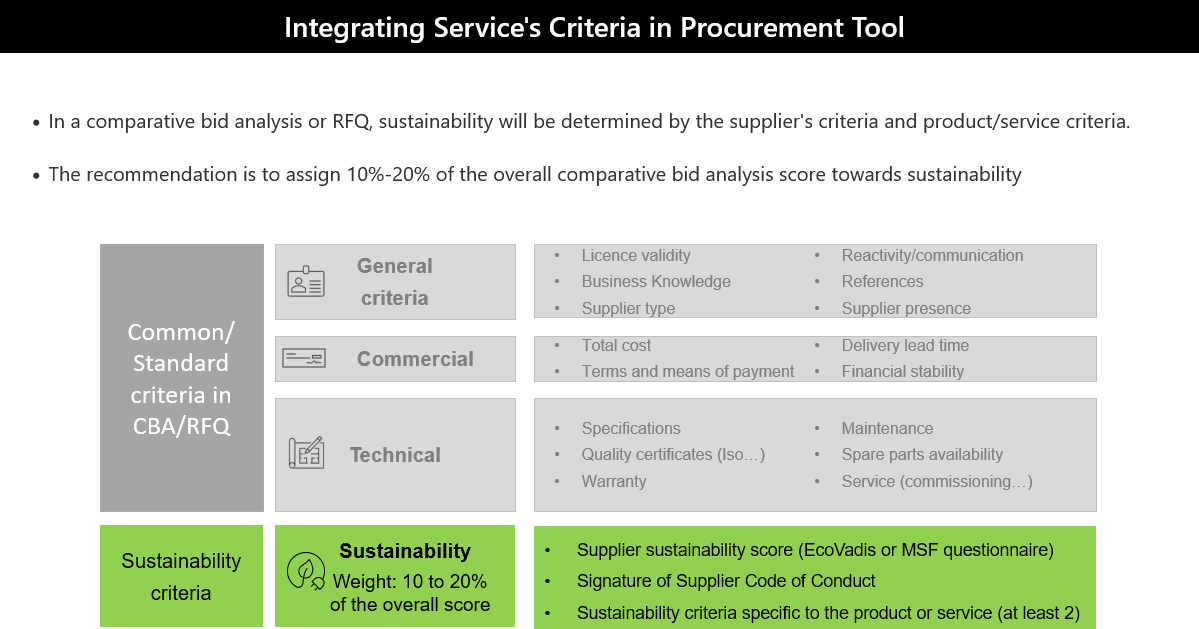
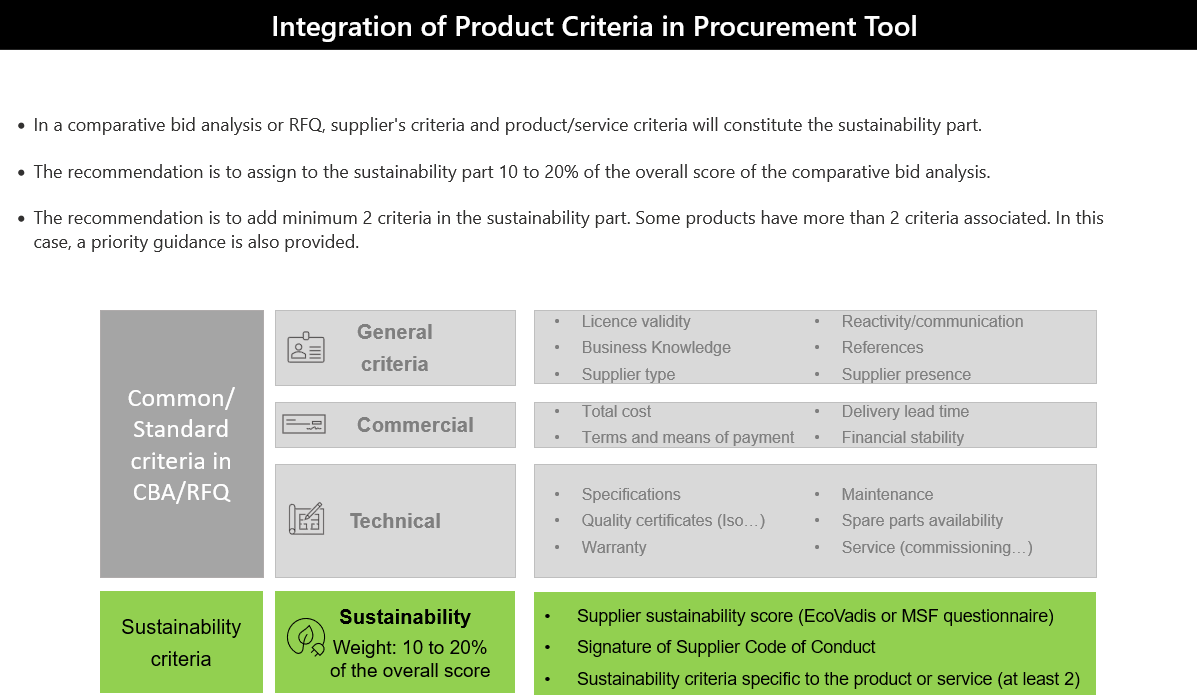
Sustainable Procurement in MSF is the continuity of our humanitarian mission. It ensures that our products and services are procured from sustainable sources with the least environmental and most positive social impact with the best value for money (following the Do Not Harm Principle). Per the Global Procurement Policy, ethics and sustainability are part of MSF’s procurement principles, reflecting the organization’s humanitarian mission.
Integrating sustainability into procurement involves balancing the different and sometimes competing priorities of the economic, environmental and social dimensions of procurement.
By defining sustainable procurement criteria, MSF encourages the selection and development of more innovative and sustainable products, services and processes. These criteria aim at addressing sustainability issues identified at different levels:
- Supplier level: high level issues identified for suppliers in managing their operations. The purpose here is to gather information about their environmental and labor practices, and to help suppliers improving these practices.
- Product/ service level: issues identified for a specific product or service throughout its entire life cycle. (e.g.: harmful substances, ease of recycling, minimizing resource use, energy consumption during operation).
For more information, please contact: [email protected]

Roadmap & Infographics
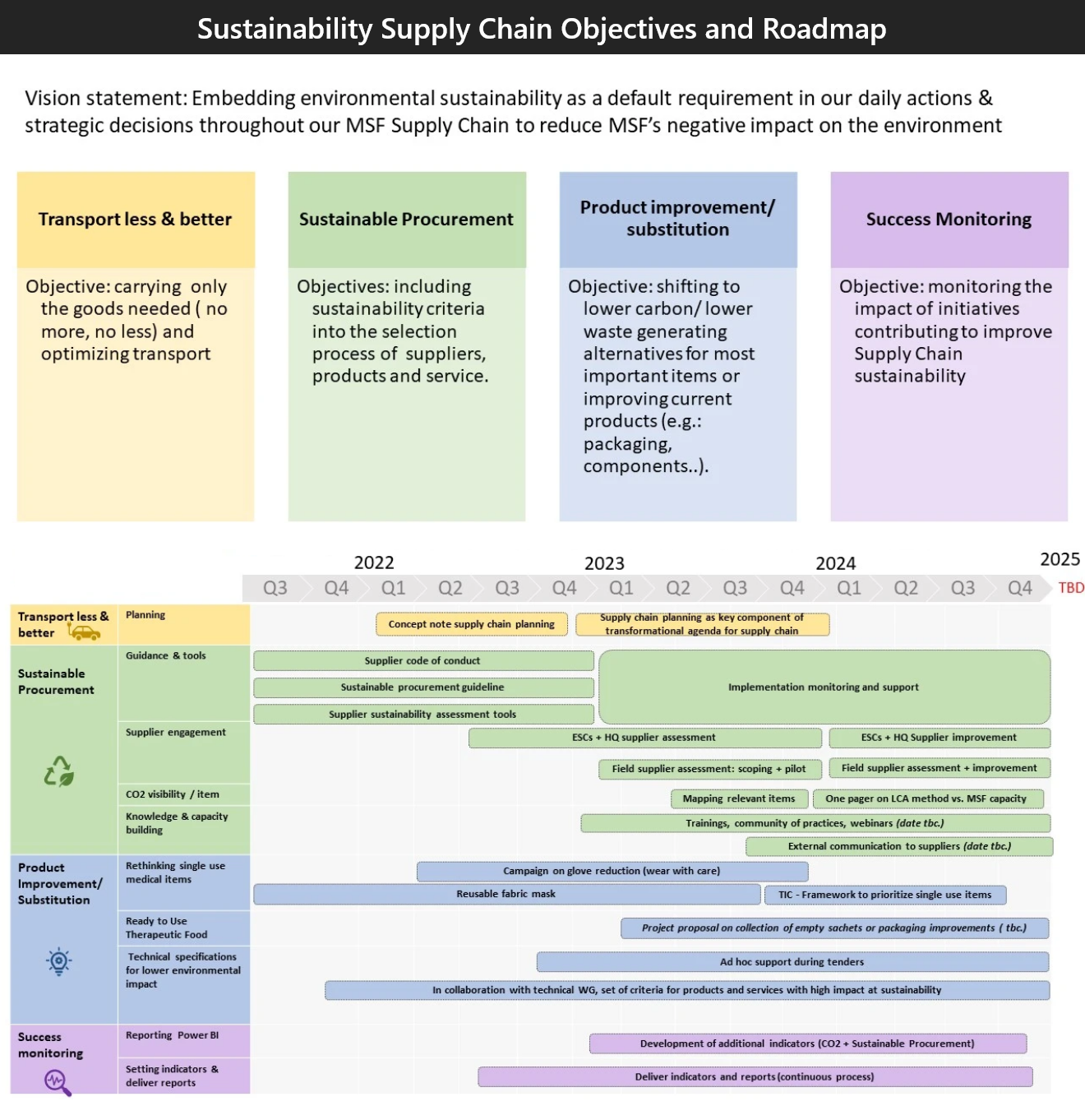
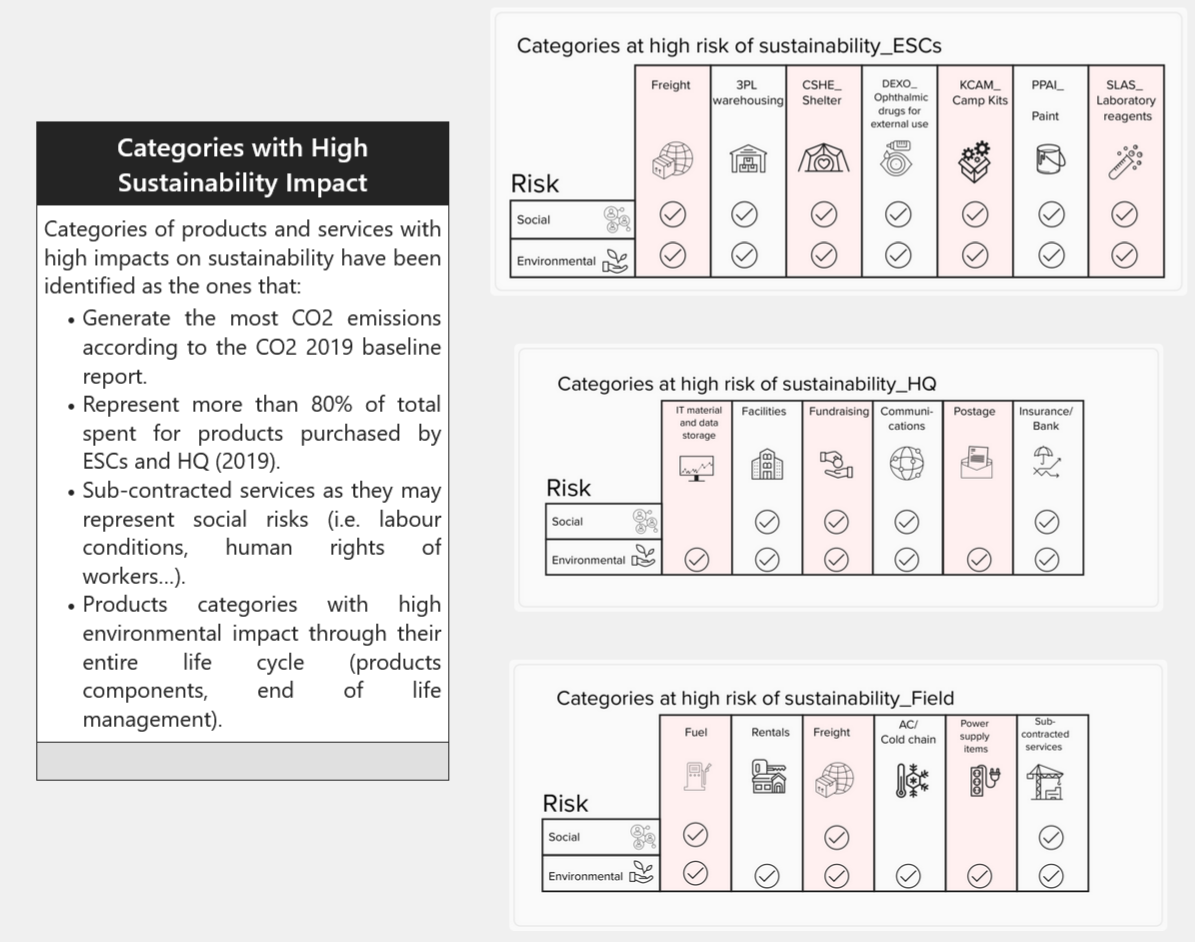
Expand the sections below to see the Sustainable Supply Chain Roadmap developed by Climate Smart TIC and various relevant infographics.

Sustainable Procurement Animated Video
This video highlights our tools, strategies, and collaborative efforts to ensure our suppliers and products align with our environmental and social standards. Discover how MSF is integrating sustainable procurement into our operations to halve our carbon footprint by 2030.
Regardez la vidéo animée en français (youtube).
Mira el video animado en español (youtube).

Sustainable Procurement Animation
Enhanced Specification for Services

Hotel
| Hotel | Simplified criteria that could be copy-pasted in the CBA | Required Documentation | Scoring Guidance |
| The bidder shall propose energy-efficient technologies in place, such as LED lighting, energy-efficient HVAC systems, or renewable energy sources like solar panels. | Bidder should provide SOP or similar documentation in support. | Points are awarded if criteria is met. | |
| The bidder has a system for waste segregation and recycling. | Bidder should provide SOP or similar documentation in support. | Points are awarded if criteria is met. | |
| The bidder has a standard operating procedures in place to monitor and reduce water and/or energy consumption. | Bidder should provide SOP or similar documentation in support. | Points are awarded if criteria is met. |
Bank
| Bank | Simplified criteria that could be copy-pasted in the CBA | Required Documentation | Scoring Guidance |
| The bidder shall have elements of a robust bank Net-Zero Transition Plan (NZTP) | Copy of Sustainability/ CSR/ ESG report or report containing this information. A credible and comprehensive NZTP must be made public and contain a range of general and sectoral measures, including commitments, restrictions, and exclusions. | Points are awarded if criteria is met. |
Insurance Pension Fund
| Insurance, Pension Fund | Simplified criteria that could be copy-pasted in the CBA | Required Documentation | Scoring Guidance |
The bidder shall consider the climate risks in its ESG policy/ investment process. Le soumissionaire doit prendre en compte les risques climatiques dans le cadre de sa politique ESG / processus d’investissement. | Copy of / link to a Sustainability/ CSR/ ESG report or the integrated report containing this information | ||
| The bidder shall set targets to decarbonise its portfolio and increased the ESG quality. Le soumissionaire doit définir des mesures de décarbonisation de son portefeuille et améliorer la qualité ESG. | Copy of / link to a Sustainability/ CSR/ ESG report or the integrated report containing this information. | Decarbonization targets adopted by insurers shall include interim and long-term targets, be intensity-based/ absoute-reduction on all material emission scopes, not include offsets. | |
The bidder shall be member of associations/ initiatives for sustainable development? (e.g. : ETHOS Engagement Pool for pension funds, Principles for Responsible Investments)?" Le soumissionaire doit être membre d'associations/ initiatives de développement durable (ex. : ETHOS Engagement Pool for pension funds, Principles for Responsible Investments)? | Copy of / link to a Sustainability/ CSR/ ESG report or the integrated report containing this information | Points are awarded if criteria is met. | |
The bidder shall measure the CO2 footprint or the financial climate risk with scenario analysis. Le soumissionaire doit mesurer l’empreinte CO2 ou le risque climatique financier avec analyse de scénarios. | Copy of / link to a Sustainability/ CSR/ ESG report or the integrated report containing this information | Points are awarded if criteria is met. |
Photovoltaic Plant
| Sub contracting Photovoltaic plant | Simplified criteria that could be copy-pasted in the CBA | Required Documentation | Scoring Guidance |
| The bidder can provide adequate recycling possibility related to batteries | Bidder should provide information on the collection, storage and transport of batteries. The bidder should provide full documentation of the waste company identified for the recycling of batteries. " | Points are awarded if criteria is met. (Subject to compliance and quality validation of the waste company by MSF experts). | |
| The bidder is able to provide information on the origin of the raw material that compose the equipment | Technical documentation including information of provenance of raw materials | Points are awarded if criteria is met. | |
| Safety and hygiene conditions of work environment | The bidder should provide a clear explanation on how the bidder ensure a safe and hygienic working environment to their workers (use of PPE and other preventive measures of the construction related risks…). | MSF may ask penalty in the contract in case this clause would not be respected. |
Travel Agency
| Travel Agency | Simplified criteria that could be copy-pasted in the CBA | Required Documentation | Scoring Guidance |
| The bidder can provide CO2 estimations for the proposed routing. | Bidder should provide the methodology used in the calculation. | Points are awarded if criteria is met. | |
| The bidder can provide Co2 emissions for the proposed routing using the methodology proposed by MSF. | Points are awarded if criteria is met. |
Data Center, Servers, Cloud
| Data Center, Server Room, Cloud Services | Simplified criteria that could be copy-pasted in the CBA | Required Documentation | Scoring Guidance |
| The bidder shall provide the energy reuse factor (ERF) for the facilities that will be used to execute the contract. The ERF must be calculated for each facility according to EN 50600-4-6:2020 or an equivalent standard. | A third party verification of the ERF can be accepted as evidence. Third party verified energy management systems ( ISO 50001) or environmental management systems ( EMAS or ISO 14001) reporting the calculated ERF can also be accepted as evidence. | Points will be awarded in proportion to the bidder that offers the highest energy reuse factor. | |
| The bidder shall have relevant competencies and experience in minimising cooling energy use, identifying opportunities to reduce energy use and to use any remaining waste heat (e.g. for heating adjacent buildings or district heating networks). | Bidders must provide evidence from previous data centre projects with similar characteristics demonstrating how they reduced the use of cooling energy. Evidence: information and references for specific data centres sites serviced in the last 3 years. | Points are awarded if criteria is met. | |
| The bidder shall provide the renewable energy factor (REF) for energy supplied and consumed in the data centre. The REF for energy supplied and consumed in the data centre must be calculated according to EN 50600-4-38. The electricity contributing to the REF must come from renewable sources as defined by Directive 2009/28/EC9. | The REF and the electricity supply and usage data on which the calculations are based must be declared. A third party verification (ISO 50001) or environmental management system EMAS or ISO 14001) of the REF can be accepted . | Points are to be awarded in proportion to the bidder that offers the highest load matched REF for their electricity use. |
I.T. EoL Mgmt
| Equipment End of Life Management | Simplified criteria that could be copy-pasted in the CBA | Required Documentation | Scoring Guidance |
| The bidder works with manufacturer that are compliant for WEEE management | The bidder should provide proof of registration of the manufacturer with the authorities in charge of WEEE management. https://www.ewrn.org/national-registers/national-registers | Points are awarded if the bidder can provide proof of registration of the Manufacturer with the authorities in charge of WEEE management in the EU country where the products are sold (i.e. syderep in France, Registro AEEE in Italy. If the Manufacturer is not registered, they’re not compliant. | |
| The bidder has established end of life disposal practice If the bidder is a distributor, the bidder organize a take back system | The bidder should provide information on the method of organizing the collection of end-of-life products (individual or collective). If collective, proof of the membership to an EPR system. | Points are awarded if criteria is met. | |
| Waste management recycling capacity | The bidder should inform on the recovery rate of waste group for the last year or information on mass balance (i.e. balance of incoming materials/outgoing fractions and info on X kg of metals/paper/plastic recycled, Y kg reused, Z kg sent to landfill.) | Bidders with a recovery rate of 80% of equipment receive good score. For recovery rate > 80%: higher score. For recovery rate > 80 %: lower score. |
Food Catering
| Food Catering | Simplified criteria that could be copy-pasted in the CBA | Required Documentation | Scoring Guidance |
| The bidder support local, regional, and small-scale farmers, and rural communities when purchasing products for the hospital kitchen. | The bidder should provide information on the origin/provenance of the products purchased. | Scoring based on % of ingredients purchased from small-scale farmers. | |
| The bidder shall propose alternatives to mitigate the impact of single use item for cutlery. | Bidder should provide a list of single use items, the possible alternatives and the material composition. | Reusable/washable cutlery are rated higher. Single use cutlery made of bio-based materials (biodegradable, compostable) are rated high. Single use cutlery made of recycled plastic are rated medium. Single use cutlery made of other material are rated low (or no point). | |
| The bidder engages in food waste monitoring and reduction. | The bidder must provide evidence in the form of standard operating procedures for purchasing, storage, cooking, menu planning and serving. | Best practices (to be selected) - establishing an accurate stock inventory and ordering system to avoid over-ordering and spoilage of stock - conducting measurement of food waste amounts on continuous or period basis - checking periodically the date of expiry - directly using food near its date of expiry (flexible meal planning) - ensuring that the food is stored under the proper conditions - efficient ordering and storage: order perishable products frequently in the quantities required - storing perishable products in appropriate conditions (e.g. correctly adjusted refrigeration units) - preventing preparation losses and training employees - selecting packaging (taking into account aspects such as the format, protection, preservation, serving portions, etc.) that minimises the generation of food waste. | |
| As regards products and ingredients produced with palm oil, bidder can provide only RSPO certified products. | Bidder should provide proof of certification: Sustainable palm oil certified RSPO; | Points are awareded in criteria is met or according to proposed % of products made with RSPO certified palm oil. | |
| As regards coffee, tea and cocoa, bidder can provide only products with UTZ/Rainforest alliance certification label. | Bidder should provide proof of certification: UTZ, rainforest Alliance certification label | Points are awareded in criteria is met or according to proposed % of products made with certified ingredients. | |
| As regards products and ingredients (produced) with soy, bidder can provide only RTRS- certified soy products. | Bidder should provide proof of certification: RTRS-certified soy products | Points are awareded in criteria is met or according to proposed % of products made with certified ingredients. |
Enhanced Specification for Logistics Products
Air Conditioner
| Air Conditioner | Simplified criteria that could be copy-pasted in the CBA | Required Documentation | Scoring Guidance | Priority Level |
| Energy efficiency of the product. | Technical specifications includes Energy Efficiency Ratio (EER) W/W | Please note: if EER > 5, check the unit of measurement. It should be W/W and not BTU/W EER > 3,2 Best option: Highest score 3,20 ≥ EER >3,00 Good option: Good score 3,00 ≥ EER > 2,80 Medium option: Medium score 2,80 ≥ EER > 2,60 Bad option: Low score 2,60 ≥ EER > 2,40 Worst option: Lowest score" | High | |
| Product uses refrigerant gas with lower Global Warming Potential (GWP) and Lower Ozone Layer Depleting Potential (ODP). | Technical specifications including the type of gas used in the equipment. | R290: Best perfomant gas: higher score R-32 Valuable option: good score R134 Valubale option: medium score R410A should be avoided if better options are available: lowest score R-22 not allowed | High |
Fridge/Freezer
| Domestic Fridge, Freezers, and Combined Fridge-Freezers | Simplified criteria that could be copy-pasted in the CBA | Required Documentation | Scoring Guidance | Priority Level |
| The product meets the most recent energy certification. | Technical specifications | Class A: highest score Class B and C: medium score. Class D: lowest score Class E, F and G: not allowed. | Medium | |
| Product uses refrigerant gas with lower Global Warming Potential and Lower Ozone Layer depletation. | Technical specifications including the type of gas used in the equipment. | R290: Best performant refrigerant gas: Highest score. R600a: performant gas, high score . R134a: high GWP so lowest score. R-438 and R22: not allowed. | High | |
| Model of combined fridge-freezer. | Technical specifications | Top-mount freezer refrigerator are scored higher than bottom-mount freezer refrigerator. French type freezer refrigerator (2 doors fridge on the top and bottom mount freezer) and side by side freezer refrigerator (freezer and refrigerator side by side) are scored the lowest. | Low | |
| Typology of fridge (inverter vs non inverter type) | Technical specifications | Points are awarded if the equipment is inverter type. | High |
Solar Lighting
| Solar Lighting | Simplified criteria that could be copy-pasted in the CBA | Required Documentation | Scoring Guidance |
| Durability of the product. | Technical specifications | Features to consider: • Casing is waterproof_ IP65 rating. • Automatic turn off. Points are awarded according to the number of features satisfied: - Both criteria are met: highest score - One criteria is met: medium score - No criteria are met: no points. | |
| Durability of the product_battery. | Technical specifications | Features to consider: • The product is equipped with rechargeable lithium-ion batteries instead of lead-acid batteries for increased durability, more than 500 charge cycle. |
Monitor & Projector
| Monitor | Simplified criteria that could be copy-pasted in the CBA | Required Documentation | Scoring Guidance | Priority Level |
| The product meets the most recent energy certification. (i.e.ENERGY STAR) | Technical product specifications or other documentation. | Point are awarded if monitors achieve at least energy efficiency class D for displays. | High | |
| Product is TCO Certified. | Technical product specifications or other documentation. | Points are awarded if criteria is met. | High | |
| Monitor switches off when computer is shut down | Technical product specifications or other documentation. | Points are awarded if criteria is met. | Medium |
| Projector | Simplified criteria that could be copy-pasted in the CBA | Required Documentation | Scoring Guidance |
| Product is TCO certified | Technical product specifications | Points are awarded if criteria is met. | |
| Product is designed to reduce energy use. | Technical product specifications | Products is designed with auto sleep mode: Tit will automatically switch to sleep mode after a maximum of 15 minutes of inactivity. Points are awarded if the criteria is met. |
Tablet
| Tablet | Simplified criteria that could be copy-pasted in the CBA | Required Documentation | Scoring Guidance | Priority Level |
| Product is equipped with a fixed, standardised USB Type-C™ power-supply connector (port) | Documentation showing that the requirement is met, such as a product information sheet, a manual etc | Points are awarded if criteria is met. Exception: This does not apply to equipment that has Qi (wireless) charging. | Low | |
| Product is repairable | Technical product specifications or other documentation. | Required conditions for mobile phone to be scored high in terms of reparability: Team can also check on this site that scores smartphone according to their repairability. | Medium | |
| Product is TCO Certified. | Technical product specifications or other documentation. | Points are awarded if criteria is met | High | |
| Durability of product_Battery | Documentation showing that the requirement is met, such as a product information sheet, a manual or similar. | Points are awarded if the product is equipped with pre-installed software that allows a maximum battery charge limit (such as ≤80% state of charge) to be set when the equipment runs regularly. | High |
Smartphone
| Smartphone | Simplified criteria that could be copy-pasted in the CBA | Required Documentation | Scoring Guidance | Priority Level |
| Product is repairable | Technical sheet | Required conditions for mobile phone to be scored high in terms of reparability: Team can also check on this site that scores smartphone according to their repairability. | High | |
| Product is refurbished. | Points are awarded if criteria is met. | Low | ||
| Product's ECO RATING score | Model of smartphone is listed on: https://www.ecoratingdevices.com/ratings/ | Eco Rating evaluates the environmental impact of the entire process of production, transportation, use and disposal of mobile phones. The Eco Rating evaluation assesses devices’ different environmental indicators (e.g. carbon footprint or resource depletion) and material efficiency criteria, which results in an overall score on a scale from 1 to 100. The closer the score is to 100, the better the sustainability performance of the device. The teams can check on the website for the Eco rating of proposed model and assign score depending on the Eco rating specific to each model. | Medium | |
| Product is equipped with a fixed, standardised USB Type-C™ power-supply connector (port) | Documentation showing that the requirement is met, such as a product information sheet, a manual etc. | Points are awarded if criteria is met. Exception: This does not apply to equipment that has Qi (wireless) charging. | Low | |
| Product is TCO Certified. | Technical product specifications or other documentation. | Points are awarded if criteria is met | High | |
| Durability of product_Battery | Documentation showing that the requirement is met, such as a product information sheet, a manual or similar. | Points are awarded if the product is equipped with pre-installed software that allows a maximum battery charge limit (such as ≤80% state of charge) to be set when the equipment runs regularly. | Medium | |
| Product uses eSim | Points are awarded if criteria is met | Low |
Microwave
| Microwave | Simplified criteria that could be copy-pasted in the CBA | Required Documentation | Scoring Guidance |
| The product meets the most recent energy certification. | Technical product specifications | ||
| The products is inverter type | Technical product specifications | Points are awarded if criteria is met |
Washing Machine
| Washing Machine | Simplified criteria that could be copy-pasted in the CBA | Required Documentation | Scoring Guidance |
| Energy Efficiency Ratio (EER) | Technical specifications | Top-Loading Washing Machines: o EER < 6.0: 5 stars o 6.0 ≤ EER < 10.0: 4 stars o 10.0 ≤ EER < 17.0: 3 stars o 17.0 ≤ EER < 22.5: 2 stars o EER ≥ 22.5: 1 star Front-Loading Washing Machines: o EER < 70.0: 5 stars o 70.0 ≤ EER < 90.0: 4 stars o 90.0 ≤ EER < 140.0: 3 stars o 140.0 ≤ EER < 220.0: 2 stars o EER ≥ 220.0: 1 star. | |
| Water efficiency | Technical specifications | The water efficiency grades are determined based on water consumption measured in liters per kilogram per cycle: Horizontal Drum Type: Grade 1: w ≤ 9.0 Grade 2: 9.0 < w ≤ 11.0 Grade 3: 11.0 < w ≤ 13.0 Grade 4: 13.0 < w |
Printer
| Printer | Simplified criteria that could be copy-pasted in the CBA | Required Documentation | Scoring Guidance | Priority Level |
| Cartridges must be individually and independently exchangeable. | Technical documentation. | Points awarded if criteria is met. | Medium | |
| Imaging equipment must be capable of processing recycled paper. | Bidder must provide a documentation proving that recycled paper meeting the requirements in EN 12281 can be used in the product. | Points awarded if criteria is met. Scanners are excluded from the scope of this criterion. | Low | |
| Product can use remanufactured toner cartridges | Bidder must provide a declaration confirming or documentation proving that remanufactured cartridges and containers can be used in the product. | Points awarded if criteria is met. | Low | |
| Product is designed to optimise the printing process. | Technical documentation. | Duplex printing or copying Printing of several images on the same paper, (N-up printing) A function to reduce unnecessary printouts, for example through a personal code or card. If all the functions are provided: 5 points, 2 functions 3 points, 1 function 1 point. | Medium | |
| The product meets the most recent energy certification. | Bidder should be able to present a verification: Test report according to Energy Star for imaging equipment, version 3, section 3.3.2. The Eco Declaration, ECMA 370 (Energy Star) or equivalent documentation. | Points are awarded if criteria is met. | High | |
| Product is TCO certified | Technical documentation | Points are awarded if criteria is met. | High |
Additional Resources
- International Supply Chain and Procurement Portal - Internal SharePoint with various resources including: Supplier sustainability assessment, Code of Conduct, Buyer Resource Center, and more.
- MSPP Webinar #20: "Sustainable Procurement" (Dec 12, 2022) - Internal Microsoft Stream video replay.
- DisasterReady.com courses - **External resource. Requires registration for an account.
- C02eq Freight Emissions Tool - Internal SharePoint link. The CO2eq freight emissions calculator allows to compare freight emissions linked with different procurement and supply scenarios. The tool provides guidance on how to use it. The emissions factors used in the tool are coherent with the CO2eq calculation methodology.
- Climate Smart - SCPM International Report - Internal Microsoft PowerBI resource. This report gives the user an overview of the total annual CO₂eq emissions generated throughout the international and the local* supply chain.
Rethinking Single Use Medical Items
msf.orgThe Rethinking Single Use Medical Items Sub-TIC Project aims to reduce the environmental impact of single-use medical items by identifying the most harmful products (like gloves, syringes, and masks) and promoting sustainable alternatives, smarter usage, and eco-friendly procurement—without compromising safety or care quality. It involves assessing the lifecycle of these items, prioritizing high-impact ones, and collaborating with medical teams to implement feasible solutions. The project unfolds in three phases: analysis, mitigation strategy development, and implementation.