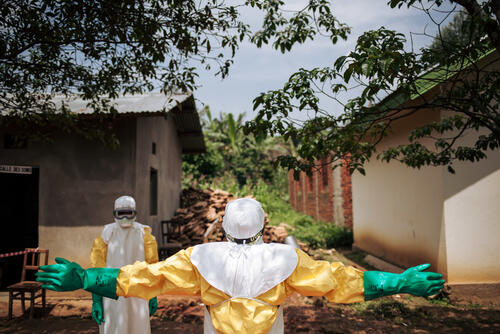
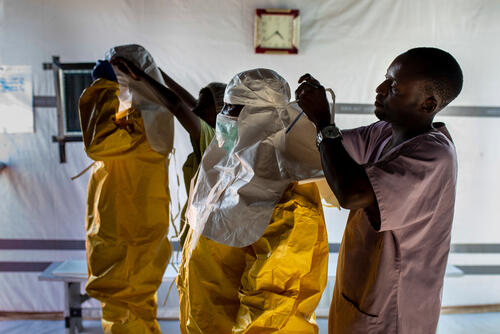
Ebola disease in DRC: find out how we're responding
Learn more
7996 Results
 
msf-placeholder

Speaking Out videos: Somalia 1991-1993: Civil War, Famine Alert and a UN “Military-Humanitarian” Intervention

Speaking Out videos: Somalia 1991-1993: Civil War, Famine Alert and a UN “Military-Humanitarian” Intervention - 9 May 2019
 
msf-placeholder

Speaking Out videos: Famine and forced relocations in Ethiopia 1984-1986

Speaking Out videos: Famine and forced relocations in Ethiopia 1984-1986 - 9 May 2019
 
msf-placeholder

Speaking Out videos: War crimes and politics of terror in Chechnya 1994-2004

Speaking Out videos: War crimes and politics of terror in Chechnya 1994-2004 - 9 May 2019
 
msf-placeholder

Speaking Out videos: Genocide of Rwandan Tutsis 1994

Speaking Out videos: Genocide of Rwandan Tutsis 1994 - 9 May 2019
 
Parents with children waiting in the queue to be vaccinated against measles in Djouna, Am Timan Region. The crowd waited since early in the morning following the announcement transmitted by community leaders the days before about the vaccination campaign. MSF is supporting the population in Am Timan district, Salamat region, with a mass measles vaccination after a new peak of the measles outbreak declared in May 2018 arises in January 2019.
Chad

Measles epidemic declared in May 2018, still not under control one year on

MSF emergency team vaccinates 107,000 children against measles and steps up its medical response as year-long outbreak increases in intensity. Project Update - 8 May 2019
 
After more than two years without humanitarian access to Mingala, MSF has finished a two-day vaccination programme in this place, located about 100 kilometres from Alindao. An area which is difficult to access due to insecurity caused by the conflict in the Central African Republic (CAR), in addition to bad road conditions.
Central African Republic

"We have not seen any doctors in Mingala for more than two years"

MSF has conducted the first phase of a vaccination campaign in Mingala, southeastern Central African Republic, where the conflict has prevented any assistance to be delivered in over two years. Project Update - 7 May 2019
 
MSF community Health worker Rozi (not her real name) interacting with one of the sex workers behind a bar hotspot in the centre of Mwanza town. Sex workers live in the rented rooms in exchange for providing services for customers.

In Mwanza and Dedza districts, and Zalewa in Neno district, MSF uses the ‘one-stop’ clinic approach combined with outreach services targeted towards sex workers who offer their services openly and often work and live together in rented accommodation near transport hubs or at hotspots and bars. 
Community health workers – themselves sex workers who have been recruited from their local communities and trained - conduct weekly health promotion sessions at different sites where they provide condoms and lubricant, and facilitate door-to-door HIV testing services (HTS) with a trained counsellor. 
The MSF community health workers identify new sex workers or those in need of medical care and navigate them towards MSF’s ‘one-stop’ clinics in nearby Ministry of Health centres in the three sites. Here, MSF clinicians offer a comprehensive package of HIV care plus sexual and reproductive healthcare, all offered in a single visit. MSF has reached approximately 3851 sex workers across these three sites.

TESTIMONY: Rozi (not her real name) MSF community health worker, 36 years.

“I was once married. When I divorced in 2002 with two children to take care of, life was hard. I had no way to earn a living. I didn’t have any qualification or financial capital to go into business and  I couldn’t support my family with decent shelter, food and clothes.
In the end, I decided to go into sex work as a way of supporting my kids and myself. I had relatives whom I could go to seek assistance, but they were also struggling financially and they said they couldn’t help me. That’s how I ended up taking the route of being a sex worker.
I started working with MSF in 2016 as Community Health Worker. My role involves carrying out outreach activities in the community and hotspots targeting sex workers. The process starts with informing sex workers followed by mobilisation. Once they are mobilised I brief them about what MSF does, followed by a health talk. The next day, the health counsellor comes to have a talk with them individually as a way of assessing if anyone needs medical attention. 
Before MSF we couldn’t access health services the hospital. We were not looked at as individuals. When we went to the hospital with any ailment, we were told our illness was the result of the job that we chose. Even if a sex workers’ ARVs were finished, it was tough for them to go to the hospital for fear of insults from health workers, so they didn’t. This was putting lives of many sex workers at risk of death.
Now things have changed. With MSF we have the right to access any medical treatment from the hospital. Our relationship with health workers has improved. 
Everyone should be treated the same. Care of the patients should be at the centre of the Ministry of Health’s approach as well. If a sex worker is able to get health services, she is able to enjoy a healthy life free of diseases. With a healthy life she will be able to do her work and support her family.”
Malawi

The sex workers on the frontlines of the HIV response

An MSF programme in four districts in southern Malawi is helping thousands of women who earn their living from sex work to overcome barriers to health services, in part by training and employing sex workers as health workers in their communities. Photo Story - 6 May 2019
 
msf-placeholder

Speaking Out videos: Salvadoran Refugee Camps In Honduras 1988

Speaking Out videos: Salvadoran Refugee Camps In Honduras 1988 - 6 May 2019
 
msf-placeholder

Speaking Out videos: Rwandan Refugee Camps in Zaire and Tanzania 1994-1995

Speaking Out videos: Rwandan Refugee Camps in Zaire and Tanzania 1994-1995 - 6 May 2019
 
msf-placeholder

Speaking Out videos: MSF and Srebrenica 1993-2003

Speaking Out videos: MSF and Srebrenica 1993-2003 - 4 May 2019
Four mothers posing in a corridor of the Hospital in Bili. All four of them are staying in the hospital with their child, that's suffering from a severe case of malaria. Since the beginning of the project in 2016, the pediatric ward already treated more than 4.000 cases of complicated/severe form of malaria.
Médecins Sans Frontières (MSF)

Independent medical humanitarian assistance

We provide medical assistance to people affected by conflict, epidemics, disasters, or exclusion from healthcare. Our teams are made up of tens of thousands of health professionals, logistic and administrative staff - most of them hired locally. Our actions are guided by medical ethics and the principles of independence and impartiality. We are a non-profit, self-governed, member-based organisation.

Learn more