



8060 Results
 
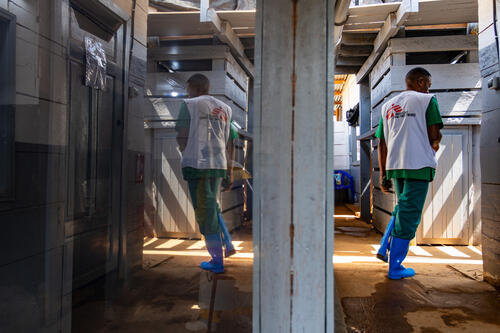
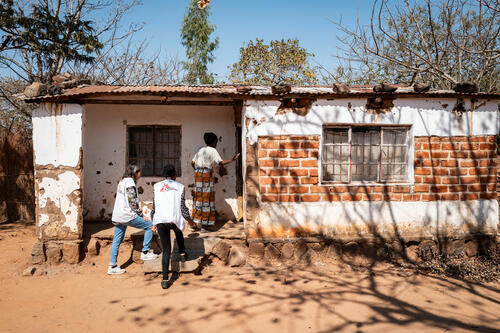
Decontamination teams are visiting the home of a patient who is being treated at the Elikya Ebola treatment centre. She has tested positive for the Bundibugyo virus.
To break the chain of transmission, they go through the house and decontaminate everything that has come into contact with the infected person: clothes, armchairs, doors, windows and mattresses.
These decontamination measures ensure that the family can continue to live in the home without risking infection.
They are accompanied by a family member, wearing personal protective equipment, who shows them around the different rooms and ensures the decontamination process runs smoothly by providing the necessary information.
Once the inside of the house has been decontaminated, the teams go round the property and decontaminate the kitchen and the toilets, which are located outside.
DRC Ebola outbreaks

100 days of Ebola disease outbreak: Faster and more flexible response needed to curb deadly spread in DRC

Communities are not receiving enough support to contain the Ebola disease outbreak in Democratic Republic of Congo. Press Release - 21 Aug 2026
 
MSF flag blowing in the wind at Aweil project base.
Gaza-Israel war

Statement on Israeli military’s decision to deny a criminal investigation into MSF killings and injuries

MSF strongly condemns the decision by the Israeli Military Advocate General to close the cases we submitted for review. Statement - 20 Aug 2026
 
An MSF staff inspects the echography of a patient during a mobile clinic in Khallet Al Mai, Hebron, West Bank. Occupied Palestinian Territory.
Palestine

Escalating violence and movement restrictions continue to drive medical needs in Hebron

Escalating violence and movement restrictions are limiting access to physical and mental health care for communities in Hebron, West Bank, Palestine. Project Update - 20 Aug 2026
 
MSF team providing medical consultations at the mobile clinic in West Wollega, Oromia Region, Ethiopia. July 2026.
Ethiopia

Ethiopia: MSF launches new healthcare programme in Oromia region

MSF has begun a new general and specialist healthcare project for hard-to-reach communities in East Wollega and West Wollega zones in Ethiopia. Project Update - 20 Aug 2026
 
A 25 year old lady sets fire outside her tent in a refugee camp on the outskirts of Sittwe, February 2, 2013. photo by Kaung Htet
MSF Speaking Out

Speaking Out Podcasts

The MSF "Speaking Out" podcasts are adapted from the original Médecins Sans Frontières (MSF) Speaking Out Case Studies (SOCS). Like the case studies, the podcast examines the challenges and dilemmas surrounding speaking out. Each series offers an in-depth look into humanitarian dilemmas in a specific crisis through the narration of extracts from MSF documents and press archives to help establish the facts. Interviews with the main MSF protagonists at the time of the events also provide insight into, and personal analysis of, the positions adopted. - 19 Aug 2026
 
19 DECEMBER 2025 / PORT-AU-PRINCE, HAITI: In Bel Air, a neighborhood of Port-au-Prince controlled by armed groups and marked by frequent gunfights, women seeking maternal and other healthcare wait at a mobile clinic in an abandoned school operated by Médecins Sans Frontières. The clinic opens just for a few hours when the security situation allows for it. Access to the community is negotiated with the armed groups controlling the area.
Haiti

Women risk their lives to reach sexual and reproductive healthcare in Port-au-Prince

Ongoing violence is restricting people's access to sexual and reproductive healthcare in Port-au-Prince, Haiti. Project Update - 19 Aug 2026
 
One of the MSF-supported water chlorination sites near the Ruzizi River in South Kivu province, DRC. These supply points are disinfected to provide safe drinking water and prevent cholera transmission.
Democratic Republic of Congo

Other health emergencies must not be neglected in eastern DRC

While the response to Ebola disease continues in Democratic Republic Congo, other health emergencies such as cholera, measles, malaria, and violence linked to ongoing conflict, must not be neglected. Project Update - 14 Aug 2026
 
An MSF water truck provides a critical source of clean drinking water. Despite producing around 500,000 litres daily, it is enough for only 80,000 people to receive the bare minimum.
Gaza-Israel war

Israel puts thousands at risk by blocking crucial supplies for healthcare in Gaza

Israel are putting thousands of people at risk in Gaza, Palestine, by blocking crucial supplies for healthcare and hygiene, including engine oil and spare parts. Press Release - 12 Aug 2026
 
A 25 year old lady sets fire outside her tent in a refugee camp on the outskirts of Sittwe, February 2, 2013. photo by Kaung Htet

MSF Speaking Out Podcast: MSF and the Rohingya 1992-2014

This podcast is adapted from the MSF Speaking Out Case Study “MSF and the Rohingya 1992 – 2014”.
It brings to light two decades of MSF advocacy activities as part of its humanitarian assistance to the Rohingya people in Bangladesh and Myanmar.
It examines the challenges that MSF teams in the field and headquarters encountered when deciding whether and how MSF could publicly speak out about the plight of the Rohingya facing persecutions and violence in Myanmar and Bangladesh. During the 1992-2014 period, MSF worked mostly through diplomatic channels “behind closed doors” to advocate about the Rohingya’s plight with foreign diplomats and United Nations agencies. This “silent advocacy” was challenged within MSF by those who felt that the lack of public speaking out meant MSF was abandoning a persecuted population. To maintain an operational presence without speaking out publicly was not seen as an ethically justifiable option for an independent and impartial humanitarian organisation like MSF.
Over 7 episodes, the podcast explores the challenges, dilemmas and internal disagreements underlying MSF’s humanitarian response to assist the Rohingya under the Myanmar authoritarian regime.
- 11 Aug 2026
 
Children admitted for severe acute malnutrition receive inpatient care in the inpatient therapeutic feeding centre (ITFC) at MSF-supported Bay Regional Hospital, Baidoa, Southwest State, Somalia.
Somalia

Survey of displaced families in Baidoa finds every second child malnourished

A recent MSF survey finds shocking levels of malnutrition among children in displacement sites in Baidoa, Somalia. Press Release - 11 Aug 2026
Four mothers posing in a corridor of the Hospital in Bili. All four of them are staying in the hospital with their child, that's suffering from a severe case of malaria. Since the beginning of the project in 2016, the pediatric ward already treated more than 4.000 cases of complicated/severe form of malaria.
Médecins Sans Frontières (MSF)

Independent medical humanitarian assistance

We provide medical assistance to people affected by conflict, epidemics, disasters, or exclusion from healthcare. Our teams are made up of tens of thousands of health professionals, logistic and administrative staff - most of them hired locally. Our actions are guided by medical ethics and the principles of independence and impartiality. We are a non-profit, self-governed, member-based organisation.

Learn more