In March 2018, Doctors Without Borders/ Médecins Sans Frontières (MSF) sent an assessment team to Mosul’s old city in northern Iraq. The old city experienced intense shelling, aerial bombing and attacks with improvised explosive devices (IED) during the conflict. Much of the old city is still inaccessible due to the destruction and presence of IEDs, unexploded ordinance (UXO) and booby traps. 

The MSF assessment team visited two primary healthcare centres (PHCCs) and donated medical supplies such as painkillers, antibiotics, dressing materials and tablets for sterilizing water. The assessment found the PHCCs were under-resourced and struggled to provide healthcare due to the lack of medication, water and electricity. One of the doctors said: “If we don't have water or electricity, we cannot do anything…most of the cases we cannot treat. We can only treat the simple cases and the complicated cases we refer.”

MSF currently runs a maternity and paediatrics hospital in west Mosul, and a post-operative and surgical unit for war-wounded patients in east Mosul. Following the assessment in the old city, MSF distributed 550 hygiene kits to families. The kits included items such as soap, toothbrushes, towels and water containers and will help families stay clean and prevent the spread of diseases.
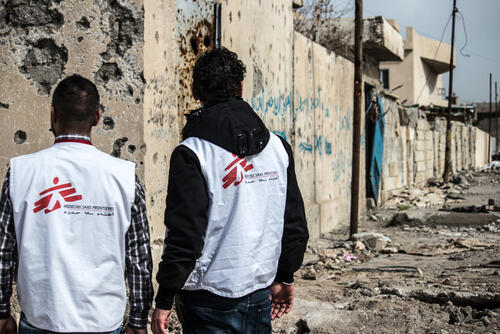
MSF outreach staff survey the damage in Mosul, Iraq, in the aftermath of intense shelling, aerial bombing and attacks with improvised explosive devices (IED) in the city. April, 2018.
© Sacha Myers/MSF

MSF in Iraq Annual Report 2018

MSF outreach staff survey the damage in Mosul, Iraq, in the aftermath of intense shelling, aerial bombing and attacks with improvised explosive devices (IED) in the city. April, 2018.
© Sacha Myers/MSF
Ebola disease in DRC: find out how we're responding
Learn more

Since 1991, MSF has been working in Iraq and with more than 1,500 staff provides free, quality healthcare for all people regardless of race, religion, gender or political affiliation.

In Iraq, MSF offer services such as basic health care, treatment for chronic diseases, secondary healthcare including maternity with surgical capacity for caesarean sections, paediatric and emergency care, specialised services to treat severely injured patients with post-operative complications and mental health support to displaced people, returning population and communities most affected by violence in the governorates of Anbar, Baghdad, Diyala, Erbil, Ninewa, and Kirkuk.

Learn more about our work in Iraq in Annual Report 2018: Médecins Sans Frontières  in Iraq.
MSF in Iraq: Annual Report 2018 pdf — 9.13 MB Download