




Ebola disease in DRC: find out how we're responding
Learn more
7996 Results
 
Bayan, 18 year old, is a mother of two children: Watan and Assil. After giving birth to Assil, who is now 2.5 months old, she decided to use family planning methods. She came to MSF’s clinic in Bourj El Barajneh camp for a family planning consultation. Bayan’s two pregnancies were followed up at MSF’s clinic. After her last delivery, she received all the information about family planning from a midwife, during the post-natal care visit. She says: "My second pregnancy was not planned; I gave birth to two children in 2 years, now I want to prevent any new pregnancy. I come here regularly for consultations, and “Em Shadi” is my favourite midwife.”
Lebanon

Empowered midwives, satisfied mothers – midwife-led care in Lebanon

For International Day of the Midwife, MSF Dr Laura Rinchey explains the benefits of midwife-led care for expectant and new mothers, and the efforts MSF is undertaking to improve midwife-led care in Lebanon. Voices from the Field - 3 May 2019
 
الدمار الذي ألحقه إعصار كينيث
Mozambique

MSF responds as second cyclone hits Mozambique

Cyclone Kenneth has hit northern Mozambique just over a month after Cyclone Idai devastated the country's central coast. MSF teams are assessing the damage and the needs in the new disaster-affected area. Project Update - 1 May 2019
 
Flood in Khuzestan Province.
Iran

Flash floods in Iran wash away homes, roads and livelihoods

Flash flooding across Iran has washed away homes, roads and bridges, and the harvest, resulting in difficult access to many towns and leaving thousands of people homeless and displaced, and struggling with finding the basics to survive. Voices from the Field - 29 Apr 2019
 
msf-placeholder

Speaking out videos: MSF and North Korea 1995-1998

Speaking out videos: MSF and North Korea 1995-1998 - 29 Apr 2019
 
msf-placeholder

Speaking Out videos: MSF and the war in the former Yugoslavia 1991-2003

Speaking Out videos: MSF and the war in the former Yugoslavia 1991-2003 - 26 Apr 2019
 
MSF emergency team mobile clinic for victims of Cyclone Idai in the outskirts of Beira city. As flood levels have receded slightly in some areas, an MSF emergency mobile medical team has been able to reach the area around Centro de Saude Marocanne health centre. The health centre itself is entirely destroyed, the the MSF team provided primary healthcare consultations going door-to-door in the neighbourhood. Mainly the team treated small wounds, stomach issues (particularly intestinal worms) and respiratory tract infections.
Cyclone Idai & Southern Africa flooding

MSF emergency response to Cyclone Idai and flooding

Mozambique, Malawi and Zimbabwe have been severely damaged by heavy rains, flooding and Cyclone Idai, which hit Beira, central Mozambique on 14 March. Our teams are on the ground in all three countries. Crisis Update - 26 Apr 2019
 
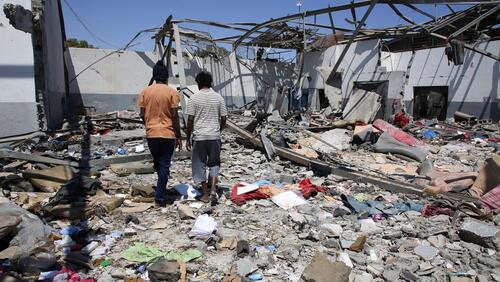
General view of detention centre

On September 2nd, 276 people were brought by the Libyan coast guard to Khoms (120 km east of Tripoli). They were then transferred to detention center where MSF works. Reportedly, they were in two rubber coats, one stopped due to engine failure, while the other boat continued to navigate for several hours before deflating and sinking. Survivors told MSF teams that over a hundred people died in the shipwreck.
Libya

Time running out for evacuations of trapped refugees in Tripoli amid shooting

On 23 April, reports surfaced of a violent incident in a Tripoli detention centre, where trapped migrants are being held. MSF has found evidence that multiple people were shot, and urges for all migrants' immediate evacuation. Press Release - 26 Apr 2019
 
msf-placeholder

Methodology

Methodology - 25 Apr 2019
 
A mother and her child speak speak to a doctor from MSF's mobile clinic in Hay Khun village, Naga.
Myanmar

Bringing healthcare to remote communities in Naga

Naga is one of the most remote parts of Myanmar, and with mountainous terrain, and few established road networks, many in Naga struggle to access healthcare. Travelling usually with motorcycles, MSF's mobile clinics reach the remote villages once or twice a month.
Photo Story - 25 Apr 2019
 
At the village of Biaro. The Zairian Red Cross are present (brought here by the rebels of Kabila, who want to make sure the bodies are burried as fast as possible, fearing typhus epidemic) and make a count of all the orphans: above 1000 children. They are lined up along the railway tracks.Tens of thousands of Rwandan Hutu refugees, (they all come from the refugee camps of Goma and Bukavu), fleeing the Zairian rebels of Laurent- Desire Kabila, for the last 5 months, hiding in the bush, exhausted, famished, and all waiting to return home, to Rwanda, are today in the midst of a new nightmare. They had taken residence in camps in 1994, when they fled their country in fear of retribution for the massacres of hundreds of thousands of Rwandan Tutsi by Hutu extremists. The presence of Hutu nettled Zairian Tutsi, who joined forces with Kabila, a longtime Mobutu foe, and  launched the insurgency. The fighting forced most of the Rwandan refugees to go home in Autumn 96, but about 350.000 of them have been marooned in tough eastern Zaire, fighting terrain. They are dying at an alarming rate. They need food, water ans safe passage home. But no one has made the refugees a priority. The Zairian rebels of Kabila who seized Kisangani, Zaire'sthird city, had ordered the Rwandan Hutu Refugees, who were in this region's camps, to move back south.
MSF Speaking Out

The Hunting and Killing of Rwandan Refugees in Zaire-Congo: 1996-1997 (PDF, 6 MB)

https://www.msf.org/sites/default/files/2026-04/VA_The%20Hunting%20and%20Killing%20of%20Rwandan%20Refugees%20in%20Zaire.pdf - 25 Apr 2019
Four mothers posing in a corridor of the Hospital in Bili. All four of them are staying in the hospital with their child, that's suffering from a severe case of malaria. Since the beginning of the project in 2016, the pediatric ward already treated more than 4.000 cases of complicated/severe form of malaria.
Médecins Sans Frontières (MSF)

Independent medical humanitarian assistance

We provide medical assistance to people affected by conflict, epidemics, disasters, or exclusion from healthcare. Our teams are made up of tens of thousands of health professionals, logistic and administrative staff - most of them hired locally. Our actions are guided by medical ethics and the principles of independence and impartiality. We are a non-profit, self-governed, member-based organisation.

Learn more