



Ebola disease in DRC: find out how we're responding
Learn more
7996 Results
 
Kario camp, is the biggest refugee settlement in East Darfur, it was created in 2016, and hosting 20,000 South Sudanese refugees as per UNHCR figures. 
Most of the residents of the camp are Dinkas, they fled South Sudan because of food shortage and lack of job opportunities. When arrived to Sudan, the refugees continued to seek job opportunities, what makes the camp’s community in constant mobility. 
MSF intervened in this camp for the first time in June 2017, at the time when an acute watery diarrhoea (AWD) outbreak was declared in the camp with extremely high mortality rates.
In July 2017, MSF opened a Health Centre in Kario camp to provide free primary health care package and basic secondary health care services to the South Sudanese refugees and hosting community in Kario, East Darfur.
Sudan

Hardships follow South Sudan’s refugees into Sudan’s East Darfur

There are more than 750,000 South Sudanese refugees currently in Sudan and around 100,000 of them are in East Darfur. Since July 2017, MSF has been providing free primary and secondary healthcare services, including maternity, nutrition and vaccination programmes for almost 40,000 people living in the area - both refugees and the host community. Project Update - 23 Jul 2018
 
ZIPPORAH ALUOCH ODONGO IS 33. SHE WAS TESTED FOR HIV IN 2016 BUT STARTED TAKING MEDICATION ON FEBRUARY 2017 BECAUSE SHE WAS AFRAID OF ARVS. SYMPTOMS OF KARPOSIS SARCOMA STARTED SHOWING SHORTLY AFTER SHE STARTED TAKING MEDICATION. SHE IS GOING TO START QUIMIOTHERAPHY.
HIV/AIDS

Stopping Senseless Deaths: Overcoming access barriers to affordable, lifesaving diagnostics and treatments for HIV and opportunistic infections

Report - Stopping Senseless Deaths: Overcoming access barriers to affordable, lifesaving diagnostics and treatments for HIV and opportunistic infections Report - 23 Jul 2018
 
Tanya is not at school, because her father cannot afford the fees. She spends a lot of time in and around the house. “When the other kids are playing outside my home, I try and use my crutches to keep up but they don’t slow down for me because I can’t walk as fast. When it happens, and they run away from me, it hurts me a lot. I start calling out to them. If they don’t come back, I go inside my home. When they run away, it’s very painful to me, sometimes it even gives me a pain in my stomach, deep down, and that’s why I end up sleeping and I will wish that my Daddy will come home and that he will be with me. When Dad comes home and I tell him what happened, he says, don’t worry about them, they are just kids playing around,” she says.
HIV/AIDS

Pfizer and GSK’s HIV/AIDS division, ViiV, prevents children with HIV from getting needed medicine

Tanya is ten years old and is unable to walk. She was diagnosed with HIV when she was just a few months old. Zimbabwe, 2016. Press Release - 23 Jul 2018
 
MSF peer educator MSM and previous sex worker, Beira (far left) guides two girls from the community to MSF’s mobile testing site where they will be able to test for HIV.

Between Mozambique and Malawi, MSF provides peer-led adapted packages of HIV and sexual and reproductive healthcare services, including PrEP, HIV testing and treating for sex workers and men who have sex with men (MSM) in six project sites located along the main transport routes. Over 9000 SW since 2013 and 330 MSM since 2016 have been enrolled in these projects. The development of services has been guided by WHO recommendations on key populations.
HIV/AIDS

Towards Peer-Led HIV and SRH Services for Sex Workers and Men Having Sex with Men

Report - Towards Peer-Led HIV and sexual reproductive health (SRH) Services for Sex Workers and Men Having Sex with Men: Experience from Médecins Sans Frontières in Malawi and Mozambique. Report - 23 Jul 2018
 
Farisai Gamariel, Supervisor of MSF’s Patient support team for MSM, in MSF’s project providing health services for sex workers and men who have sex with men (MSM), Beira, Mozambique
HIV/AIDS

Meeting the specific needs of key populations living with HIV

MSF’s experience in Mozambique, Malawi and India shows that if we do not respond to the specific health needs of key populations, we won’t be able to curb the HIV epidemic. Project Update - 23 Jul 2018
 
Thun Mina Aung, 18, from Myammar inside the MSF's Insein clinic in Yangon.

Thu Min Aung is 18 years old and lives with his aunt. Back in June 2017, he was working as an air conditioner installer in Sang Jae township when he started to feel sick. He went to a nearby clinic and they gave him medications, but the drugs did not treat his symptoms. 

Soon after, he moved to Hlaing Tharyar, where he went to another clinic and discovered that he has MDR-TB. Treatment has greatly impacted his day-to-day life. Everyday, he wakes up at 7am, eats breakfast, and takes the bus for 45 minutes to the MSF clinic to take his medication. The pills make him feel very dizzy. When he gets home from the clinic, he has to lie down and sleep for the entire afternoon. His whole life revolves around treatment right now because the side effects are very severe. He has 12 more months of this day-to-day before finishing treatment.
Tuberculosis

Last-minute pressure to drop language on protecting access to affordable medicines from TB Summit declaration negotiations

MSF's Access Campaign appeals to all countries to urgently stand up right now against bullying that aims to keep medicines out of the hands of your people who need treatment. Press Release - 20 Jul 2018
 
Registration area to define which vaccine children should receive.
Central African Republic

Protecting as many children as possible in an emergency context

MSF and the Ministry of Health complete a two-year multi-antigen mass vaccination campaign targeting about a quarter of all children under five in the Central African Republic. Project Update - 20 Jul 2018
 
The Sudd is a vast swamp extending from Bor to Malakal.

Le Sudd est un vaste marécage s'étendant de la ville de Bor à celle de Malakal.
South Sudan

A hospital in the swamp

Despite the many challenges that patients and medical workers face in the remote area of Old Fangak, South Sudan, MSF's 'hospital in the swamp' remains the best hope for many people with serious conditions. Photo Story - 20 Jul 2018
 
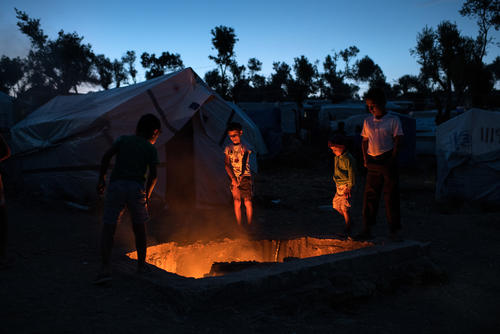
Thousands of people seeking safety after fleeing countries such as Syria, Afghanistan, Iraq, Sudan, and Congo continue to risk their lives to reach Europe. Those who try to arrive via Turkey and the Aegean Sea have been trapped for an indefinite period of time on islands in Greece as part of the EU/Turkey deal and its deterrence and containment approach. 
In Moria refugee camp, on Lesbos island, there are currently more than 7,500 people in a camp made for a maximum of 2,500. With the camp so full, refugees are now staying in an informal extension of the camp known as Olive Grove. The awful conditions at Moria camp/Olive Grove and arbitrary administrative situations have had a dramatic impact on their health and in particular their mental health. 
Médecins Sans Frontières teams provide medical and mental health support outside Moria camp and run a clinic for severe mental health cases in Mytilene, the capital of the island.
Greece

Trapped in Moria

Photo Story - 19 Jul 2018
 
MSF psychologist/physiotherapist/social worker with a patient in MSF clinic for treatment of victims of violence in Maadi Egypt
Egypt

“Our patients were among the strongest and bravest human beings I have ever met”

Egypt is a key transit and destination country for migrants from African and the Middle East, many of whom have experienced immense difficulties resulting in psychological problems and physical disabilities. Interview and testimonies from MSF's integrated healthcare centre in Maadi, Cairo. Voices from the Field - 19 Jul 2018
Four mothers posing in a corridor of the Hospital in Bili. All four of them are staying in the hospital with their child, that's suffering from a severe case of malaria. Since the beginning of the project in 2016, the pediatric ward already treated more than 4.000 cases of complicated/severe form of malaria.
Médecins Sans Frontières (MSF)

Independent medical humanitarian assistance

We provide medical assistance to people affected by conflict, epidemics, disasters, or exclusion from healthcare. Our teams are made up of tens of thousands of health professionals, logistic and administrative staff - most of them hired locally. Our actions are guided by medical ethics and the principles of independence and impartiality. We are a non-profit, self-governed, member-based organisation.

Learn more