


Ebola disease in DRC: find out how we're responding
Learn more
7996 Results
 
Phole Khoromana, MSF health promotion officer, during mobilization activities. The MSF team drives along rural roads to tell women in the surrounding villages to come to MSF health talks. The team works in rural communities where the nearest health center is more than 5 km away.
How we work

Discover how we deliver medical humanitarian assistance

Our teams conduct independent evaluations and assess how best we can help reduce suffering and save lives of people caught in crises. Improving our medical and humanitarian practice is part and parcel of our ongoing activity and our work is underpinned by a solid network of supply and logistics.
 
Veronika Polcova, MSF MDR-TB Doctor, is consulting Samuel, 66, suspected to be TB infected. Matsapha, Manzini Region, Swaziland.
Eswatini

MSF hands over its Manzini project, while continuing activities in Shiselweni

As a mark of the project's success and the great gains made in the fight against HIV/AIDS and TB in Swaziland, MSF is handing over its Manzini project to the Ministry of Health at the end of June 2018. Statement - 25 Jun 2018
 
MSF health promotion officer, Chidinma Ugonna, educating the public about Lassa fever in Iboko market, Izzi local government area, Ebonyi state, Nigeria. MSF teams have built and maintained a remarkably high level of community acceptance in Ebonyi state and have a good relationship with the people. There is still a lot of stigma for Lassa fever survivors and our teams try to use every means available to let people know that those who have been treated and cured for Lassa fever are no longer contagious.
Get in touch

Contact us

Contact MSF sections and branch offices around the world.
 
Left to right:
Erastus Cheti, Eric Stobbaerts, Dr. Isabelle Defourny, Yves McGale, Marc Dubois, Dr. Micaela Serafini, Paula Gil, Christopher Lockyear, Bhelakazi Mdelalose, Dr. Saleem Kassam, Dr. Teresa Bonyo, Dr. Ali Ouattara, Katrin Kisswani, Sam Bumicho, Ingrid Johansen and Dr. Javid Abdelmoneim.
How we're run

The International Board

The International Board (IB) is the board of MSF International. It acts on behalf of and is accountable to the International General Assembly (IGA). As the highest associative governance body of MSF, the IGA delegates duties to the Board, as defined in the Statutes of the association. Discover the current members of the International Board.
 
Survivor of an airstrike in al-Dashisha area, in north east Syria, receiving treatment at an MSF hospital in Hassakeh governorate. The airstrike that injured them killed 14 others.
After a period of relative calm, airstrikes on the Islamic State group in Der ez-Zor and Hassakeh governorates intensified in June 2018. As a result, and over a period of ten days in early June, 17 people arrived to the MSF hospital with injuries related to airstrikes, compared to 7 between January and June.
For those who survived the airstrikes and reached the MSF hospital, they had to travel for hours. The meandering frontlines between armed groups can turn a mere one-hour journey into a six hour trek, as people often have to take detours and travel through rural parts of the governorates to avoid checkpoints. In parallel, the few remaining and functioning health centers in the region are either private and very expensive, or they lack specialized teams.
Syria

MSF Hassakeh hospital seeing an increase in casualties of airstrikes in northeast Syria

Between 4 and 14 June, MSF-supported hospital in Hassakeh received 17 survivors of airstrikes, including 6 children and 3 women. Project Update - 21 Jun 2018
 
Migrants also use the shelters to gather information on routes to continue on their way through Mexico.
Mexico

An unsafe country for thousands of refugees fleeing violence in Central America

Migrants and refugees fleeing danger in Central America are trapped and exposed to more violence in Mexico due to ever tighter and more callous United States border control policies, said Médecins Sans Frontières (MSF) on World Refugee Day. Press Release - 20 Jun 2018
 
View of the hospital of Bikoro, where MSF has set up an Ebola treatment center (ETC)
DRC Ebola outbreaks

Ebola update June 2018

Since the Ebola epidemic in Democratic Republic of Congo (DRC) was declared on 8 May 2018, over 60 people who presented symptoms of haemorrhagic fever, including 38 confirmed Ebola cases and 28 deaths (of whom 14 were confirmed as Ebola)*, have been notified by the national health authorities in the Equateur region, in the west of the country, where the outbreak started. 24 patients (confirmed Ebola cases) have recovered from the disease and been discharged from treatment centres. Crisis Update - 19 Jun 2018
 
Marie-Vincent’s husband welcoming her home with a prayer. He lost his son and grandsons to Ebola but his wife has returned home a survivor.

“I WILL START TODAY FROM ZERO” – MARIE-VINCENT’S STORY

“At first, we didn’t believe in Ebola,” says Marie-Vincent, a woman recently discharged from MSF’s Ebola treatment centre (ETC) in Bikoro, Democratic Republic of Congo (DRC). She has just recovered from the virus, after her entire family fell sick.

Marie-Vincent doesn’t know how old she is, but she looks to be perhaps 60, and has certainly seen a lot in her life. Her family’s story of Ebola started with her son, Charles. 

One of 11 children, Charles was a nurse who ran a remote health centre in Itipo, tiny town some 170 kilometres from Mbandaka, the capital of Equator Province in Democratic Republic of Congo, over dirt roads and broken bridges. Itipo is the so-called epicentre of the recent Ebola outbreak. 

Charles spent years caring for patients with diseases like malaria, diarrhoea and malnutrition, as well as assisting women with antenatal care and complicated deliveries. He died from a case of probable Ebola on 9 May, the day after the epidemic was officially declared. His body was never tested for the virus, but was treated with care and respect, washed and carried back to the village of his birth for a traditional burial. 

In the days that followed, the full force of the virus would be released on his family and the colleagues who cared for him when he was sick.

“We became suspicious about why Charles was ill when the other nurses told us to distance ourselves from him,” says Marie-Vincent, “But I still looked after him, because a mother cares for her son when he is sick.” 

The body of a person who has died from Ebola is extremely contagious. In the days after Charles was buried, Marie-Vincent and several members of her family began to fall sick. 

“As soon as he was in the ground, we began to feel ill. We had fevers, vomiting and diarrhoea. We began to believe it really was a sickness and not a curse. I’d heard about Ebola and the mysterious deaths in some local villages. But at the time, we just didn’t know.” 

Soon, Marie Vincent was extremely sick with the virus and was taken to be tested. Her oldest son and his wife, then another son and another male relative, all fell ill one after the other. Next, Charles’ pregnant wife began to run a fever, as did two of his son’s and his son’s young fiancée. The whole family was brought to MSF’s Ebola transit centre in Itipo and referred onto the ETC in Bikoro, a town a few hours away, after their tests came back positive for the virus. 

The next weeks were spent inside the treatment centre, battling the symptoms and the fear, together.

“The staff were very warm and did everything they could to help us survive,” says Marie Vincent. “They encouraged us and made us believe we would recover even when we felt like giving up.”

Sadly, however Marie-Vincent’s grandsons (Charles’ sons) as well as the young fiancée all died from Ebola. Although Charles’ wife would later recover, her unborn child, a little boy, would not survive. The Ebola virus crosses the placenta where the mother’s immune system cannot go and has no hope of protecting it.

“I’ve recovered, but there is nothing left for me at home. Everything I own has been burned. I’m old, but I will have to start my life again from scratch. I will start today from zero.”
DRC Ebola outbreaks

“I will start today from zero”

The story of Marie-Vincent, a woman recently discharged from MSF’s Ebola treatment centre (ETC) in Bikoro, DRC, who lost her son and other family members to the virus. Voices from the Field - 19 Jun 2018
 
Omar Mahmoud Mental Health Activity Manager Assistant
Iraq

Syrian refugee works to heal wounds of Iraq's displaced

Omar Mahmoud, MSF aid worker and refugee, highlights the helplessness of those displaced. thenational.ae - 19 Jun 2018
 
Two children stand next to a destroyed shelter inside a camp for internally displaced people in the town of Pulka, northeast Nigeria.
Nigeria

“There is no place to take cover or hide from the rain”

Around 5,000 internally displaced people are living in precarious conditions in 38 shared shelters in the transit camp in Pulka, northeast Nigeria. Project Update - 18 Jun 2018
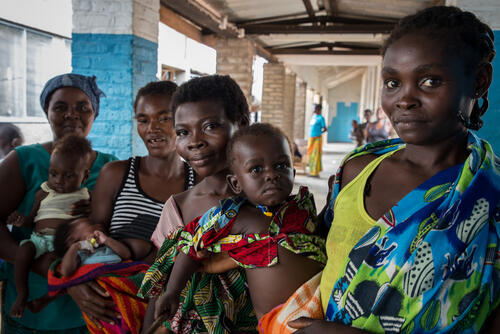
Four mothers posing in a corridor of the Hospital in Bili. All four of them are staying in the hospital with their child, that's suffering from a severe case of malaria. Since the beginning of the project in 2016, the pediatric ward already treated more than 4.000 cases of complicated/severe form of malaria.
Médecins Sans Frontières (MSF)

Independent medical humanitarian assistance

We provide medical assistance to people affected by conflict, epidemics, disasters, or exclusion from healthcare. Our teams are made up of tens of thousands of health professionals, logistic and administrative staff - most of them hired locally. Our actions are guided by medical ethics and the principles of independence and impartiality. We are a non-profit, self-governed, member-based organisation.

Learn more