



Ebola disease in DRC: find out how we're responding
Learn more
7996 Results
 
Abu Ahmad: “I always have so many worries; worries about the future.”

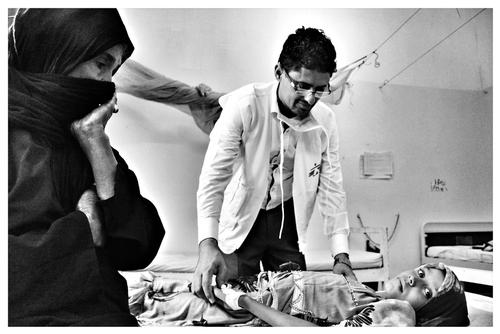
Abu Ahmad is a 52-year-old father of eight (four daughters and four sons). His 11-year-old daughter Rukia became paralysed shortly before the violence erupted in August 2017. After arriving in Bangladesh, Rukia spent over seven months at MSF’s medical facility in Kutupalong. She returns to the facility every couple of days to have her bedsores treated. Here, Abu Ahmad recounts how the family fled, what life is like for his family in Bangladesh, and their hopes for the future.

“Before the conflict, we had cows, goats, land, all those things. Our business and livelihoods we earnt ourselves. But we faced lots of threats and torture from the government in Myanmar. If someone wanted to get higher education, that person would have to flee the country because if the government found out, they would arrest him. Our movements were very restricted; we were not allowed beyond the checkpoints. We could only move within our area. Other people, like monks and different [ethnic] communities, were free to move around everywhere. 

Then the conflict began. 
Fighting, stabbings and the burning of houses. Not long before that, my daughter Rukia had somehow became paralysed. She complained of pain and then stopped being able to feel anything below the waist. One night I called all my children together to discuss what to do. We did not see much hope; we could be arrested or killed no matter what we did. My eldest son told me that when the fighting starts, we would not be able to run with Rukia. “There will be no chance to save her life, he said. “You and mother should take her to Bangladesh now, ahead of us. We can join you later.” So I told my other children to get ready, and my wife and I left for Bangladesh with Rukia. 

Fleeing Myanmar.
After we left the house ... we were unable to [openly] leave our village because everywhere we looked we saw government people with weapons. We trekked miles throug
Rohingya refugee crisis

Abu Ahmad: “I always have so many worries; worries about the future.”

A Rohinga refugee and father of eight, recounts how he and his family fled Myanmar, what life is like for his family in Bangladesh, and their hopes for the future. Voices from the Field - 23 Aug 2018
 
KABALA, SIERRA LEONE - Health Promoter and IEC officer Sama T Marah talk to mothers at the neonatal ward at Kabala General Hospital on November 10, 2017 in Kabala, Sierra Leone. Photo by Xaume Olleros / MSF
Sierra Leone

Learning from the past, preparing for the future

Paul Jawor, an MSF water and sanitation (WATSAN) expert who has been working on the post-Ebola response in Sierra Leone since 2016, recounts the progress he has seen in the Mongo and Kabala regions in the north of the country over the last three years. Project Update - 21 Aug 2018
 
Tun Tun Oo, 40, from Myammar, inside the MSF's Insein clinic in Yangon, Myanmar.

Tun Tun Oo is 40 years old from Hlaing Tharyar. In 2017, he felt severely sick and his body temperature was very low. He went to another hospital where he discovered he had cholera, HIV, and MDR-TB. They treated him for cholera at the hospital, and then referred him to MSF clinic to receive treatment for HIV and TB. At the MSF clinic, the doctors took tests to see which drugs would be the most effective to treat his MDR-TB, and then put him on a treatment regiment that included Bedaquiline. He started to feel dramatically better after one month of treatment. After 5 months of treatment, he was able to have enough strength to go back to work as a street vendor selling dried fish and fish paste. 

Currently, he lives with his son who is 5 and a half years old. His wife and their three other children live together in a separate home. She wants him to come back, but he is having a hard time with the decision because he struggles to afford rent (MSF doctor has helped him pay rent the last 2 months). At times, he feels really upset that he didn't get a better life. Both his parents died when he was a child, and he had to take care of himself growing up. Because he grew up alone, he wishes to one day be able to afford a home where his whole family can eat around the dining table together. He knows that he has to complete his treatment so that he can start saving money and take care of his family. His son encourages him to complete the treatment plan so that "we can have more snacks to eat!"

He was excited to speak with MSF about his experience, because he "doesn't want other people to end up like him." He shares his experience with his friends and neighbours, but many do not want to speak to him. He encourages people to get tested and lets them know they can get treatment at MSF. He hopes one that that his wife and kids will come and get tested, too.
Tuberculosis

Improved treatment options recommended by the World Health Organization

MSF calls on Johnson & Johnson to make key drug bedaquiline affordable for all people who need it Press Release - 17 Aug 2018
 
On August 16, MSF launched inpatient services for severely malnourished children under five years-old, as well as paediatric care for patients under 15 years-old with severe malaria and other diseases, in a facility with a capacity of 30 beds. The medical intervention began as a response to a lack of healthcare assistance to newly arrived displaced people in Bama. Over 1.7 million people have been displaced by the conflict between the Nigerian military and non state armed groups in northeast Nigeria.
Nigeria

Critical humanitarian situation unfolding among internally displaced people in Bama, Borno state

Médecins Sans Frontières (MSF) has started emergency nutritional and paediatric activities in Bama, Borno state, in response to a critical humanitarian situation among newly arrived internally displaced people. Press Release - 17 Aug 2018
 
Bihać, Bosnia: One – and only one – room in this five-story abandoned concrete dormitory features bunk-bed cots for refugees and migrants to sleep. Flooding throughout the building is a frequent problem.
Bosnia-Herzegovina

Push-backs, violence and inadequate conditions at the Balkan route’s new frontier

As the stream of people arriving in Bosnia and Herzegovina rises, basic humanitarian conditions in the two largest points of congregation along the border remain alarmingly inadequate. Project Update - 17 Aug 2018
 
A girl carries a water bucket and other relief items donated by the UN through the wet streets of Balukhali camp.  The monsoons have caused havoc in the camps and for local communities, resulting in landslides, floors and fires, and have led to injuries, deaths and the destruction of infrastructure and facilities. Water supplies have become contaminated with dirty water/human waste, posing a public health risk. One year on since the biggest influx of Rohingya refugees to Bangladesh, the Rohingya face an uncertain future. Overcrowding and congestion are major issues in the camps, access to safe drinking water and sanitation services is insufficient, and the Rohingya suffer from a lack of formal legal status,.
Rohingya refugee crisis

Crisis update – August 2018

August 2018 update on activities in Cox's Bazar district, Bangladesh, providing care for Rohingya refugees who have fled Myanmar. Crisis Update - 16 Aug 2018
 
Ebola DRC MSF treatment centre opens in Mangina
DRC Ebola outbreaks

MSF Ebola treatment centre opens in Mangina, North Kivu

MSF has opened an Ebola treatment centre at the epicentre of the outbreak, where 31 confirmed Ebola patients and six suspect cases are currently hospitalised.

Project Update - 16 Aug 2018
 
Newborn babies in the MSF facility in Likoni
Kenya

Tales from MSF’s ‘Container Village’ in Likoni

While renovating and expanding the old Mrima health centre in Likoni, Kenya, MSF set up an innovative shipping-container facility where it offered sexual and reproductive health services, including caesarean sections. In the two and a half years it was operational before services were moved to the new facility in May 2018, MSF’s medical team assisted 11,578 deliveries in the ‘Container Village’. Photo Story - 16 Aug 2018
 
Khawla, pharmacist, joined MSF in 2012. (Refer to staff profile)
Lebanon

One year after the battle, medical needs remain high in Arsal

MSF has been continuously providing free medical care for vulnerable communities of Syrian refugees and local Lebanese residents in Arsal, on the Lebanon-Syria border, since 2012. Despite improvements in the security situation, key gaps in healthcare remain. Project Update - 16 Aug 2018
 
At 11:50 AM local time on Friday, 10 August 2018, 25 people were rescued in the Central Mediterranean near the Libyan coast. The rescued people were found adrift on a small wooden boat with no engine on board and were believed to have been at sea for nearly 35 hours. Just hours later, the Aquarius performed a second rescue of 116 men, women and children, including 67 unaccompanied minors, found on an overcrowded wooden boat. Those rescued originated from Somalia, Eritrea, Cameroon, Ivory Coast, Egypt, Morocco, Senegal, Togo, Ghana, Bangladesh, and Nigeria. While there were no critical medical cases among those rescued, many people were extremely weak from being out at sea on unstable boats and from their time in Libya where many say they were held in inhumane conditions.
Mediterranean migration

Aquarius calls on European governments to assign place of safety after rescues on Mediterranean

Responding to the ongoing humanitarian crisis in the Central Mediterranean, a total of 141 people were rescued on Friday by the search and rescue vessel Aquarius, chartered by SOS MEDITERRANEE and operated in partnership with Médecins Sans Frontières (MSF). Press Release - 15 Aug 2018
Four mothers posing in a corridor of the Hospital in Bili. All four of them are staying in the hospital with their child, that's suffering from a severe case of malaria. Since the beginning of the project in 2016, the pediatric ward already treated more than 4.000 cases of complicated/severe form of malaria.
Médecins Sans Frontières (MSF)

Independent medical humanitarian assistance

We provide medical assistance to people affected by conflict, epidemics, disasters, or exclusion from healthcare. Our teams are made up of tens of thousands of health professionals, logistic and administrative staff - most of them hired locally. Our actions are guided by medical ethics and the principles of independence and impartiality. We are a non-profit, self-governed, member-based organisation.

Learn more