



Ebola disease in DRC: find out how we're responding
Learn more
8006 Results
 
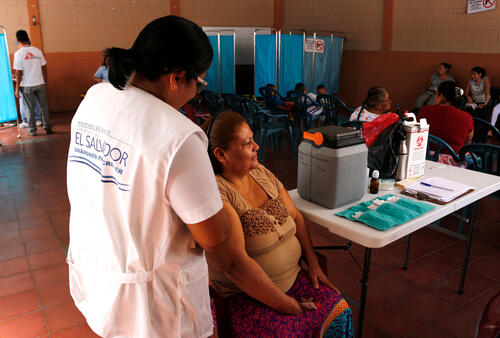
Personnel of the Ministry of Health (Minsal) was able, thanks to the presence of Doctors Without Borders (MSF), to cross the invisible borders imposed by the situation of violence that hinders access to health in some neighborhoods in the capital.
El Salvador

Behind the wheel – driving ambulances in El Salvador’s red zones

In the "red zones" of El Salvador - areas that are controlled by gangs and marked by violence - access to medical care is not easy for residents. So MSF goes to them with an ambulance driven by trained nurses. Voices from the Field - 7 Jun 2019
 
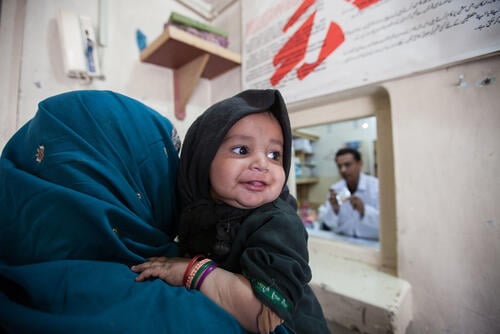
A woman collects medicine from the MSF pharmacy at MSF’s mother and child health centre in Kuchlak, Balochistan.
Pakistan

Witnessing poor mother and child healthcare in Balochistan

In Pakistan's southwest Balochistan province, poor healthcare practices - such as feeding newborns green tea - often result in illness and death for babies and children. Read more about the MSF teams providing care and trying to improve knowledge in the community. Project Update - 6 Jun 2019
 
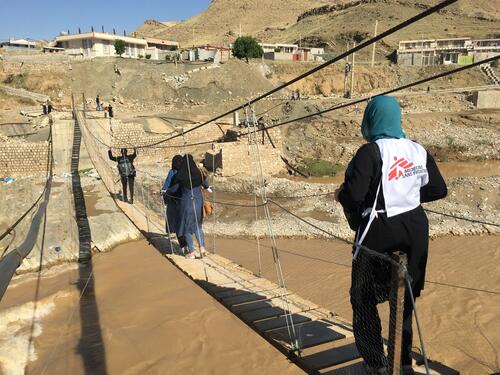
MSF Medical Team crossing Kyan Abad rope bridge to deploy a mobile clinic in Paran Parvis village on the ride side of Kashkan River.
Iran

Providing health care to vulnerable people in Lorestan after floods in Iran

Two months since violent flash floods stormed areas along the Kashkan River, in Lorestan province, west Iran, life is starting to return to normal. In Pol-e Dokhtar town, most of the sludge and rubble have been cleaned out while reconstruction of a few houses and shops are beginning in this devastated area. Project Update - 6 Jun 2019
 
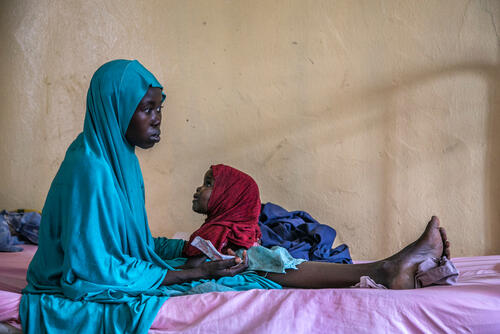
Fatima and her daughter, inside the MSF hospital in Pulka town, northeast Nigeria, close to the border with Cameroon. Fatima is 18-years-old from Geidem town, in the north-eastern Nigerian state of Yobe. She was only 14-years-old when members of a non-state armed group stormed her hometown. She was separated from her family and forced to marry. Fatima has spent the last four years living between the bush and a village in an area non-controlled by the Government. She arrived in Pulka in May. She is now staying in a camp for internally displaced people, along with her three-year-old son, Mustafa, and  18-month-old daughter, also called Fatima. Fatima is malnourished, and has diarrhoea and a fever.
Nigeria

Fighting to survive: Conflict in northeast Nigeria

Conflict has ravaged the northeastern Nigerian states of Borno, Adamawa and Yobe for a decade, displacing more than 2 million people and leaving nearly 8 million reliant on humanitarian assistance. This photo story describes the toll the conflict has taken, particularly on women. Photo Story - 5 Jun 2019
 
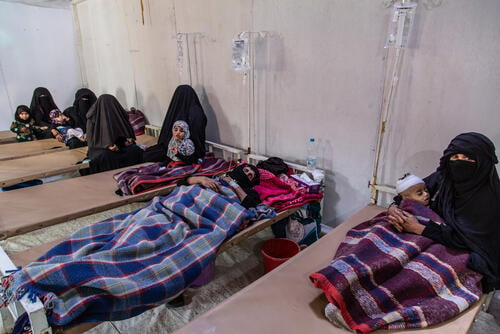
Yemen, Amran governorate, Khamer Cholera treatment Centre, 25 April 2019 - Women ward, Khamer CTC. Between 1 January and 26 March 2019, MSF has admitted 7,938 suspected cholera cases to its health facilities in Amran, Hajjah, Ibb and Taiz governorates, 50% of them coming from Ibb governorate. Over this period, the number of cholera patients treated by MSF increased from 140 to 2,000 per week. Results of rapid diagnostic tests done in MSF projects show that, in the same period, the percentage of cholera-positive cases increased from 58% to 70%.
MSF has scaled up its response: teams have opened a 42-bed cholera treatment centre in Khamer. Since March, there are around 30 patients every day in Khamer CTC, they are staying between 2 and 3 days. MSF teams have also increased the bed capacity of the cholera treatment unit in Taiz; have bolstered centres in Ibb and Kilo; and opened a cholera treatment centre in Al Kuwait hospital in Sana’a. During the last two weeks of April, our teams have observed a decrease of suspected cases in most of our projects. 
Cholera is endemic in Yemen: between 2016 and 2017, two waves of cholera hit the country. Although the disease was subsequently brought under control, health authorities and medical organisations have continued to see cholera cases in almost all governorates of the country since then.
Yemen

Endemic in Yemen, cholera still hits Yemenis hard

VIDEO REPORT: Although cholera is endemic in Yemen, a collapsed health system has resulted in waves of the disease over the last three years. Earlier this year, MSF teams saw yet another spike in cases, witnessing the impact on ordinary people struggling to cope. Project Update - 5 Jun 2019
 
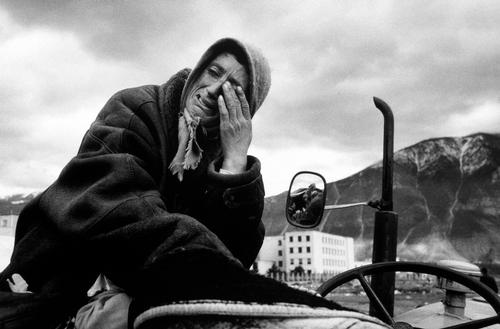
A pregnant woman, who has fled persecution in Kosovo, breaks down in a refugee camp in Kukes, a remote Albanian border town. 

During the civil war in Kosovo, thousands of people were forced to leave their home, and fled to Albania, Macedonia and Montenegro.
MSF Speaking Out

All Case Studies

In MSF, this means a willingness to speak on behalf of the people we seek to help: to bring abuses and intolerable situations to public attention. Through case studies, we openly examine and analyse our actions and decision-making processes during humanitarian emergencies that have led us to speak out. - 3 Jun 2019
 
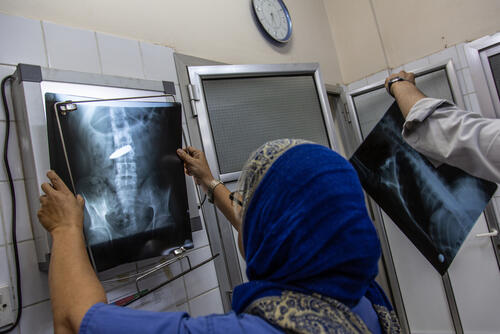
Yemen, Hodeidah, Al Salakhana hospital, 28 April 2019 - Maria Teresa Ingalla, ortho surgeon is watching the Xray of a patient injured by a gunshot in the abdomen. Mohammed, 18, was sitting in a street in Hodeidah, around 4.00pm when he was injured by a stray bullet: the bullet entered through his hip to his abdomen, next to one of his arteries. Luckily the bullet did not touch the spinal cord. It was removed after a laparotomy.
Yemen

A day treating wounded in Yemen's Al Salakhana hospital

VIDEO report: MSF teams started working in Al Salakhanah hospital, in the northeast of the port city of Hodeidah, Yemen, in September 2018 to provide care to the injured, including war-wounded civilians. Project Update - 30 May 2019
 
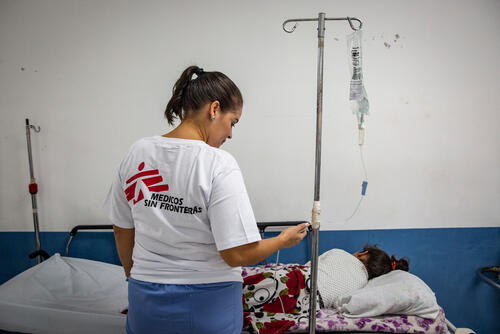
MSF medical staff checks on a 6 year old girl, hospitalized for Dengue fever at the Mario Catarino Rivas Hospital in San Pedro Sula. To ease the overcrowding of the hospital due to the recent alarming increase in dengue fever cases in Honduras this year, MSF has set up an emergency ward at the Mario Catarino Rivas Hospital where so far more than 850 patients have been treated. San Pedro Sula, April 10th, 2019.
Honduras

MSF expands efforts to control dengue epidemic in northern Honduras

MSF is ramping up its efforts to control the epidemic of dengue fever in northern Honduras’ Cortes department. Project Update - 29 May 2019
 
Amara is the youngest in a family of 10 children. Since her birth, she has suffered from chest and breathing problems, so she was admitted to the paediatric ward that MSF runs in Elias Haraoui Governmental Hospital in Zahle, where she stayed for 10 days. 
Amara’s mother, Rakad, is very grateful for the free services that her daughter received from MSF in the hospital. Since she was born, Amara’s health situation was putting burdens on her parents who can’t afford the cost of her treatment. 
Rakad lives with her husband and 10 children in a refugee settlement. In addition to Amara’s health problems, two of Rakad’s children suffer from a physical disability and require treatment. All that Rakad wishes for is that her children get better, and the situation in Syria goes back to normal so the family can return.

International Financial Report 2018

Annual Report - 28 May 2019
 
75-year-old Hassan is one of the community leaders in the village Ton-Habalan. He has 21 children with three wives: “Now that I am old, my grown up children work for me. Before, my work was to take care of my livestock. I do not have any education. But me and my family had many camels and goats. The big draught in 2017 killed almost all my livestock, and now we only have a very small number of livestock left. The biggest problem is water, most of the berkits (rainwater ponds) are now empty, and there is no water here. It is good that we have access to healthcare but we do not have water. It is now the driest season here. And also food is a problem, we don’t have enough and we did not get food and water distribution.”
Ethiopia

Bringing healthcare to places where no health posts exist

MSF runs 17 mobile clinics in Doolo zone, a vast, arid area in Ethiopia’s Somali region, where patient numbers have consistently increased, indicating that we are reaching the right places. Project Update - 27 May 2019
Four mothers posing in a corridor of the Hospital in Bili. All four of them are staying in the hospital with their child, that's suffering from a severe case of malaria. Since the beginning of the project in 2016, the pediatric ward already treated more than 4.000 cases of complicated/severe form of malaria.
Médecins Sans Frontières (MSF)

Independent medical humanitarian assistance

We provide medical assistance to people affected by conflict, epidemics, disasters, or exclusion from healthcare. Our teams are made up of tens of thousands of health professionals, logistic and administrative staff - most of them hired locally. Our actions are guided by medical ethics and the principles of independence and impartiality. We are a non-profit, self-governed, member-based organisation.

Learn more