





12,700
12,7
680
68
290
29
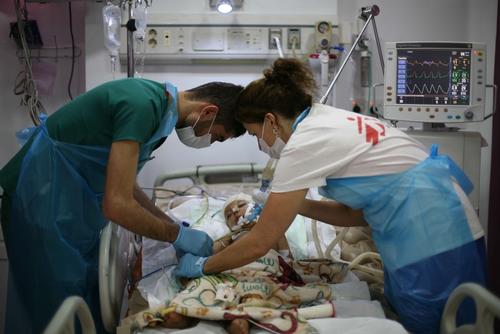
This was a year of political and economic upheaval in South Africa, with the leading political party losing control of several major cities following municipal elections in August. South Africans continued to make strident and often violent demands for better public services and accountable leaders.
KwaZulu-Natal province
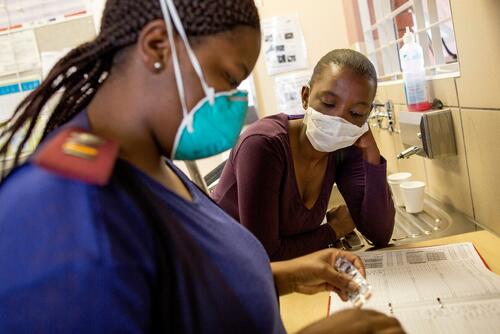
The MSF HIV/tuberculosis (TB) project in uThungulu district, which covers a population of 114,000, is still aiming to be the first site in South Africa to meet the ambitious UNAIDS 90-90-90 targets.Globally endorsed HIV treatment targets that aim, by 2020, for more than 90 per cent of people living with HIV to be aware of their status; 90 per cent of those diagnosed to be initiated on antiretroviral (ARV) treatment; and 90 per cent of those on ARVs to achieve viral suppression. A report, Bending the Curves of the HIV/TB Epidemic in KwaZulu-Natal, outlined the project’s community-oriented approach to increasing integrated HIV testing and TB screening as well as access and adherence to HIV treatment, with the aim of influencing the South African government’s future strategy for meeting 90-90-90 treatment targets nationally. In 2016, 56,029 individuals were tested, 2370 male circumcisions were supported and 1.5 million condoms were distributed.
Khayelitsha
The Khayelitsha project near Cape Town continues to develop and implement treatment regimens for MDR-TB and innovative models of care for patients living with HIV and TB.
In 2016, the team focused on developing models of care to support specific at-risk groups, such as pregnant women and their infants, adolescents and men. Thirteen postnatal ‘Moms and Tots’ clubs were established in partnership with the city of Cape Town and NGO mothers2mothers, enabling women to access one-stop services for HIV and other health issues for both themselves and their babies, thereby improving adherence to treatment.
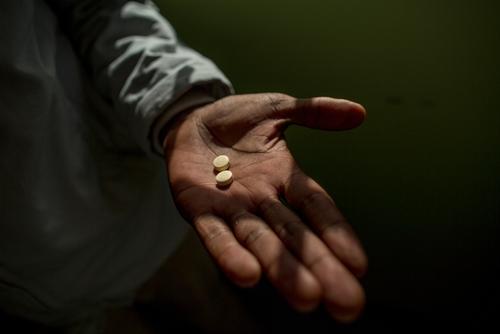
Throughout 2016, MSF fought for access to new TB drugs for eligible patients, both in Khayelitsha and nationally. South Africa now has national access to the new TB drug, bedaquiline, and in Khayelitsha, MSF has the largest national cohort on another promising new medication, delamanid, with 61 new patients initiated on treatment this year. MSF also supports the Western Cape Department of Health to offer ‘strengthened treatment’ regimens to drug-resistant TB patients.
Rustenburg
MSF continued to support the Department of Health in North West province to expand access to care for victims of sexual violence in Rustenburg, in South Africa’s platinum mining belt.
The results of an MSF survey of 800 Rustenburg women between the ages of 18 and 49, which were published in 2016 in a hard-hitting report, Untreated Violence show that one in four women in Bojanala district have been raped in their lifetime. Half have experienced some form of sexual or intimate partner violence, but 95 per cent of women had never told a health facility about their assault.
MSF supports three Kgomotso care centres, primary healthcare facilities that provide an essential package of medical, legal and psychosocial care to victims of sexual violence, with the aim of preventing illness and reducing the suffering associated with rape. The package includes a forensic examination, post-exposure prophylaxis (PEP) to prevent HIV and other sexually transmitted infections, and psychosocial support and counselling. In 2016, 290 victims of sexual violence were treated, and all of those eligible received essential medication and/or psychological care.
In addition to working with the provincial health authorities in Rustenburg, MSF continued to advocate nationally for increased access to services at healthcare facilities for victims of sexual violence.
Fix the Patent Laws
Launched in 2011 with MSF as a founding member, the Fix the Patent Laws coalition consists of 32 patient groups and organisations that campaign for reform of South Africa’s intellectual property laws to address obstacles to national access to affordable medicines. Following years of pressure, the South African Department of Trade and Industry released a new intellectual policy consultative framework in July 2016. In September, the coalition published a report entitled Patent barriers to medicine access in South Africa, comprehensively making the case for patent law reform in the country. The coalition continues to exert pressure on the government to expedite legislative reform.
Stop Stockouts
The Stop Stockouts Project is a civil society consortium supported by MSF and five other organisations, which monitors availability of essential drugs in clinics across the country and pushes for the rapid resolution of stockouts and shortages. Communities are trained on how to report stockouts and national health authorities are encouraged and if needed, pressured, to advocate the reform of supply chains. In 2016, the project received 605 reports of stockouts through its national hotline, and trained 3,454 patients and community activists. It also secured a three-year grant from the European Union to continue its current operations.
224
224
7.6 M
7.6M
1999
1999
Find us online
Patient story
Sinethemba Kuse – 17, from Khayelitsha, was one of the first multidrug-resistant TB patients initiated on delamanid in South Africa.
“Just imagine being told that you have MDR-TB just before Christmas. The same day the doctor gave me tablets and I also got an injection. The injections were painful. I was scared of the needle because I had to be injected every day. Sometimes I would bleed and I even got lumps. I swallowed a lot of tablets, so I would vomit or be dizzy. Later, we were told about a new medication that is available in Khayelitsha that not a lot of people are lucky enough to have. Dr Jenny [Hughes] of MSF explained more about this new drug called delamanid. In February 2015, I started taking it. All I can say is that there is hope. I trusted it with my life and it worked. My gran and everybody started noticing the difference – even my gran’s church friends saw the change.”
Learn More![Sinethemba in the streets outside the home she shares with her grandmother and four other family members, Zone C29, Khayelitsha, Western Cape.
Sinethemba, 16 years, lives with her grandmother, Vuyisiwa Madubela, and four other family members in a two-bedroomed home in Zone C29, Khayelitsha, Western Cape, South Africa.
Her grandmother’s determination and love, combined with receiving a six-month trial of one the newest DR-TB drugs on the market likely saved her life this year.
Current regimen: delamanid, linezolid, pyrazinamide, ethambutol, clofazimine, high dose levofloxacin, terizidone.
Grandmother Vuyisiwa Madubela:
“Sinethemba’s mother died when she was 6 months old, she was taken [raised] by my elder daughter who also died last December.
She’s from PE (Port Elizabeth) and when I arrived there for the funeral I saw Sinethemba was very sick – thin, weak, shaking, very pale, sleeping, very high temperature . She was very quiet. I hadn’t seen her for a long time, nearly three years.
On the day of the funeral, the senior sister in the area called me – “Can you take her? This child is sick… “
I thought I was going to lose her. It was painful as I’ve lost three children. I used say ‘if I lose one child, I’ll die; I was thinking: I’ve lost her mum, and she’s going to die too.’
During her first month with us in Khayelitsha, it was terrible - she wouldn’t eat. We’d all just watch her. Everyone was sad. When I wanted to cry, I had to go outside.
On 12 December 2015, she had X-rays, and they took sputum. They called and said I had to come immediately, she had MDR-TB and they were putting her in Brooklyn Chest Hospital.
That day, I lost hope. I thought she was going to die. If she stayed in PE, she would have died.
By end December 2015 she started MDR treatment with kanamycin injections, as well as the other drugs – they said she could go deaf because of the side effects of the injection. She had to go to the clinic Monday to Friday, every day.
It was painful and some days she asked not to go. In February 2016, her sputum showed that she was resistant to the injection, so they applied for new drugs to change her treatment.
In February 2016, MSF came and explained that they could apply for a new drug for Sinethemba called delamanid if I gave my permission for her to take part, because the drug is not usually available for TB patients in South Africa. We met with a counsellor, and got a lot of information.
The first few days she had nausea, wanting to vomit. I sat her down and I said: “You have to accept this; you must talk to your tablets. You must give them an order: ‘I am in charge.’”
Not even a month later, she started speaking, even dancing. She’s going to church, she’s singing in the church choir. Everyone could see there was an improvement and they wanted to know what happened. She’s going for an electrocardiogram (ECG) every month and it’s normal.
Last year was very hard for the whole family, but from February when she started delamanid, she didn’t take a long time to get better.
The only problem is now she eats everything. We have to dish up twice! She’s gained weight.
When she went for her last x-ray they told me they don’t see any signs of TB in her chest.
Sinethemba hasn’t been to school this year, I was told that she wouldn’t cope, that the treatment would make her drowsy, sleepy. We’ve been told she can go next year.
Everyone could see there was improvement. Everyone wanted to know.
What would I like to tell the manufacturer of delamanid?
I would ask the manufacturer of delamanid to give it to every patient who really needs it. I see lots of TB patients at the TB clinic. If people got this drug, they could really control DR-TB. TB is a giant but not a killer. TB can be cured.”](https://img.msf.org/AssetLink/f31lbo56u8u05c8imar6urfc86637n67.jpg "Sinethemba- MSF Treatment For TB in South Africa.")