




12,700
12,7
680
68
290
29
2016, année de troubles politiques et économiques en Afrique du Sud, a vu le principal parti politique perdre le contrôle de plusieurs grandes villes après les élections municipales d’août. Les Sud-Africains ont continué de réclamer, avec véhémence et souvent violence, des services publics plus performants et des dirigeants responsables.
Province du KwaZulu-Natal
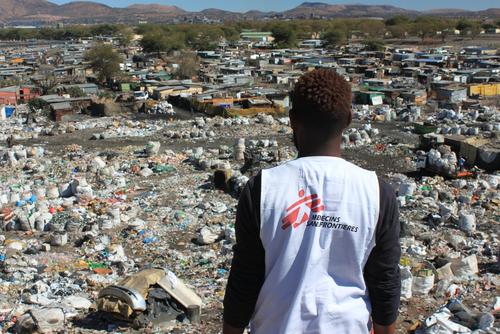
Dans le district d’uThungulu, qui compte 114000 habitants, Médecins Sans Frontières (MSF) gère un projet VIH/tuberculose (TB) qui vise toujours à être le premier site d’Afrique du Sud à atteindre les objectifs ambitieux 90-90-90 d’ONUSIDA.Objectifs de lutte contre le VIH approuvés à l’échelon mondial : d’ici 2020, plus de 90% des personnes vivant avec le VIH connaissent leur séropositivité, 90% des personnes diagnostiquées sont mises sous antirétroviraux (ARV) et 90% des patients sous ARV ont une charge virale indétectable. Un rapport intitulé Bending the Curves of the HIV/TB Epidemic in KwaZulu-Natal décrit l’approche communautaire adoptée par ce projet pour étendre le dépistage intégré du VIH et de la TB ainsi que l’accès au traitement du VIH et son observance. Il entend ainsi influencer la future stratégie du gouvernement sud-africain pour atteindre les objectifs de traitement 90-90-90 à l’échelon national. En 2016, le projet a permis de dépister 56029 individus d’aider à circoncir 2’370 hommes et de distribuer plus de 1,5 million de préservatifs.
Khayelitsha
Le projet de Khayelitsha, près du Cap, développe et met en œuvre des schémas thérapeutiques pour soigner la TB-MR et des modèles de soins novateurs pour les patients coinfectés par le VIH et la TB.
En 2016, l’équipe s’est concentrée sur l’élaboration de modèles de soins pour des groupes à risque spécifiques, tels que les femmes enceintes et leurs bébés, les adolescents et les hommes. Treize clubs post-natals « Mamans et bébés », créés en partenariat avec la ville du Cap et l’ONG mothers2mothers, ont permis à des femmes d’accéder à des « guichets uniques » pour le VIH et d’autres problèmes de santé pour elles-mêmes et leurs bébés, ce qui a amélioré l’observance du traitement.
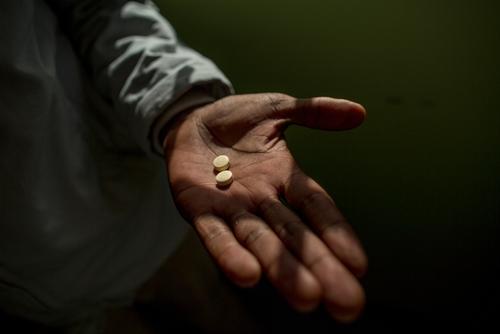
En 2016, MSF n’a cessé de plaider pour l’accès à de nouveaux médicaments pour les patients admissibles, tant à Khayelitsha que dans l’ensemble du pays. L’Afrique du Sud a accès au niveau national à la bédaquiline, un nouvel antituberculeux. À Khayelitsha, MSF a mis la plus grande cohorte nationale sous un autre antituberculeux prometteur, le délamanide : 61 nouveaux patients ont débuté ce traitement cette année. MSF aide en outre le département de la Santé du Cap occidental à offrir des « traitements renforcés » aux patients atteints de TB résistante.
Rustenburg
MSF a poursuivi son soutien au département de la Santé de la province du Nord-Ouest pour étendre l’accès des victimes de violence sexuelle aux soins à Rustenburg, dans la ceinture sud-africaine d’exploitation du platine.
Les résultats d’une enquête menée par MSF parmi 800 habitantes de Rustenburg âgées de 18 à 49 ans, ont été publiés en 2016 dans un rapport très dur, Untreated Violence, qui montre qu’une femme sur quatre dans le district de Bojanala a été violée au cours de sa vie. La moitié a connu une forme de violence sexuelle ou conjugale mais 95% d’entre elles n’ont jamais parlé de leur agression à un centre de santé.
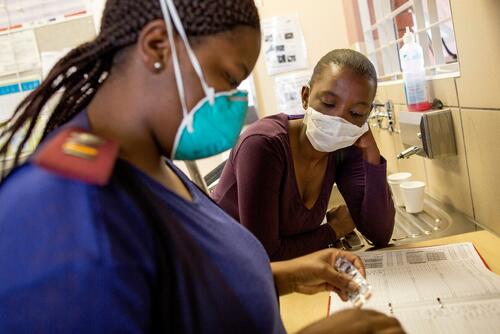
MSF soutient trois centres de santé Kgomotso, des structures de soins primaires qui offrent un ensemble de services médicaux, juridiques et psychosociaux essentiels aux victimes de violence sexuelle, en vue de prévenir des maladies et de réduire la souffrance liée au viol. Ces centres proposent des examens médico-légaux, une prophylaxie post-exposition (PPE) pour prévenir le VIH et d’autres maladies sexuellement transmissibles, ainsi qu’un soutien psychosocial et du conseil. En 2016, 290 victimes de violence sexuelle ont été traitées et toutes celles qui étaient éligibles ont reçu des médicaments essentiels et/ou des soins psychologiques.
Outre son travail avec les autorités sanitaires provinciales à Rustenburg, MSF poursuit son travail de plaidoyer au niveau national pour que les victimes de violence sexuelle bénéficient d’un accès renforcé aux services des centres de santé.
Modifier la législation sur les brevets
Fondée en 2011 par MSF, la coalition Fix the Patent Laws (corriger la législation sur les brevets) se compose de 32 groupes de patients et d’organisations qui font campagne pour réformer la loi sud-africaine sur la propriété intellectuelle afin de lever les obstacles à un accès national à des médicaments abordables. Après des années de pression, le département sud-africain du Commerce et de l’Industrie a publié, en juillet 2016, un nouveau cadre consultatif sur la propriété intellectuelle. En septembre, la coalition a publié un rapport intitulé Patent barriers to medicine access in South Africa, qui rassemble tous les arguments en faveur d’une réforme de la loi sur les brevets dans le pays. Cette coalition continue d’exhorter le gouvernement à accélérer cette réforme.
Stop aux ruptures de stocks
Le projet Stop aux ruptures de stocks est un consortium de la société civile soutenu par MSF et par cinq autres organisations, qui surveille la disponibilité de médicaments essentiels dans les cliniques du pays et fait pression pour une résolution rapide des ruptures de stocks et pénuries. Les communautés sont formées pour signaler ces ruptures de stocks et les autorités sanitaires nationales sont encouragées, voire exhortées, à plaider pour une réforme des circuits d’approvisionnement. En 2016, ce projet a reçu 605 signalements de ruptures de stocks via sa ligne d’appel nationale et a formé 3454 patients et militants communautaires. Il a aussi obtenu un financement de trois ans de l’Union européenne pour poursuivre ses activités actuelles.
224
224
7.6 M
7.6M
1999
1999
Histoire de patient
SINETHEMBA KUSE – Sinethemba Kuse, 17 ans, de Khayelitsha, a été parmi les premiers patients mis sous délamanide
« Imaginez qu'on vous dise, juste avant Noël, que vous avez la TB-MR. Le jour même, le médecin m'a donné des comprimés et aussi une injection. Les injections étaient très douloureuses. J'avais peur de l'aiguille parce que ces injections étaient quotidiennes. Parfois je saignais et j'ai même eu des kystes. J'ai avalé beaucoup de comprimés. Je vomissais ou la tête me tournait. Plus tard, on nous a parlé d'un nouveau médicament disponible à Khayelitsha, le délamide, mais peu de malades avaient la chance de le recevoir. Dr Jenny [Hughes] de MSF a donné plus d'explications. En février 2015, j'ai commencé à le prendre. Tout ce que je peux dire c'est qu'il y a de l'espoir. J’ai misé ma vie et cela a fonctionné. Ma grand-mère et tout le monde ont commencé à voir la différence — même les amis de ma grand-mère à l’église l’ont vue. »
![Sinethemba in the streets outside the home she shares with her grandmother and four other family members, Zone C29, Khayelitsha, Western Cape.
Sinethemba, 16 years, lives with her grandmother, Vuyisiwa Madubela, and four other family members in a two-bedroomed home in Zone C29, Khayelitsha, Western Cape, South Africa.
Her grandmother’s determination and love, combined with receiving a six-month trial of one the newest DR-TB drugs on the market likely saved her life this year.
Current regimen: delamanid, linezolid, pyrazinamide, ethambutol, clofazimine, high dose levofloxacin, terizidone.
Grandmother Vuyisiwa Madubela:
“Sinethemba’s mother died when she was 6 months old, she was taken [raised] by my elder daughter who also died last December.
She’s from PE (Port Elizabeth) and when I arrived there for the funeral I saw Sinethemba was very sick – thin, weak, shaking, very pale, sleeping, very high temperature . She was very quiet. I hadn’t seen her for a long time, nearly three years.
On the day of the funeral, the senior sister in the area called me – “Can you take her? This child is sick… “
I thought I was going to lose her. It was painful as I’ve lost three children. I used say ‘if I lose one child, I’ll die; I was thinking: I’ve lost her mum, and she’s going to die too.’
During her first month with us in Khayelitsha, it was terrible - she wouldn’t eat. We’d all just watch her. Everyone was sad. When I wanted to cry, I had to go outside.
On 12 December 2015, she had X-rays, and they took sputum. They called and said I had to come immediately, she had MDR-TB and they were putting her in Brooklyn Chest Hospital.
That day, I lost hope. I thought she was going to die. If she stayed in PE, she would have died.
By end December 2015 she started MDR treatment with kanamycin injections, as well as the other drugs – they said she could go deaf because of the side effects of the injection. She had to go to the clinic Monday to Friday, every day.
It was painful and some days she asked not to go. In February 2016, her sputum showed that she was resistant to the injection, so they applied for new drugs to change her treatment.
In February 2016, MSF came and explained that they could apply for a new drug for Sinethemba called delamanid if I gave my permission for her to take part, because the drug is not usually available for TB patients in South Africa. We met with a counsellor, and got a lot of information.
The first few days she had nausea, wanting to vomit. I sat her down and I said: “You have to accept this; you must talk to your tablets. You must give them an order: ‘I am in charge.’”
Not even a month later, she started speaking, even dancing. She’s going to church, she’s singing in the church choir. Everyone could see there was an improvement and they wanted to know what happened. She’s going for an electrocardiogram (ECG) every month and it’s normal.
Last year was very hard for the whole family, but from February when she started delamanid, she didn’t take a long time to get better.
The only problem is now she eats everything. We have to dish up twice! She’s gained weight.
When she went for her last x-ray they told me they don’t see any signs of TB in her chest.
Sinethemba hasn’t been to school this year, I was told that she wouldn’t cope, that the treatment would make her drowsy, sleepy. We’ve been told she can go next year.
Everyone could see there was improvement. Everyone wanted to know.
What would I like to tell the manufacturer of delamanid?
I would ask the manufacturer of delamanid to give it to every patient who really needs it. I see lots of TB patients at the TB clinic. If people got this drug, they could really control DR-TB. TB is a giant but not a killer. TB can be cured.”](https://img.msf.org/AssetLink/f31lbo56u8u05c8imar6urfc86637n67.jpg "Sinethemba- MSF Treatment For TB in South Africa.")
© Sydelle WIllow Smith/MSF