


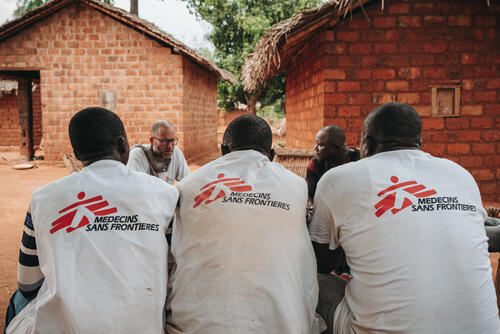

Ebola disease in DRC: find out how we're responding
Learn more
8003 Results
 
Susana small village -  MSF base -prevention work & sensibilisation. 
After an initial assessment in Guinea Bissau, where the epidemic is quickly spreading, MSF sent a charter plane with more than 70 tons of medical and logistical supplies. An Antonov 124 left last Saturday night from Ostende airport in Belgium. The freight contains cholera kits to treat 3,000 people, first aid kits, 2,400 meters of plastic sheeting, 12 dispensary tents to set up cholera treatment centres, water tanks as well as 1,200 jerry cans and spraying equipments.
Africa

Guinea-Bissau

We left Guinea-Bissau in June 2020. Country
 
Port-au-Prince, Haiti, Monday, June 21, 2022.
   After being treated and stabilized by the MSF team in Turgeau, these patients, victims of a road accident, were discharged from the hospital and returned home.
  MSF/Johnson Sabin
The Americas

Haiti

Political instability, an earthquake in August 2021, a fuel crisis and chronic violence have pushed the healthcare system in Haiti to its limits as needs are on the rise. Country
 
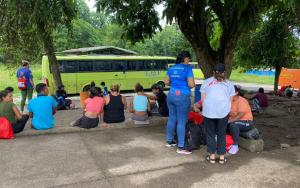
Monument to the Mother Park is a small park located in Danlí, which in recent weeks has become an improvised refuge for migrants.
The Americas

Honduras

Honduras has experienced years of political, economic and social instability, and has one of the highest rates of violence in the world. This has great medical, psychological and social consequences for people. Country
 
An MSF cultural mediator along with a nurse explain to a patient how to use a wound kit during a medical consultation of the MSF mobile clinic in Horgos 2 border crossing area in Serbia. In 2022 MSF is operational in informal settlements at the Serbian-Hungarian and Serbian-Romanian borders, with two mobile clinics providing primary health care, psycho-social support and health promotion activities, assessing and treating patients for physical injuries allegedly as a result of border violence.
Europe & Central Asia

Hungary

MSF supported refugees in Hungary in 2022. Country
 
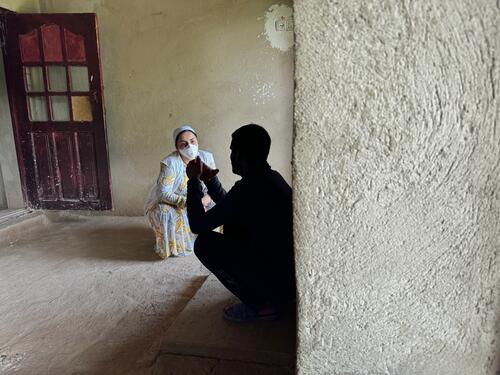
An MSF staff member converses with Anam (name changed), a 17-year-old DRTB (Drug Resistant Tuberculosis) patient and her mother outside the MSF DRTB Clinic, Chembur, Mumbai.


Anam (name changed on request), a bright 17-year-old, excels not only at English and Science in school but is an equally good Mehndi/henna artist. She tells us happily that she has completed a professional Mehndi course and learnt needlework. She aspires to become a fashion designer. 
She scrolls through her phone gallery, bringing up photos of the bridal henna designs that she has created. As her hand moves over the screen, there is a contrast between those delicate designs and the pattern on her own hand from the PICC Line (Peripherally Inserted Central Catheter).
Anam was first diagnosed with pulmonary TB at the age of nine. Before her diagnosis, she frequently had a cough and a fever. When her mother initially took her to a doctor, she was suspected of having double typhoid. 
Being diagnosed with TB at such a young age came as a blow to Anam’s family, who had no history of the disease.  Her mother later got to know that Anam studied with around eight to ten TB positive patients in school. The stigma around the disease is so strong that other children or their families never informed the school authorities. The parents feared that their children would be expelled, bullied, harassed or discriminated against. Anam’s mother decided that it was important to break this lethal chain. She informed the Principal and did not send Anam to school for the next five months. 
For 14 months, Anam received treatment at a private hospital with support from her immediate family and friends. However, the treatment did not work and her symptoms such as weight loss and vomiting worsened. The treatment at the private hospital cost her family around Rs 5,500 monthly (Rs 2,500 for medicines and Rs 3,000 for tests). In February 2021 she was finally diagnosed with drug-resistant tuberculosis (DR-TB) at a government DR-TB centre.  She was put on a DR-TB regimen, however subsequent investigations revealed additional resistance to other drugs as well. She suffered from cough, fever and weight loss. Since her condition was not improving with the treatment received so far, she ultimately came to MSF.  
At the MSF Clinic, Anam was put on a regimen of the oral drugs bedaquiline, delamanid, linezolid and amoxicillin, and an intravenous treatment with the injection imipenem. This regimen was built for her based on her resistance to certain drugs and she has been taking it for the last one and a half years.  
Anam’s mother says, “We have been through a very rough patch, but we found help every step of the way. The psychosocial support in terms of counselling, and the medical support that we received at the MSF clinic reduced our financial and medical treatment worries.”
Despite constant encouragement and support, every day Anam is also witness to another TB story unfolding outside her bedroom window. The impact of stigma and lack of awareness about TB is having serious consequences for a girl not much older than Anam in the neighbouring house. Anam recalls distraught conversations with her ‘window friend’: how she has been locked inside her room because of the disease; how her parents have abandoned her; and the irregularity of her meals. Anam’s mother says that their neighbours don’t allow other community members to help them. Bereft of medical and psychosocial support, her ‘window friend’ developed suicidal tendencies that resulted in one failed attempt to jump off the roof.  
Anam realises that her friend’s parents may have prevented the suicide attempt, yet they contributed nothing to alleviating the everyday suffering. No proper treatment is sought, she says. Anam’s mother tried to counsel the girl’s parents but they are reluctant to listen to anyone.
The story of Anam and her ‘window friend’ highlights the importance of medical treatment and psychosocial support in TB treatment, and the importance of raising awareness around the disease and fighting stigma.  And for Anam, even a small dream like hanging out with friends on a vacation post-recovery, keeps her going.
Asia & Pacific

India

In India, we focus mainly on mental healthcare, screening and treatment for HIV, tuberculosis (TB) and hepatitis C, and support to victims of sexual and gender-based violence. Country
 
The MSF Indonesia adolescent health project focused on improving the quality of, and access for adolescents to, targeted health services, including health promotion and education sessions. Capacity building was one of the activities in this project, and health workers were trained on the topic of adolescent sexual reproductive health.
Asia & Pacific

Indonesia

Learn about MSF projects in Indonesia, where we work on emergency preparedness. Country
 
MSF Medical Team crossing Kyan Abad rope bridge to deploy a mobile clinic in Paran Parvis village on the ride side of Kashkan River.
Middle East & North Africa

Iran

MSF provides free healthcare to excluded and marginalised groups in south Tehran, including drug users, sex workers, street children and the ghorbat ethnic minority. ​​​ Country
 
MSF health promoter is talking to one of the visitors of the Sinuni general hospital, she is explaining the mental health services that MSF is providing in Sinuni.
Middle East & North Africa

Iraq

Learn about MSF projects in Iraq, where the health sector is struggling to meet the dire needs. Country
 
On 27 April 2023, the 75 survivors, including many women and children, have finally touched the ground in Naples. We hope they will receive the assistance and protection they deserve and need.
Europe & Central Asia

Italy

In Italy, we address the needs of migrants and people on the move. Country
 
The MSF team is conducting an exploratory research in Tateno, Minami-aso village, Kumamoto prefecture.
Asia & Pacific

Japan

MSF has responded to natural disasters in Japan in 2011 and 2016, and the COVID-19 pandemic in 2020. Country
Four mothers posing in a corridor of the Hospital in Bili. All four of them are staying in the hospital with their child, that's suffering from a severe case of malaria. Since the beginning of the project in 2016, the pediatric ward already treated more than 4.000 cases of complicated/severe form of malaria.
Médecins Sans Frontières (MSF)

Independent medical humanitarian assistance

We provide medical assistance to people affected by conflict, epidemics, disasters, or exclusion from healthcare. Our teams are made up of tens of thousands of health professionals, logistic and administrative staff - most of them hired locally. Our actions are guided by medical ethics and the principles of independence and impartiality. We are a non-profit, self-governed, member-based organisation.

Learn more