



Ebola disease in DRC: find out how we're responding
Learn more
7996 Results
 
Nurse supervisor Joseph Azeem (left) and lab supervisor James Primo share a moment of camaraderie. Joseph is a long-time nurse for MSF who began his career as a national staff in Pakistan after the 2005 earthquake that hit his country. James is South Sudanese and moved to Doro to work with MSF in the camp.
Work with MSF

Minimum field requirements

Every year, thousands of international MSF field staff provide lifesaving medical assistance to people who would otherwise be denied access to even the most basic health care. To work in the field with MSF, every applicant must meet this list of general requirements.
 
Community Mental Health worker holding MSF jacket and planner.​
Accountability and transparency

Promoting a work environment free of harassment, exploitation and abuse

We expect all staff to abide by our professional code of ethics. Our leadership has unequivocally committed to fight abuse and to reinforce mechanisms and procedures to prevent and address it. This includes enhancing grievance channels at all levels of the organisation, and supporting victims and whistle-blowers.
 
A patient with malaria being treated by an MSF doctor. In the nort-east Nigerian town of Gwoza, patients are brought to the MSF health centre in a customised three wheeler called a keke napep.
Nigeria

Crisis update: Borno and Yobe states, June 2018

Nine years of conflict between the Nigerian military and armed groups in northeast Nigeria has taken a heavy toll on the population with serious humanitarian consequences. Crisis Update - 5 Jun 2018
 
Nidal Ahmed Dahud is pictured with her son Amir Bassam Al Ahmed (1 year and a half) at MSFs clinic in Jandoula (Lebanon). Nidal is originally Palestinian and used to live in Tripoli, in Nahr al Bared camp. When she married someone from Wadi Khaled, she moved there. “Life in Wadi Khaled is extremely difficult. Families are big and services expensive. So everybody knows about MSF over here. This centre is essential for people, it’s our only resource when there is an issue with our children”, she comments. Nidal came to the MSF clinic today because her son has fever. “This is the second time I come here” she says. “The fact that services are free makes a huge difference. If I went to the doctor today, I would have to pay between 30 and 40$ for a consultation. I have 9 children and my husband is the only breadwinner in the family, so we simply cannot afford that.”
Child health

Paediatrics in West Africa: small patients, big diseases

Most West African and Sahelian countries face a significant number of childhood illnesses and diseases each year, mostly related to climate change or instability in the region. In the coming months, these countries will also contend with the usual peaks, when malaria and malnutrition are particularly risky. Health workers, paramedics and community agents are preparing once again to ensure that they do not severely affect the communities in the region. Project Update - 1 Jun 2018
 
A woman dances during a Stop Stock Outs Project activist meeting  in Soshanguve, a township outside of Pretoria on April 16, 2015. As a grassroots project, SSP regularly organizes training for people living with HIV in order to equip them on the know how to monitor and report drug shortages.
South Africa

Country takes landmark step for access to medicines

MSF applauds effort to ‘take off patent blindfold’ and change patent laws to increase access to affordable medicines
Press Release - 31 May 2018
 
Women carry Medecins Sans Frontieres (MSF) equipment as the medical team moves from one location to the other to be flown out of the area after having finished their work at various MSF outdoor support clinics, close to Thaker, Leer County, South Sudan, March 23, 2017.
South Sudan

People caught in the frontlines of intense fighting in country’s north

Since the end of April, the conflict-ravaged counties of Leer and Mayendit, in South Sudan’s north, have once again been wracked by violence. Thousands of people are caught between the frontlines of the fighting, and health facilities have been attacked. The high level of violence prevents many people from reaching basic services, including healthcare. Press Release - 31 May 2018
 
Gloria Chipasula (Left), 11 years old, HIV and TB positive patient, stands outside her family house as MSF international staff doctor from Rwanda checks her X-Ray looking for TB evidences.

International Financial Report 2017

Annual Report - 30 May 2018
 
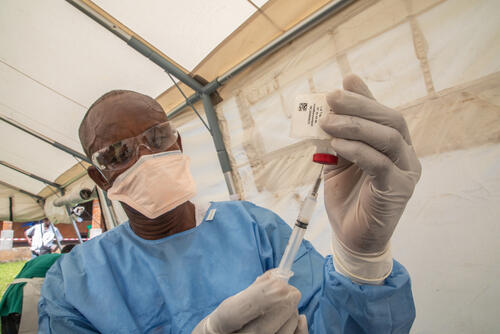
Frontline worker been vaccinated in Bikoro, Equateur Province, DRC.
Participants to the vaccination receive information on the vaccine before consenting, and will be carefully monitored over a period of time. Participation is voluntary and the vaccination is free.
DRC Ebola outbreaks

MSF starts Ebola vaccination targeting remote communities

Médecins Sans Frontières (MSF) yesterday started vaccinating Ebola frontline workers in Bikoro, Equateur Province, Democratic Republic of Congo (DRC), where teams have been working with the Ministry of Health and the World Health Organization (WHO) over the past few weeks. The trial vaccination will also be offered to contacts of patients. Press Release - 29 May 2018
 
Mary Horgan, MSF specialist psychologist, and Kumbulani Kaliwo, MSF social worker, in the corridors of the Queens Elizabeth Hospital in Blantyre where MSF runs the cervical cancer project.

Resource centre

We believe in openness, honesty and self-reflection as a way to constantly improve our work. Evaluation and operational research contribute to better understanding the contexts we work in and the projects we implement. This helps improve the effectiveness and quality of the medical care we deliver, and provides us with the tools to convince others to take action or change their treatment protocols.
 
Dr Abdu Samya Bashagha checking X-ray scan of a patient in Abu Sitta Hospital where MSF is running TB support activities

Resource centre

Our medical research helps us improve the medical care we deliver, as well as helping other medical practitioners in the field. We produce medical guidelines in a number of languages - including in French, Arabic and Spanish - for a number of different diseases and medical protocols. We also produce drug procurement guidelines, a list of essential medicines, and information for drug manufacturers on having their medicines qualified for use by MSF.
Four mothers posing in a corridor of the Hospital in Bili. All four of them are staying in the hospital with their child, that's suffering from a severe case of malaria. Since the beginning of the project in 2016, the pediatric ward already treated more than 4.000 cases of complicated/severe form of malaria.
Médecins Sans Frontières (MSF)

Independent medical humanitarian assistance

We provide medical assistance to people affected by conflict, epidemics, disasters, or exclusion from healthcare. Our teams are made up of tens of thousands of health professionals, logistic and administrative staff - most of them hired locally. Our actions are guided by medical ethics and the principles of independence and impartiality. We are a non-profit, self-governed, member-based organisation.

Learn more