


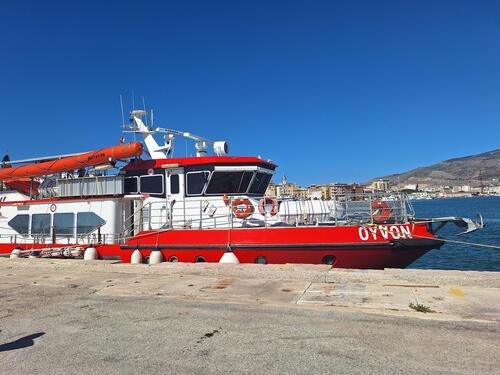
On Monday, 31 August, the Oyvon, a search and rescue vessel operated by Médecins Sans Frontières (MSF), rescued 18 people in distress on the central Mediterranean Sea. Most were Eritrean, and 12 were unaccompanied minors, including one young girl.
The rescue took place within the Maltese search and rescue zone, and the survivors were brought to Trapani, Sicily, which the Italian authorities designated as the place of safety on Tuesday, 1 September.
“The people we rescued, many of them children, had left Libya over 24 hours earlier,” says Leah Kenny, Humanitarian Affairs Coordinator aboard Oyvon. “By the time we reached them, they were exhausted, adrift in international waters and out of fuel.”
The Mediterranean route is still deadly for migrants
The sea journey across the central Mediterranean has been one of the world's deadliest migration routes for more than a decade, according to the International Organization for Migration (IOM).
“Since 2015, more than 35,000 people have been recorded dead or missing in the Mediterranean, and these figures likely underestimate the true scale of the tragedy,” adds Kenny.
Since 2015, more than 35,000 people have been recorded dead or missing in the Mediterranean, and these figures likely underestimate the true scale of the tragedy.Leah Kenny, Humanitarian Affairs Coordinator aboard Oyvon
Search and rescue activities remain essential. MSF has conducted search and rescue operations in the central Mediterranean since 2015, rescuing more than 94,000 people across nine different vessels.
“People on the move face increasing violence at sea and along migration routes, including dangerous and violent interceptions,” says Claire San Filippo, MSF search and rescue representative. “Humanitarian rescue vessels are also subjected to harassment, intimidation, and armed attacks, often by the EU-funded Libyan or Tunisian Coast Guards, putting both survivors and rescue teams at risk. This is unacceptable.”
Restrictive migration policies continue to endanger lives
Current EU policies restricting rescue vessels or criminalising NGOs do not prevent people from attempting the crossing. People flee because of what they are escaping, not because we are present at sea.
European governments must stop their continued outsourcing of migration management to third countries, including equipping and funding their Coast Guards to intercept and push back people at sea.
“For some of the people we rescued, this was not their first attempt to make the crossing,” says Kenny. “They had previously been intercepted and forcibly returned to Libya by the EU-funded Libyan Coast Guard. Libya is not a place of safety, and the EU's support for operations that return people there exposes them to the risk of serious human rights violations.”
Libya is not a place of safety, and the EU's support for operations that return people there exposes them to the risk of serious human rights violations.Leah Kenny, Humanitarian Affairs Coordinator aboard Oyvon
“This directly contravenes the principle of non-refoulement, to which EU Member States are bound,” she says.
MSF teams have heard countless testimonies about how people who are forcibly returned to Libya face a cycle of arbitrary detention, violence, torture, and extortion. This is not a safe nor legal response to migration.
All of this is the result of the deadly policies of the EU and its Member States. Saving lives at sea should not be controversial. It is a legal obligation, a human and ethical duty, and Europe is failing it.

Yemen
Yemen: Renewed fighting puts pressure on the health system and increases people's humanitarian needs
Project Update
15 Sep 2026