


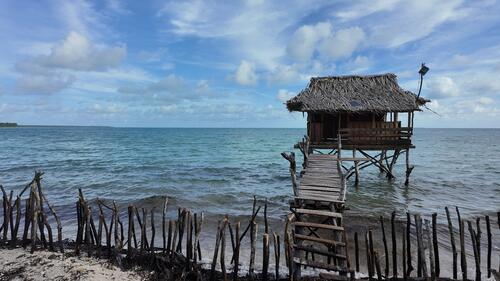
At Tabontebike primary school on the remote atoll of Abaiang, Kiribati, the school bell rings out, signalling the start of recess. Children stream out from classrooms, bare feet racing towards the shade of breadfruit trees through the mid-morning humidity.
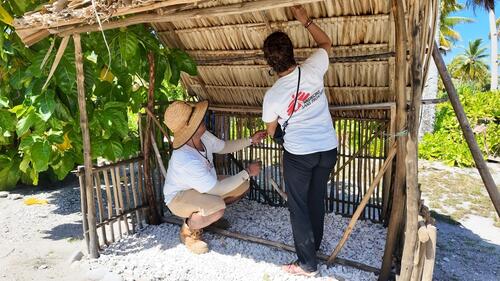
Nearby a team from Médecins Sans Frontières (MSF) gathers under a buia. This raised structure, built from coconut tree wood with a palm-thatched roof offers shade and ventilation from the island heat. The team is here to meet with the principal to assess the school’s water and sanitation needs.
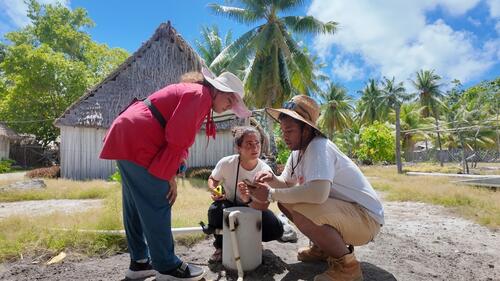
Mila Tirikai, an I-Kiribati MSF water and sanitation (WASH) supervisor takes the lead in these discussions. Born in Tarawa, the country’s capital, with family roots in Abaiang and Beru, Mila brings a deep understanding of life in these remote island communities. MSF work closely with Abaiang’s communities as part of a broader climate-sensitive disease approach that addresses non-communicable diseases, particularly in women and children, as well as a unique healthcare waste management project.
For Mila, this work is deeply personal: this is his community.
In Tabontebike, access to a reliable water supply shapes daily life. With no public water system on the island, communities rely on shallow groundwater wells or rainwater collection for everyday drinking water.
But climate change is increasingly undermining these already fragile sources of water. Rising sea levels push saltwater into the thin freshwater lens beneath the island, turning the groundwater brackish (salty). Seasonal droughts and unpredictable rainfall can mean rainwater tanks run dry more often, while flooding and intense downpours – which are expected with this year’s predicted El Niño weather system – can overwhelm simple sanitation systems and contaminate shallow wells.
For Tabontebike’s pupils, this translates to a growing uncertainty that the water they draw each day – whether from a well or a rainwater tank – may be too salty to drink, contaminated, or simply not available in the quantity they need. The slow creep of climate change is quietly reshaping children’s everyday lives.
For the I-Kiribati however, this is not a new challenge — they’ve long been addressing the impacts of climate change and advocating for action over many decades.
“From a young age, I was taught that climate change is one of the natural enemies of Kiribati — not only because it affects our daily life, but because we lack the resources to fight it,” says Mila.
“The sea level has risen, flooding homes and washing away our coastline,” he says. “Our wells have turned salty, and traditional crops like bwabwai [giant swamp taro] are dying. The weather has become unpredictable, with stronger winds, longer droughts, and sudden heavy rains.”
“When safe water becomes limited or unreliable, people may depend on contaminated wells or poorly stored water, increasing the risk of diarrhoeal disease, dehydration, skin infections, and other health problems,” Mila says.
On the frontline of the climate crisis
Few people could point to Kiribati on a map, yet it sits on the frontline of the climate crisis. Kiribati is one of the world’s most climate-vulnerable nations, its footprint spanning 3.5 million square kilometres of the Pacific, across 32 low-lying atolls and the raised phosphate island of Banaba. Its 138,000 people live on narrow strips of land only metres above sea level, dependent on fragile natural systems for water and fresh food. Climate change and environmental degradation are not an existential threat, but a reality that challenges the most basic determinant of health: safe water.
From a young age, I was taught that climate change is one of the natural enemies of Kiribati — not only because it affects our daily life, but because we lack the resources to fight it.Mila Tirikai, MSF water and sanitation supervisor
The reliability and safety of drinking water have a direct impact on health outcomes. When water sources are unsafe for drinking, communities face higher rates of diarrhoeal disease, skin infections, and other waterborne illnesses, which are particularly dangerous for children, pregnant women, and older people. Increasing environmental pressures in Kiribati, such as rising sea levels, temperatures, drought, land degradation, food insecurity and extreme remoteness, compound an already fragile public health landscape.
Mila has no doubts about the profound impacts this has on community health:
"Water is life,” he says.
“It is survival itself. I have witnessed firsthand how water scarcity and limited access affect entire communities, and Kiribati is a striking example of this.”
“When schools and health facilities cannot depend on clean, sufficient water,” he continues, “infection prevention and control, maternal and child health, and treatment of diarrhoeal and skin diseases all become more precarious.”
Te maraia, te buaka, te rongo
To Mila, climate change is not abstract. He describes it using Kiribati words like: te maraia [drought], te buaka [strong winds and waves], and te rongo [when the land feels lifeless].
“These changes don't happen one at a time, they build on each other, and that's what makes life harder for our communities,” he says.
“When the rain doesn't come for a long stretch, our crops suffer and families start to worry about having enough food to eat,” he continues.
“Then when the rain finally does come, it often comes too hard and too fast, flooding the very water sources we depend on and turning them turbid (cloudy) and unsafe to drink,” says Mila. “And because outer islands rarely have the resources to treat or clean this water, families are often left with few safe options.”
There is overwhelming scientific consensus that climate change is fuelling more frequent and extreme weather events, including heatwaves, floods, droughts, and storms. A remote island like Abaiang is among the most vulnerable to the impacts.
“Te buaka [the strong winds and waves] bring their own kind of hardship,” Mila says.
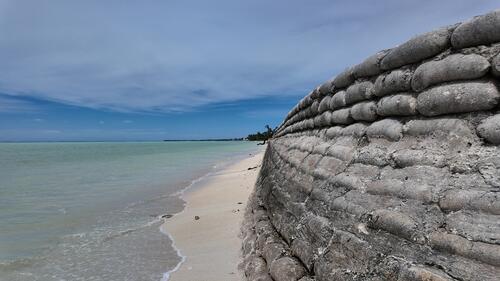
“They push the sea into powerful surges that eat away at our coastlines, flooding homes and damaging the wells we rely on for fresh water,” he says. “Because our islands are so narrow, there's nowhere for the land to retreat to. When we lose a well, a home, or a stretch of land to the sea, it's not something we can easily get back.”
Strengthening climate-resilient health systems
MSF’s work in Abaiang has a simple goal: strengthening climate-resilient health systems and addressing key health challenges within the community. These activities are done in close partnership with the Ministry of Health and Medical Services and local remote healthcare workers. Mila and the WASH team support a programme of strengthening water infrastructure in schools, communities, and health clinics by protecting groundwater, improving rainwater harvesting and storage, upgrading sanitation facilities, and supporting reliable sources of drinking water.
To guide this work, MSF takes an evidence-informed approach to understand Abaiang’s freshwater resources. Rainfall is the only source of recharge for the islands’ freshwater lenses, leading to a more vulnerable water supply. Understanding how the water flows underground is crucial to gaining a broader understanding of groundwater quantity and quality, which will inform what type of water system can realistically be sustained in such a remote setting.
A recent hydrogeological assessment used electrical resistivity tomography (ERT) to investigate the subsurface and characterise the freshwater lens and underlying geological layers. A hydrogeologist mapped the underground layers by placing a line of electrodes into the ground. Sending a small electrical current through the soil and measuring how it travels (since electricity moves differently through water, soil, and rock). The team created a 2D ‘slice’ of the subsurface, producing detailed images of where freshwater is stored.
Then, the team performed infiltration tests to see how quickly the ground absorbs water, known as hydraulic conductivity. This provided crucial information as to how fast water can soak down into the lens, with this information helping inform decisions around sustainable groundwater abstraction.

Video
What is hydrogeology?
Results showed that shallow, hand-dug wells, which are widely used across the island, are highly vulnerable to contamination and often unreliable. These findings support MSF’s ongoing water quality analysis which measures how environmental changes affect well water quality. By testing for salinity and coliform bacteria, the team identify which areas are at highest risk of contamination and map the results using Geographic Information System (GIS) technology. Several of the freshwater wells were found to be contaminated, indicating just how susceptible the groundwater is when not protected or replenished through natural cycles.
Protecting the freshwater lens and carefully managing groundwater abstraction are essential to maintaining the resource over time. MSF’s approach takes a multi-dimensional view of water systems: connecting groundwater availability and quality with contamination risks, climate pressures, population changes, infrastructure limits, and how people access and use water. The challenge is then to translate this evidence into a sustainable water supply, acknowledging that solutions that work elsewhere may not be sustainable in practice in Abaiang.
A climate-resilient response therefore, should integrate protected groundwater use, carefully managed abstraction and treatment, rainwater harvesting, and community-led water management within systems that can be sustained over time.
Using this evidence, MSF and community members work together to rehabilitate wells located near schools and clinics, employing simple adaptions like covering open water sources, improving drainage, installing and maintaining rainwater harvesting systems and establishing hygiene committees to protect these vital resources.
The support and knowledge from the community is crucially important, emphasises Mila: “Residents' long-term observations, such as changes in taste, water levels, or historical avoidance of certain sources helped validate technical findings and, in some cases, identified issues before they were formally confirmed through mapping.”
A call for action
As COP31 approaches, the urgency to acknowledge and strengthen the link between climate change and health grows ever stronger.
The interconnected link between climate and health is undeniable. Climate-sensitive diseases such as diarrhoeal illness, skin infections and vector-borne diseases are linked to water scarcity, flooding and poor sanitation. These impacts on already fragile health systems are happening now. Strong climate action through reducing emissions and adapting health systems means better health outcomes for all.
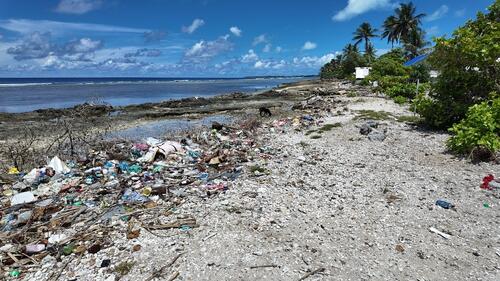
COP decisions matter because they influence the environment in which communities and health systems operate. This can shape whether Kiribati and other small island developing states have the resources to prepare for climate challenges, but this can only be done if health is considered central to climate action decision-making.
“I want global leaders to understand that in Kiribati, climate change, water, and health are directly connected,” says Mila.
Lessons from Abaiang
At Tabontebike primary school, the gong sounds, and recess ends.
The solutions proposed by MSF are modest but transformative at the school. In a month’s time, MSF’s WASH team return to the school and install well covers to reduce contamination and upgrade rainwater systems with first-flush devices, repair gutters and debris filters, and improve piping. They spend time with school staff and community members to train them on how to maintain these improvements and later MSF’s health promoters visit classes to guide hygiene and sanitation sessions with children and teachers.
On these fragile atolls, the climate crisis is a health and humanitarian crisis, particularly for the children growing up on the frontline.
Climate change disproportionately hits the most vulnerable people. This includes people who are among the least responsible for the crisis, but are paying the highest price.
Kiribati may be small, but its experience carries global significance. What we learn here can inform climate and health responses across the Pacific and beyond. Investment in resilient, climate-ready water systems is a global imperative, not a local choice.
“Global leaders must move beyond discussion and provide practical, long-term support,” says Mila. “Protecting water in Kiribati means protecting health, dignity, and the future of our communities.”
Médecins Sans Frontières (MSF) supports Kiribati’s national priorities for strengthening WASH, environmental health and climate-resilient health systems, including the Ministry of Health and Medical Services’ focus on protecting communities from climate-sensitive health risks. In coordination with the Ministry of Health and Medical Services, the Ministry of Infrastructure and Sustainable Energy, and local communities, MSF continues to support agreed monitoring of water quality, alongside training and clear handover arrangements so that infrastructure and knowledge can be maintained locally and sustainably in the future.
Palestine
MSF calls for protection of Palestinian communities after Israeli settlers injured staff member
Statement
19 Oct 2026
DRC Ebola outbreaks
Children are being left behind in the current Ebola disease outbreak response
Press Release
15 Oct 2026
DRC Ebola outbreaks
What will it take to end the Ebola disease outbreak in Democratic Republic of Congo?
Project Update
30 Sep 2026