


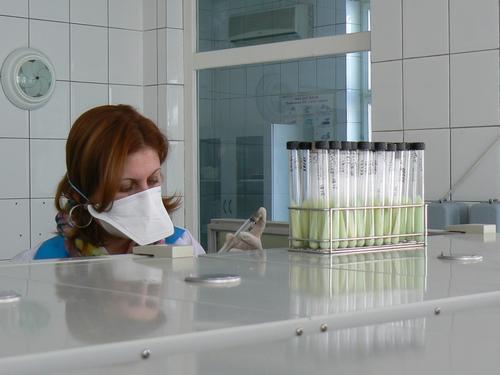


 National Reference Laboratory, Abovyan. Sputum culture is currently used to detect TB, together with chest X-rays, sputum smear microscopy and Mantoux test. However, the growth of TB bacteria in culture is the only method allowing determining complete drug-susceptibility.<br> *** Local Caption *** Treatment options for patients with drug-resistant TB remain far short of what is needed. Treatments are long (up to 2 years), toxic (serious side-effects) and expensive. Furthermore, the cure rate is only 50%.
Bedaquiline, one of two new TB drugs to be developed in 50 years, is as yet only available for compassionate use, i.e., patients for whom most antibiotics are not effective. MSF has been administering a new treatment including bedaquiline to around thirty patients in Armenia since April 2013. Although we can not draw any definitive conclusions (at this point), several patients have shown significant signs of improvement and we have not observed any side effects associated with bedaquiline until now.
But, while compassionate use of this new drug gives cause for optimism to patients who have lost hope, it is not the solution for treating the hundreds of thousands of patients worldwide suffering from DR-TB. New, shorter, less toxic and cheaper treatments including bedaquiline and delamanid, the other new TB drug, need to be developed.
International Activity Report 2016

Armenia

A laboratory technician at the National Reference Laboratory in Abovyan, Armenia.
© Andrea Bussotti/MSF
Ebola disease in DRC: find out how we're responding
Learn more
MSF in Armenia MSF is focusing on implementing new regimens for patients with multidrug-resistant tuberculosis (MDR-TB) in Armenia, which has one of the highest rates of the disease in the world.
Armenia Map IAR 2016

Tuberculosis continues to be a major public health concern in Armenia. The incidence of drug-sensitive TB is estimated at 41 new cases per 100,000 people per year, while 11 per cent of new cases and 47 per cent of previously treated cases are drug-resistant. Around 10 per cent of MDR-TB patients have the extensively drug-resistant (XDR) form of the disease. The main challenge when treating MDR-TB patients is the length and toxicity of the regimen itself – it involves taking up to 20 tablets every day for two years, and months of painful daily injections. For some patients, a port-a-cath is implanted to ease the twice-daily intravenous injections. Permanent hearing loss, suicidal depression and psychosis are among the side effects of the treatment, which is only successful for around half of MDR-TB patients and a quarter of those with XDR-TB.

Armenia was one of the first countries in the world to authorise the use of two new TB drugs, bedaquiline and delamanid, which promise to be less toxic and more effective. In 2016, this continued to be the focus of MSF activities in Armenia, and care of patients on standard MDR-TB treatment was handed over to the Armenian authorities.

Between January and December 2016, 66 MDR-TB patients started the new regimen, and a total of 79 patients were under treatment by the end of the year.