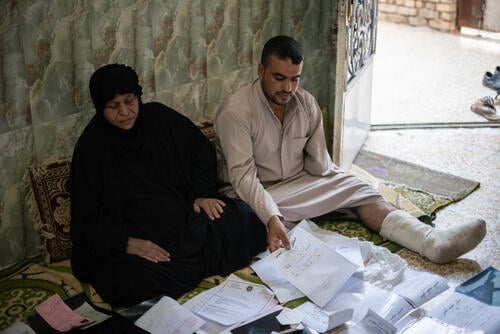
Hameeda and her son look at her medical files. She was diagnosed with tuberculosis 4 years ago, and since then had several treatment regimens, both injections and oral, and several relapses until she was cured with the new oral treatment for multidrug-resistant tuberculosis.
Al-Fathilia, Baghdad, Iraq.
---
Hamida's testimony:
---
My name is Hameeda, I am 65 years old and I am from Baghdad (Iraq). I am a mother of six daughters and three sons.

The first time I was diagnosed with tuberculosis (TB) was in 2015. At that time, we didn’t know what was wrong with me. I was coughing, had night-time fever and I wasn’t feeling well. My blood pressure and blood sugar were both high. When I went to seek medical advice I was told that I had had a light stroke, and I was given treatments to better control my hypertension and blood sugar as well as medications for the stroke. But the coughing and the night-time fever didn’t go away. 

I started noticing that I was coughing up sputum and my overall health was not improving. My son took me again to be seen by doctors, who then sent us to the National Tuberculosis Institute in Baghdad. There, I was diagnosed with TB. The medical team at the institute prescribed injections for me that made me tired and weak. 

When I first got the disease, the doctors told us that TB was an infectious disease and that I had to isolate from others. I stopped going out, visiting others or seeing anyone outside. I took my medications for about eight months, after which point the doctors told me that I was cured. However, since then, I have had three relapses. The last one was at the beginning of 2020. I was told that it was a drug-resistant form of the disease this time around and I was put on a new drug regimen which involved taking pills.

During my previous infections, I was treated with daily injectable medications, which were giving me many side effects. For example, my body was itching a lot and I had developed bruise marks on my skin. But since I started taking oral tablets, I feel better. The tablets still hurt my stomach, but they are much better and I have fewer side effects compared to the injections.

At the beginning of the treatment, I was very tired. I couldn’t walk or even move. My son was taking care of me and only with his help was I able to go to the National Tuberculosis Institute for check-ups. He is the only provider for the family, and it was a hard time for him too. Sometimes he would have to take me to private clinics for consultations for my other chronic conditions, which would also need medications that he had to buy, and they were not cheap. All of that prevented him from going to work and that in turn affected our livelihood. But now, after almost 18 months of taking medication, I’m thankful I have finished my treatment and got rid of the disease and its hardships. Now I am in a better health and I don’t need care from others.
Hameeda and her son look at her medical files. She was diagnosed with tuberculosis four years ago, and since then had several treatment regimens, both injections and oral, and several relapses until she was finally cured with the new oral treatment for multidrug-resistant tuberculosis. Iraq, September 2021. 
© MSF/CHLOE SHARROCK

Tackling multidrug-resistant tuberculosis, one patient at a time

Hameeda and her son look at her medical files. She was diagnosed with tuberculosis four years ago, and since then had several treatment regimens, both injections and oral, and several relapses until she was finally cured with the new oral treatment for multidrug-resistant tuberculosis. Iraq, September 2021. 
© MSF/CHLOE SHARROCK
Ebola disease in DRC: find out how we're responding
Learn more

In the neighbourhood of Sadr City, in Baghdad, Iraq, Ihsan Ali sits with his four children in their home. The 44-year-old man is enjoying the company of his family after weeks of having to isolate from them. Ihsan has had tuberculosis (TB) a couple of times before, but most recently he was diagnosed with a multidrug-resistant form of the disease. 

Patients with TB generally experience serious symptoms that greatly affect their lives, including severe coughing, chest pain, significant weakness, sudden loss of weight and fever. Uncomplicated TB is curable, but patients must endure long months of treatment with harsh drugs. TB can also become resistant to these medications and evolve into a form of the disease called multidrug-resistant tuberculosis (MDR-TB). 

Drug resistance emerges when TB medicines are used inappropriately, through incorrect prescription by healthcare providers, when poor quality drugs are used, and/or when patients do not adhere to their prescribed treatments. Until recently, the only way to treat MDR-TB was with potent oral and injectable drugs. This treatment regimen can take up to two years and cause serious side effects such as deafness, kidney damage and severe psychological illness.
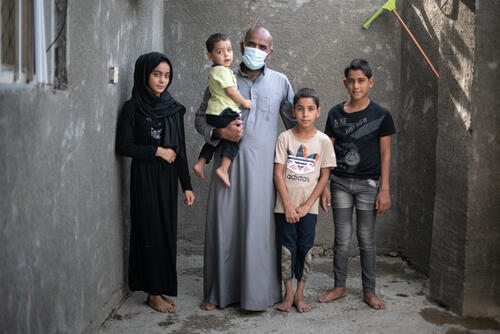
Ihsan, 44 multidrug-resistant (MDR-TB) patient, and his family.
Since February 2021, Ihsan was declared not contagious, and since then, he doesn't have to isolate himself anymore from his family.
Sadr City, Baghdad, Iraq.
---
Ihsan's testimony:
---
My name is Ihsan Ali and I’m 44 years old. I’m married and I have three boys and one girl. I live in the Hamidiya area, in Baghdad (Iraq). I don’t have a steady job: sometimes I work as a construction worker and sometimes I borrow my friend’s taxi to work as a driver. 

The first time I got tuberculosis (TB) was in 2014. I went to the hospital and they told me I had caught it. Back then, I took the treatment for almost three months, but as soon as I got better, I stopped it. 

A year later, the disease came back, even stronger than before. I was put again on mediation–both pills and injections. This time, I continued my treatment for the whole period it was prescribed, eight months in total. I was feeling much better. 

But one day at the beginning of 2020, I was coming back from work and I suddenly felt lightheaded and tired. I didn’t expect it to be TB again, but my family suggested that I do a test just to be sure. The test came back positive: I had had a relapse. This time it was multidrug-resistant tuberculosis (MDR-TB). 

I isolated myself in my house and didn’t let anyone come near me. It wasn’t easy but it had to be done. I was then informed that there was a new treatment regimen, of 18 months duration and that wouldn’t involve injections. I agreed immediately as didn’t want to go back to taking injections every day. 

It’s been almost 10 months that I’m on this new drug regimen and I’m doing very well. It’s still a long way to recovery but hopefully I will overcome this. The pills that I am taking are a blessing compared to the injections. The injections were painful, and I had to go to a local private clinic every day for them to be administered. 

A month ago I got sick again: I had a fever, body ache and cough. I did a test and this time it was COVID-19. I had to isolate again and became a bit depressed. But I never lost hope, my belief was strong. I trusted in God, the treatment, and the precaution measures I was taking. I was very sick for 20 days. Although not fully recovered, I’m much better now thanks to God. 

I’m the breadwinner in my family, and for most of the period when I was sick I couldn’t work. Thankfully friends and relatives stood by my side, supported me and helped my family. I’m thankful to God and to them. Now, my only hope is for my health to get better so that I can work again, provide for my family and make up for all the time I was sick.
Ihsan, 44, and his family. Ihsan is a multidrug-resistant (MDR-TB) patient. Since February 2021, he has been declared non contagious, and so doesn't have to isolate himself from his family anymore. Sadr City, Baghdad, Iraq, September 2021. 
MSF/CHLOE SHARROCK

A better treatment for MDR-TB patients

In Iraq, our teams support the Iraqi National Tuberculosis Institute (NTI) to detect and diagnose TB and MDR-TB. 

Our teams have also introduced an innovative treatment regimen for MDR-TB patients, involving the use of new drugs bedaquiline and delamanid. This new, World Health Organization-recommended regimen involves all-oral drugs, removing the need for painful injections, which MDR-TB patients had to experience previously. These new drugs have also demonstrated superior patient adherence rates, higher success in treating MDR-TB in a shorter period and less side effects for patients. 

“During my previous infections, I was treated with daily injectable medications, which gave me many side effects,” says Hameeda, a 65-year-old grandmother who had MDR-TB. “My body was itching a lot and I developed bruise marks on my skin.

“But since I started taking oral tablets, I feel better. The tablets still hurt my stomach, but they are far better and I have fewer side effects compared to the injections.” Hameeda is one of the first Iraqi patients to be completely cured from the disease after completing this new treatment regimen. 

Hameeda, a 65-year-old grandmother who had MDR-TB. “During my previous infections, I was treated with daily injectable medications, which gave me many side effects. But since I started taking oral tablets, I feel better... they are far better and I have fewer side effects compared to the injections.”
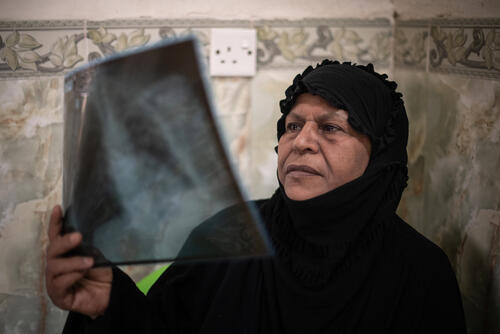
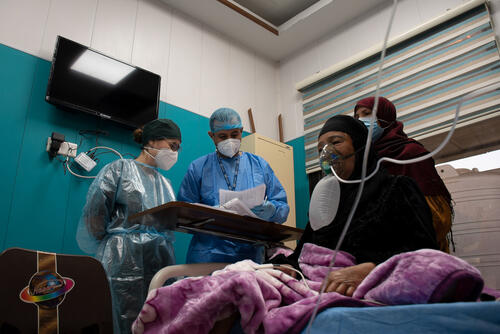
Hameeda looks at an x-ray of her lungs.
Hameeda, 65, photographed in her home, is Iraq’s first patient to be cured with the new oral treatment for multidrug-resistant tuberculosis. Before starting this treatment, she was having daily painful injections that had the potential of causing serious side effects; like hearing loss and kidney damage. Since her first diagnosis, Hameeda has relapsed several times.
Al-Fathilia, Baghdad, Iraq.
---
Hamida's testimony:
---
My name is Hameeda, I am 65 years old and I am from Baghdad (Iraq). I am a mother of six daughters and three sons.

The first time I was diagnosed with tuberculosis (TB) was in 2015. At that time, we didn’t know what was wrong with me. I was coughing, had night-time fever and I wasn’t feeling well. My blood pressure and blood sugar were both high. When I went to seek medical advice I was told that I had had a light stroke, and I was given treatments to better control my hypertension and blood sugar as well as medications for the stroke. But the coughing and the night-time fever didn’t go away. 

I started noticing that I was coughing up sputum and my overall health was not improving. My son took me again to be seen by doctors, who then sent us to the National Tuberculosis Institute in Baghdad. There, I was diagnosed with TB. The medical team at the institute prescribed injections for me that made me tired and weak. 

When I first got the disease, the doctors told us that TB was an infectious disease and that I had to isolate from others. I stopped going out, visiting others or seeing anyone outside. I took my medications for about eight months, after which point the doctors told me that I was cured. However, since then, I have had three relapses. The last one was at the beginning of 2020. I was told that it was a drug-resistant form of the disease this time around and I was put on a new drug regimen which involved taking pills.

During my previous infections, I was treated with daily injectable medications, which were giving me many side effects. For example, my body was itching a lot and I had developed bruise marks on my skin. But since I started taking oral tablets, I feel better. The tablets still hurt my stomach, but they are much better and I have fewer side effects compared to the injections.

At the beginning of the treatment, I was very tired. I couldn’t walk or even move. My son was taking care of me and only with his help was I able to go to the National Tuberculosis Institute for check-ups. He is the only provider for the family, and it was a hard time for him too. Sometimes he would have to take me to private clinics for consultations for my other chronic conditions, which would also need medications that he had to buy, and they were not cheap. All of that prevented him from going to work and that in turn affected our livelihood. But now, after almost 18 months of taking medication, I’m thankful I have finished my treatment and got rid of the disease and its hardships. Now I am in a better health and I don’t need care from others.
Hameeda looks at an X-ray of her lungs. Hameeda, 65, is Iraq’s first patient to be cured with the new oral treatment for multidrug-resistant tuberculosis. Before starting this treatment, she was having daily painful injections that had the potential of causing serious side effects, including hearing loss and kidney damage. Iraq, September 2021. 
© MSF/CHLOE SHARROCK

“We are very happy that six Iraqi patients with MDR-TB have now fully completed their treatment and are cured. And as of August, 2021, we have 93 patients still being treated,” says Hemant Pangtey, MSF’s project medical advisor in Baghdad who oversees the MDR-TB patient cohort.

Our teams started implementing this new drug regimen to treat MDR-TB patients in Iraq in 2020, in partnership with the NTI. Later that year, it was officially recognised as the treatment regimen for all MDR-TB patients in the country. Today, all new patients diagnosed with MDR-TB in the country are treated with the oral new regimen, with only a few exceptions based on medical requirements.

“When I was told that I had a multidrug-resistant form of TB, doctors at the National Tuberculosis Institute told me about this new drug regimen that needs to be taken orally,” says Ihsan. “I agreed straight away as I didn’t want to take painful injections again every day. I’ve been on this drug regimen for almost 10 months and I’m doing very well.  The pills that I am taking are a blessing compared to the injections.” 

Ihsan, 44, multidrug-resistant tuberculosis patient. “Doctors at the National Tuberculosis Institute told me about this new drug regimen that needs to be taken orally. I agreed straight away as I didn’t want to take painful injections. The pills I'm taking are a blessing compared to the injections.”
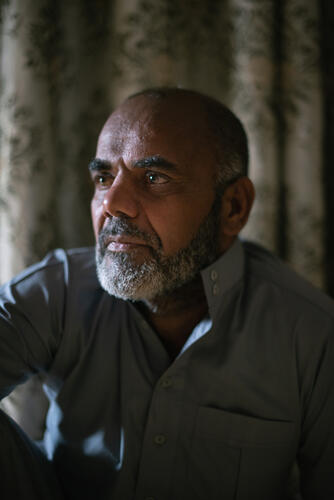
Ihsan, 44, was first diagnosed with tuberculosis in 2014, and since 2017, he is diagnosed with multidrug-resistant tuberculosis (MDR-TB). He’s taking the new oral treatment since October 2020 and is now slowly recovering, with seven months of treatment to go before being fully cured.
Sadr City, Baghdad, Iraq.
---
Ihsan's testimony:
---
My name is Ihsan Ali and I’m 44 years old. I’m married and I have three boys and one girl. I live in the Hamidiya area, in Baghdad (Iraq). I don’t have a steady job: sometimes I work as a construction worker and sometimes I borrow my friend’s taxi to work as a driver. 

The first time I got tuberculosis (TB) was in 2014. I went to the hospital and they told me I had caught it. Back then, I took the treatment for almost three months, but as soon as I got better, I stopped it. 

A year later, the disease came back, even stronger than before. I was put again on mediation–both pills and injections. This time, I continued my treatment for the whole period it was prescribed, eight months in total. I was feeling much better. 

But one day at the beginning of 2020, I was coming back from work and I suddenly felt lightheaded and tired. I didn’t expect it to be TB again, but my family suggested that I do a test just to be sure. The test came back positive: I had had a relapse. This time it was multidrug-resistant tuberculosis (MDR-TB). 

I isolated myself in my house and didn’t let anyone come near me. It wasn’t easy but it had to be done. I was then informed that there was a new treatment regimen, of 18 months duration and that wouldn’t involve injections. I agreed immediately as didn’t want to go back to taking injections every day. 

It’s been almost 10 months that I’m on this new drug regimen and I’m doing very well. It’s still a long way to recovery but hopefully I will overcome this. The pills that I am taking are a blessing compared to the injections. The injections were painful, and I had to go to a local private clinic every day for them to be administered. 

A month ago I got sick again: I had a fever, body ache and cough. I did a test and this time it was COVID-19. I had to isolate again and became a bit depressed. But I never lost hope, my belief was strong. I trusted in God, the treatment, and the precaution measures I was taking. I was very sick for 20 days. Although not fully recovered, I’m much better now thanks to God. 

I’m the breadwinner in my family, and for most of the period when I was sick I couldn’t work. Thankfully friends and relatives stood by my side, supported me and helped my family. I’m thankful to God and to them. Now, my only hope is for my health to get better so that I can work again, provide for my family and make up for all the time I was sick.
Ihsan, 44, was first diagnosed with tuberculosis in 2014, and since 2017, he has been diagnosed with multidrug-resistant tuberculosis (MDR-TB). He’s been taking the new oral treatment since October 2020 and is now slowly recovering, with seven months of treatment to go before being fully cured. Sadr City, Baghdad, Iraq, September 2021.
© MSF/CHLOE SHARROCK

Alleviating the daily suffering 

Patients with all forms of TB face many challenges in their personal lives due to their medical condition. In the early phase of the disease, they are infectious and must isolate themselves to avoid infecting others, which usually affects their mental health as well as their livelihood.

“Before getting sick, I used to work as a porter, but due to my illness I can’t work anymore. We can’t afford many things,” says Ibrahim Mohammed, a father of eight from the Baghdad suburb of Sadr City.  He has MDR-TB and is currently in the infectious stage of the disease. “Most of the time we can only afford food and that’s mainly from my son’s work - he is a porter too.” 
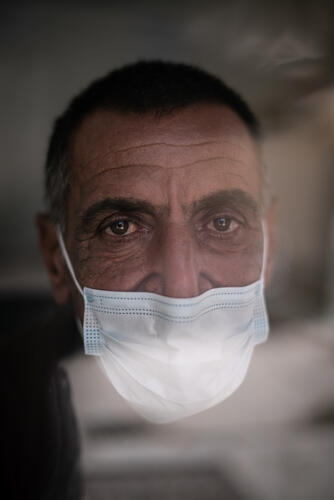
MSF provides support to patients with MDR-TB to decrease the financial burden of treatment, and to encourage people to attend their follow-up appointments as advised by their healthcare providers. This includes providing transportation allowances to and from the NTI, as well as food baskets for those who, like Ibrahim, are unable to work while sick. 

Ibrahim Mohammed, an MDR-TB patient from Sadr City. “Before getting sick, I used to work as a porter, but due to my illness I can’t work anymore. We can’t afford many things. Most of the time we can only afford food and that’s mainly from my son’s work - he is a porter too.” 
Ibrahim, 52, was first diagnosed with tuberculosis (TB) almost 3 years. And later his disease was diagnosed to be multidrug-resistant tuberculosis (MDR-TB). He’s currently taking the new oral treatment with 6 pills a day since six months, and still needs to isolate as he is still contagious.
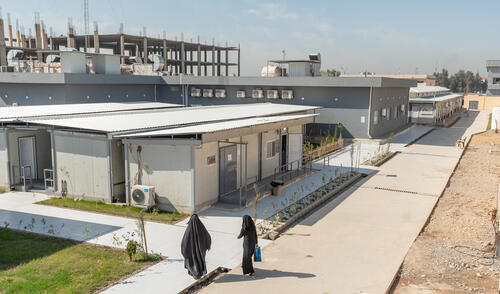
National Tuberculosis Institute, Medical City, Baghdad, Iraq.
---
Ibrahim's testimony:
---
My name is Ibrahim Mohammed, I am 50 years old, and I am from Baghdad’s Sadr City. I am married and a father of eight children. 

I first got infected with tuberculosis (TB) about three years ago. It took me a year of treatment to be cured from it. But after some time, I started feeling the same symptoms again and I knew that the TB had come back. 

I went back to the National Tuberculosis Institute and they told me that this time, I had a drug-resistant form of TB. They prescribed me oral medications, unlike the drugs I had received the first time I had TB, which were injectables. 

Following the doctor’s advice, I immediately isolated myself from my family and I moved to my brother’s empty house, which is right next to mine. I locked myself inside and I didn’t go out at all. Not even to see my family.  I only saw them from behind the windows. My family was sad and worried about me. They didn’t know much about the disease and how it would affect me. Since then, I’ve spent my days at home. When I wake up, I put my bed in the sun to disinfect it and clean the house. Then, when it’s lunch time, my family brings me food. I don’t let them enter the house. They leave the food outside for me and I go out to take it after they leave.

Before getting sick, I used to work as a porter, but due to my sickness I can’t work anymore. We can’t afford many things. We even had to cut the secondary power line from my home because we cannot pay for it anymore. Most of the time, we can only afford food, and that’s mainly from the work of my son, who is a porter too. 

On top of my multidrug-resistant tuberculosis (MDR-TB), I have chronic diseases as well. I take medications for hypertension, diabetes and heart disease. I must buy these medications on my own. They cost me 30,000 IQDs (about 20 USD) per month, and sometimes I have to borrow money from others until I receive my social security salary to pay for it.

I feel weaker and I get tired quickly. But overall, I’m feeling good being on this treatment as it doesn’t have many negative side effects for me. I hope to regain my full health so that I can go back to work and support my family again. I miss my children a lot. I can only see them from behind the window when they play outside. I can’t wait to hold them in my arms again.
Ibrahim, 52, was first diagnosed with tuberculosis (TB) almost three years ago. Later his disease was diagnosed to be multidrug-resistant tuberculosis (MDR-TB). For six months he’s been taking the new oral treatment with six pills a day, and needs to isolate as he is still contagious. Baghdad, Iraq, September 2021. 
© MSF/CHLOE SHARROCK

Our teams are aiming to go a step further in our projects for MDR-TB patients in Iraq. “The ongoing aim now is to decentralise the treatment so that people do not have to travel to Baghdad to benefit from it,” says Pangtey. “Until now, patients from all over Iraq have had to come here to get their medication and follow-up care. We want this to change. Overcoming TB is hard and painful enough in itself.

“Suffering from the multidrug-resistant form of the disease is even more complicated to treat. So, we want to make the treatment process easier for patients in whatever way we can, and we have already, along with the National Tuberculosis Institute, taken big steps in this direction,” says Pangtey.

Since June 2021, MSF teams have collaborated with the NTI and the International Organization for Migration (IOM) to provide trainings to healthcare providers in several governorates of Iraq on MDR-TB early detection, treatment and follow up care.

“This decentralisation will help patients save time and money, by enabling them to access quality care closer to their homes,” concludes Pangtey. “We hope that all these steps will help to alleviate their suffering and contribute positively to both their treatment and their daily lives.”