



8077 Results
 
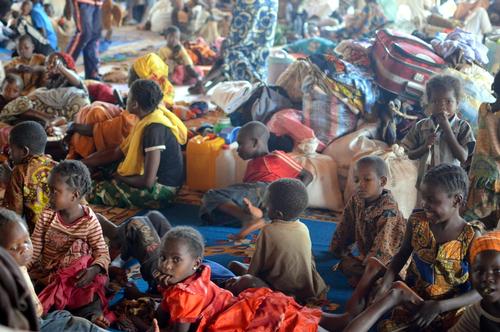
Deplaces a l'eglise a Carnot.<br/>Forced displaced in the church in Carnot. *** Local Caption *** Since February 1st, date of the anti-Balakas takeover of the city, a thousand people (mostly Peuls/Fulani in transit on their way to Cameroon) are trapped in the city ,victims of attacks and violences.
Central African Republic

An account from Carnot, Central African Republic: "Let's be clear - we are witnessing a true cleansing in CAR"

A testimony by Muriel Masse, MSF’s project coordinator in Carnot, CAR Voices from the Field - 28 May 2014
 
msf-placeholder
Ukraine

Médecins Sans Frontières Strongly Denies Involvement in Transporting Combatants in Donetsk

MSF Strongly Denies Involvement in Transporting Combatants in Donetsk Statement - 27 May 2014
 
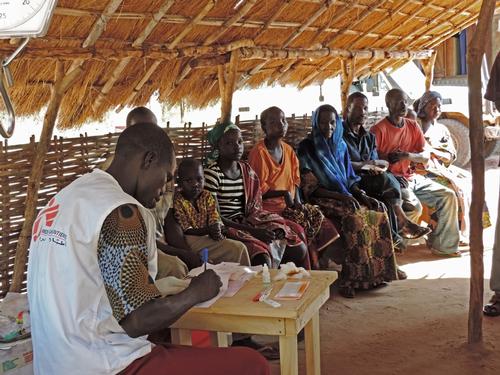
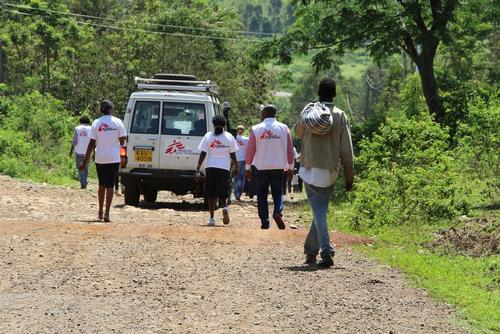
MSF teams from Kabo carry out mobile clinics and support health centres in the periphery.
Central African Republic

‘We have seen women and children with gunshot injuries heading for exile’

‘We have seen women and children with gunshot injuries heading for exile’ Voices from the Field - 26 May 2014
 
msf-placeholder
Tuberculosis

Phumeza takes TB Petition to World Health Assembly Delegates

Phumeza Tisile, a former XDR-TB patient, takes the ‘Test Me, Treat Me’ Drug-Resistant TB Manifesto to the 67th World Health Assembly in Geneva, Switzerland. Project Update - 26 May 2014
 
During the April 14th launch event, the out-reach team, with a street theater group, went around the city of Ndhiwa to call on public participation to the ceremony and raise public awareness on HIV. *** Local Caption *** On April 11th, 2014 –Médecins Sans Frontières (MSF) and local health authorities officially launched a new HIV program that they will jointly run in Ndhiwa sub-county, Homa Bay County, in Western Kenya. In this region, more than one fourth of the population is leaving with HIV.
During the 4 years of activities, the program will aim at reducing the number of new infections among the population as well as the mortality related to HIV. This will be made possible by implementing universal and regular testing for the whole population of Ndhiwa sub county and setting up early quality treatment for people living with HIV as well as providing quality care for people hospitalized. Furthermore, the increase access to viral load testing will help ascertain that patients are at the lowest risk of transmitting the virus
The MSF / Ministry of Health program will focus on simplifying the way healthcare is provided to patients, through an adaptation of medical protocols and the inclusion of non-medical workers in the provision of care. Such medical protocols will include encouraging the community to get tested and receive ART as early as possible if found infected to reduce transmitting the virus to others, as well as to support adherence to the treatment. Systematic screening and provision of ART for all HIV positive pregnant women will be implemented, in order to reduce mother-to-child transmission (PMTCT) of the virus. HIV testing program will also be integrated in routine immunization programs for young children. Medical male circumcision will also be key in impacting the rate at which men get infected.
HIV/AIDS

Ndhiwa HIV programme, partners quotes

Ndhiwa HIV programme, partners quotes Project Update - 26 May 2014
 
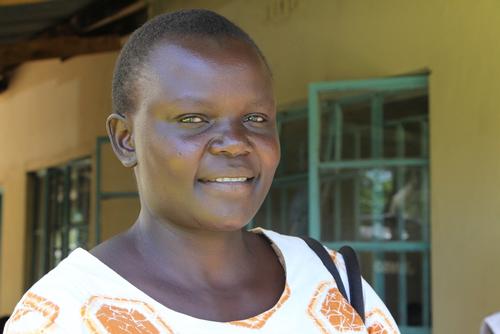
“My mane is Esther OREGE, I am 41 years old and I have five children. When we discovered that I was infected by HIV, in 2001, my husband left me. I was alone; I was sick and sad, so weak also. Then I joined the HIV program in Homa Bay and I could receive anti-retroviral for free. But it was far from my home, it cost me 400 KSH to go there and come back every month.
Fortunately, today, I can walk to Ndhiwa hospital to get my treatment, and I only need to come once every three months. And I am confident in the future, I can work, I take care of my family”.  *** Local Caption *** On April 11th, 2014 –Médecins Sans Frontières (MSF) and local health authorities officially launched a new HIV program that they will jointly run in Ndhiwa sub-county, Homa Bay County, in Western Kenya. In this region, more than one fourth of the population is leaving with HIV.
During the 4 years of activities, the program will aim at reducing the number of new infections among the population as well as the mortality related to HIV. This will be made possible by implementing universal and regular testing for the whole population of Ndhiwa sub county and setting up early quality treatment for people living with HIV as well as providing quality care for people hospitalized. Furthermore, the increase access to viral load testing will help ascertain that patients are at the lowest risk of transmitting the virus
The MSF / Ministry of Health program will focus on simplifying the way healthcare is provided to patients, through an adaptation of medical protocols and the inclusion of non-medical workers in the provision of care. Such medical protocols will include encouraging the community to get tested and receive ART as early as possible if found infected to reduce transmitting the virus to others, as well as to support adherence to the treatment. Systematic screening and provision of ART for all HIV positive pregnant women will be implemented, in order to reduce mother-to-child transmission (PMTCT) of the virus. HIV testing program will also be integrated in routine immunization programs for young children. Medical male circumcision will also be key in impacting the rate at which men get infected.
HIV/AIDS

Testimony: Esther Orege from Ndhiwa

Testimony: Esther Orege from Ndhiwa Voices from the Field - 26 May 2014
 
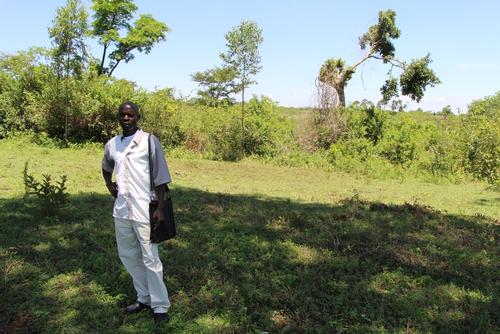
Thomas Soyoua is leaving with HIV. He discovered his status in 2008. He is a farmer, in Kawanga, a sub-district near the city of Ndhiwa. It is a very rural area, where the population is spread out in the country side, in the West part of Kenya, not far from Victoria Lake. 
He has five children and he needs to work in the fields to feed his family. But, by the time he discovered his status he was feeling weak, he couldn’t work and he couldn’t pay the school fees for his children.
“At that time I was very week. Then I was immediately put under treatment with ARVs. I was given the adherence on how to use the drugs. And from those days until now, I am just feeling okay” he says.
 *** Local Caption *** On April 11th, 2014 –Médecins Sans Frontières (MSF) and local health authorities officially launched a new HIV program that they will jointly run in Ndhiwa sub-county, Homa Bay County, in Western Kenya. In this region, more than one fourth of the population is leaving with HIV.
During the 4 years of activities, the program will aim at reducing the number of new infections among the population as well as the mortality related to HIV. This will be made possible by implementing universal and regular testing for the whole population of Ndhiwa sub county and setting up early quality treatment for people living with HIV as well as providing quality care for people hospitalized. Furthermore, the increase access to viral load testing will help ascertain that patients are at the lowest risk of transmitting the virus
The MSF / Ministry of Health program will focus on simplifying the way healthcare is provided to patients, through an adaptation of medical protocols and the inclusion of non-medical workers in the provision of care. Such medical protocols will include encouraging the community to get tested and receive ART as early as possible if found infected to reduce transmitting the virus to others, as well as to support adherence to the treatment. Systematic screening and provision of ART for all HIV positive pregnant women will be implemented, in order to reduce mother-to-child transmission (PMTCT) of the virus. HIV testing program will also be integrated in routine immunization programs for young children. Medical male circumcision will also be key in impacting the rate at which men get infected.
Kenya

Testimony: Thomas Soyoua from Kawanga

Testimony: Thomas Soyoua from Kawanga Voices from the Field - 26 May 2014
 
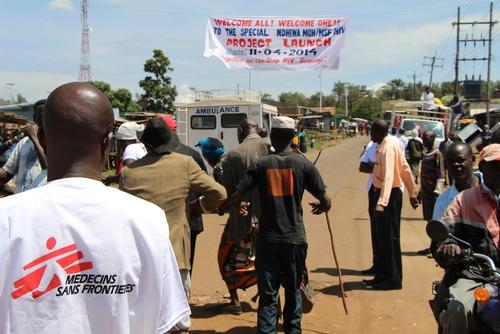
During the April 14th launch event, the out-reach team, with a street theater group, went around the city of Ndhiwa to call on public participation to the ceremony and raise public awareness on HIV. *** Local Caption *** On April 11th, 2014 –Médecins Sans Frontières (MSF) and local health authorities officially launched a new HIV program that they will jointly run in Ndhiwa sub-county, Homa Bay County, in Western Kenya. In this region, more than one fourth of the population is leaving with HIV.
During the 4 years of activities, the program will aim at reducing the number of new infections among the population as well as the mortality related to HIV. This will be made possible by implementing universal and regular testing for the whole population of Ndhiwa sub county and setting up early quality treatment for people living with HIV as well as providing quality care for people hospitalized. Furthermore, the increase access to viral load testing will help ascertain that patients are at the lowest risk of transmitting the virus
The MSF / Ministry of Health program will focus on simplifying the way healthcare is provided to patients, through an adaptation of medical protocols and the inclusion of non-medical workers in the provision of care. Such medical protocols will include encouraging the community to get tested and receive ART as early as possible if found infected to reduce transmitting the virus to others, as well as to support adherence to the treatment. Systematic screening and provision of ART for all HIV positive pregnant women will be implemented, in order to reduce mother-to-child transmission (PMTCT) of the virus. HIV testing program will also be integrated in routine immunization programs for young children. Medical male circumcision will also be key in impacting the rate at which men get infected.
Kenya

MSF launches new project to curb spread of HIV in western Kenya

MSF launches new project to curb spread of HIV in western Kenya Press Release - 26 May 2014
 
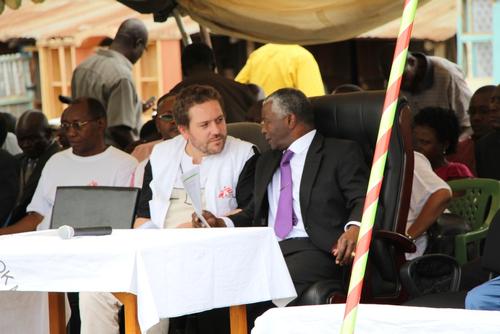
William Hennequin, MSF Head of Mission, with Hon. Hamilton Orata, deputy governor- Homa Bay County *** Local Caption *** On April 11th, 2014 –Médecins Sans Frontières (MSF) and local health authorities officially launched a new HIV program that they will jointly run in Ndhiwa sub-county, Homa Bay County, in Western Kenya. In this region, more than one fourth of the population is leaving with HIV.
During the 4 years of activities, the program will aim at reducing the number of new infections among the population as well as the mortality related to HIV. This will be made possible by implementing universal and regular testing for the whole population of Ndhiwa sub county and setting up early quality treatment for people living with HIV as well as providing quality care for people hospitalized. Furthermore, the increase access to viral load testing will help ascertain that patients are at the lowest risk of transmitting the virus
The MSF / Ministry of Health program will focus on simplifying the way healthcare is provided to patients, through an adaptation of medical protocols and the inclusion of non-medical workers in the provision of care. Such medical protocols will include encouraging the community to get tested and receive ART as early as possible if found infected to reduce transmitting the virus to others, as well as to support adherence to the treatment. Systematic screening and provision of ART for all HIV positive pregnant women will be implemented, in order to reduce mother-to-child transmission (PMTCT) of the virus. HIV testing program will also be integrated in routine immunization programs for young children. Medical male circumcision will also be key in impacting the rate at which men get infected.
Kenya

Can the HIV epidemic be curbed?

An op-ed written by William Hennequin, MSF representative in Kenya Opinion - 26 May 2014
 
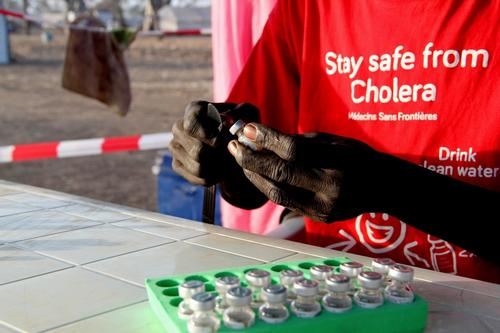
MSF team member preparing the oral cholera vaccine.
Cholera

MSF rapidly scales up response to contain cholera outbreak in South Sudan

MSF rapidly scales up response to contain cholera outbreak Project Update - 23 May 2014
Four mothers posing in a corridor of the Hospital in Bili. All four of them are staying in the hospital with their child, that's suffering from a severe case of malaria. Since the beginning of the project in 2016, the pediatric ward already treated more than 4.000 cases of complicated/severe form of malaria.
Médecins Sans Frontières (MSF)

Independent medical humanitarian assistance

We provide medical assistance to people affected by conflict, epidemics, disasters, or exclusion from healthcare. Our teams are made up of tens of thousands of health professionals, logistic and administrative staff - most of them hired locally. Our actions are guided by medical ethics and the principles of independence and impartiality. We are a non-profit, self-governed, member-based organisation.

Learn more