


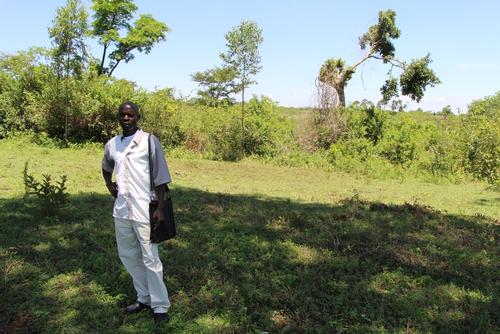
Thomas Soyoua is leaving with HIV. He discovered his status in 2008. He is a farmer, in Kawanga, a sub-district near the city of Ndhiwa. It is a very rural area, where the population is spread out in the country side, in the West part of Kenya, not far from Victoria Lake. 
He has five children and he needs to work in the fields to feed his family. But, by the time he discovered his status he was feeling weak, he couldn’t work and he couldn’t pay the school fees for his children.
“At that time I was very week. Then I was immediately put under treatment with ARVs. I was given the adherence on how to use the drugs. And from those days until now, I am just feeling okay” he says.
 *** Local Caption *** On April 11th, 2014 –Médecins Sans Frontières (MSF) and local health authorities officially launched a new HIV program that they will jointly run in Ndhiwa sub-county, Homa Bay County, in Western Kenya. In this region, more than one fourth of the population is leaving with HIV.
During the 4 years of activities, the program will aim at reducing the number of new infections among the population as well as the mortality related to HIV. This will be made possible by implementing universal and regular testing for the whole population of Ndhiwa sub county and setting up early quality treatment for people living with HIV as well as providing quality care for people hospitalized. Furthermore, the increase access to viral load testing will help ascertain that patients are at the lowest risk of transmitting the virus
The MSF / Ministry of Health program will focus on simplifying the way healthcare is provided to patients, through an adaptation of medical protocols and the inclusion of non-medical workers in the provision of care. Such medical protocols will include encouraging the community to get tested and receive ART as early as possible if found infected to reduce transmitting the virus to others, as well as to support adherence to the treatment. Systematic screening and provision of ART for all HIV positive pregnant women will be implemented, in order to reduce mother-to-child transmission (PMTCT) of the virus. HIV testing program will also be integrated in routine immunization programs for young children. Medical male circumcision will also be key in impacting the rate at which men get infected.
© Jean-Christophe Nougaret/MSF

Testimony: Thomas Soyoua from Kawanga

© Jean-Christophe Nougaret/MSF
Ebola disease in DRC: find out how we're responding
Learn more


Thomas Soyoua is a farmer in Kawanga, a sparsely populated, rural area in western Kenya, not far from Lake Victoria. He has five children and works in the fields to earn enough to feed his family. Six years ago, Thomas felt so weak that work became impossible. His children had to drop out of school because he could no longer pay the fees. Soon after, he took a test, discovered he was HIV-positive and was promptly put on antiretroviral (ARV) treatment.

“At that time I was very weak,” says Thomas. “I was immediately put on treatment with ARVs. I was given advice on how to use the drugs. And from those days until now, I am just feeling okay.”

We meet Thomas in Got Kojowi health centre. He is proud of his recovery and invites us to visit him at home and see his farm. “It’s very close,” he says.

We drive for about half an hour, first on roads, then on rough tracks, until finally the path becomes so narrow that the car can’t squeeze through and we have to proceed on foot. We walk for another 30 minutes before reaching Thomas’ house.

When Thomas first began ARV treatment, getting hold of the drugs was not easy because of the distance to the nearest health centre. Today, with improvements in the treatment and because Thomas’ health is now stable, he only needs to visit the health centre once every three months.

Thomas will have to take ARV drugs every day for the rest of his life, but he is upbeat and positive about the future, and keen to encourage other people with HIV to live healthy lives. “My hope for the future is to continue with those drugs and to see that I achieve my goal: to educate my children, who are all at school or university now,” he says. “I have also been talking to various people and telling them to be very careful with that disease, because if they don’t stick to their treatment, then they can easily lose their life.”