


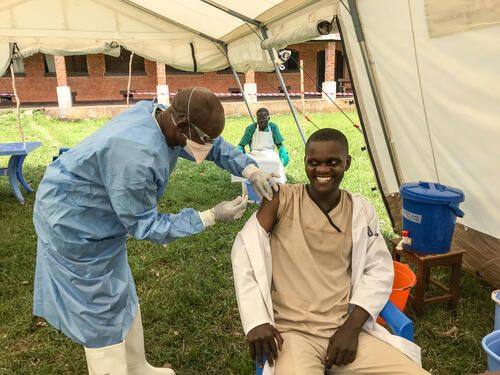

Ebola disease in DRC: find out how we're responding
Learn more
7996 Results
 
The female inpatient department at MSF cholera treatment center in Khamer. MSF is receiving an increased number of cholera patients in Yemen since the beginning of May 2017. This cholera treatment center alone, treated more than 1200 patients in less than two weeks. The center is still receiving patients.
Yemen

Yemen: A timeline of more than three years of war

A timeline of more than three years of war Project Update - 4 Apr 2018
 
Raqqa, the west side of the city. A woman looks at what was her home once and now turned into rubble due to the Raqqa offensives.
Syria

Raqqa - The hidden deadly threat

"Raqqa is devastated and many homes and public places were, and still are, littered with improvised explosive devices and unexploded munitions." Photo Story - 4 Apr 2018
 
Humaid, 45 years old, is from Dhiban, in Deir ez-Zor. Five of his daughters (Sedar (4 years old), Dumua (5), Butul (6), Arimas (9) and Lamis (13)) were on the rooftop of the house when they were severely injured by a booby-trap. Sedar, the youngest, has been partially amputated of both legs, and Lamis, the eldest, of one leg.

“We fled Dhiban because of the clashes. Once the situation calmed down I went back by myself to check the house and did not see any suspicious device, so I brought my family as well.” The accident that almost killed the girls happened two month later. “The girls had never seen a mine before, how could a child know about a mine? They put the mines in the fridge, in the door handle, under the carpet, inside the Quran. The hospital is full of people who have amputated legs. What was the fault of the children? They are not part of the conflict. This is not a war, it’s a war against human.”
Syria

Patient numbers double in northeast as more people return home to landmines

“These explosive devices do not choose their targets. They do not respect peace treaties or ceasefires and can stay concealed for months or years after a conflict ends.” Project Update - 3 Apr 2018
 
msf-placeholder
Tuberculosis

Breast tuberculosis in men: A systematic review

Breast tuberculosis in male is a rarely reported and poorly described condition. Public Library of Science - 3 Apr 2018
 
Yemen, gouvernorat de Saada, Haydan, mars 2018. L'école de Haydan, bombardée en 2016 par la coalition internationale dirigée par l'Arabie Saoudite.

Saada governorate in Yemen, Haydan, March 2018.Haydan school, bombarded in 2016 by the international coalition led by South Arabia.
Yemen

Pledging conference – money alone is not enough

"The pledges made today by donor countries are obviously essential, however they must be complemented by much more robust action on the ground." Statement - 3 Apr 2018
 
Many homes in the towns of Jalawla and Sadiya, Diyala governorate, central Iraq, were destroyed in 2014/15 and still lay in ruin because their owners cannot afford to rebuild them. 

Doctors Without Borders/ Médecins Sans Frontières (MSF) has been working in Diyala governorate since 2015 supporting displaced people, host communities and people who have returned to the area. 

In both Jalawla and Sadiya, MSF provides treatment for non-communicable diseases (NCD), mental health and sexual reproductive healthcare for families returning to the area in collaboration with the Directorate of Health. Currently, 2,117 NCD patients receive treatment in both locations. In Jalawla, MSF contributed to the rehabilitation of the primary healthcare centre and hospital.

In Alwand 1 and 2 Camps, MSF provides mental health services, NCD consultations and Sexual Reproductive Health services. In all project locations in Diyala, MSF conducts health educational sessions about NCD, sexual reproductive health, psychological first aid and endemic diseases. In February 2018, in Alwand 1 Camp, MSF provided 213 individual and 287 group mental health consultations.
Iraq

Isolated, angry, anxious and stressed - mental health in Iraq

The psychological and emotional scars of war in Iraq are immense and thousands of people need mental health assistance. Voices from the Field - 2 Apr 2018
 
The 31th of march we receive the order to not rescue people on a rubber boat. The boat was closed from us and we had the obligation to wait for the LCG.
Mediterranean migration

MSF Evacuates 39 Vulnerable People From Packed Rubber Boat

Yesterday at 10.32am the search and rescue ship Aquarius along with the Libyan coast guard, were alerted by the Italian Rescue Maritime Coordination Centre (IMRCC) to a rubber boat in distress with an estimated 120 people, in international waters 23-24 nautical miles from the Libyan coast. Statement - 1 Apr 2018
 
msf-placeholder
Tuberculosis

Global programmatic use of bedaquiline and delamanid for the treatment of multidrug-resistant tuberculosis

The World Health Organization recommended two new drugs, bedaquiline (BDQ) and delamanid (DLM), for the treatment of multidrug-resistant tuberculosis (MDR-TB) in 2013 and 2014, respectively. An estimated one third of patients with MDR-TB would benefit from the inclusion of these drugs in their treatment regimens. The International Journal of Tuberculosis and Lung Disease - 1 Apr 2018
 
msf-placeholder
Tuberculosis

Tuberculosis in Visceral Leishmaniasis-Human Immunodeficiency Virus Coinfection: An Evidence Gap in Improving Patient Outcomes?

Visceral leishmaniasis (VL)-human immunodeficiency virus (HIV) coinfection remains a major problem in Ethiopia, India, and Brazil. Tuberculosis (TB), a treatable factor, could contribute to high mortality (up to 25%) in VL-HIV coinfection. However, the current evidence on the prevalence and clinical impact of TB in VL-HIV coinfection is very limited. In previous reports on routine care, TB prevalence ranged from 5.7% to 29.7%, but information on how and when TB was diagnosed was lacking.
Open Forum Infectious Diseases - 1 Apr 2018
 
Noor lives in Balukhali makeshift settlement. 

‘’If a woman has been raped she will immediately feel alone and isolated. She will not speak to anyone and she will not look after herself. I’ve helped different women speak about their feelings and  fears. Women have been suffering a lot, many of them have lost their husbands. Now they are alone and they have to educate their children.”
Bangladesh

Three questions about sexual violence against Rohingya refugees

MSF teams in Bangladesh are treating survivors of sexual violence as part of their response to the Rohingya refugee crisis. To date, they have treated more than 125 people but the suspected number of cases is much higher. Midwife Aerlyn Pfeil helped set up the programme. Here, she answers questions about the challenges in treating these patients, MSF's approach, and what she will remember about the survivors she met in Bangladesh. Voices from the Field - 1 Apr 2018
Four mothers posing in a corridor of the Hospital in Bili. All four of them are staying in the hospital with their child, that's suffering from a severe case of malaria. Since the beginning of the project in 2016, the pediatric ward already treated more than 4.000 cases of complicated/severe form of malaria.
Médecins Sans Frontières (MSF)

Independent medical humanitarian assistance

We provide medical assistance to people affected by conflict, epidemics, disasters, or exclusion from healthcare. Our teams are made up of tens of thousands of health professionals, logistic and administrative staff - most of them hired locally. Our actions are guided by medical ethics and the principles of independence and impartiality. We are a non-profit, self-governed, member-based organisation.

Learn more