Complex fractures, resulting from road accidents or bullet or knives wound, usually require at least a cast, often an external fixator, and sometimes amputation.
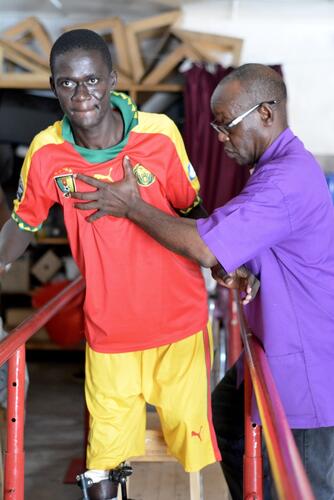
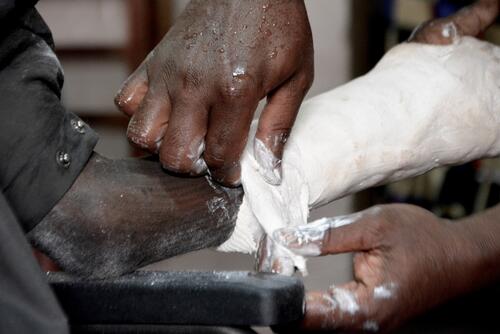
Applying plaster, bandages, giving massages… but also listening and reassuring. Throughout the sessions, close links are forged between patients and physiotherapists. For many patients, mental acceptance of their new physical condition is also achieved through physiotherapy.
© Elise Mertens/MSF

Restoring body and mind through physiotherapy

Applying plaster, bandages, giving massages… but also listening and reassuring. Throughout the sessions, close links are forged between patients and physiotherapists. For many patients, mental acceptance of their new physical condition is also achieved through physiotherapy.
© Elise Mertens/MSF
Ebola disease in DRC: find out how we're responding
Learn more

The physiotherapy department of the SICA hospital in Bangui, the capital of Central African Republic, plays an essential role in the recovery process of patients. Teams ensuring an optimal recovery period for patients, giving them a maximum amount of autonomy in order to allow them a rapid social and professional reintegration, and learning to live with a new physical condition. At the SICA hospital, 75 percent of patients are victims of road accidents or have been wounded by bullets or knives.

Fractures are often so complex that they require external fixation and sometimes even the amputation of the damaged limb. In order to avoid long-term physical consequences, particularly due to a bad repositioning of bones or significant weakening of the muscles, physiotherapists must treat patients as early as possible, as soon as they leave the operating theatre or the emergency department. However, whatever the treatment, regaining mobility and the rehabilitation process often lasts for months or even years.

Composed of five members, the SICA physio team performs an average of 150 consultations per week and oversees the weekly outpatient monitoring of more than 100 people. Over 10 percent of patients treated at the SICA hospital are referred from the provinces. Due to the lack of specialised care outside of Bangui, the continuity of rehabilitation is generally difficult to ensure once the patients are discharged from hospital. This is why the physiotherapists make sure that patients learn simple and easy to perform exercises at home. The aim is to get back on track as quickly as possible.
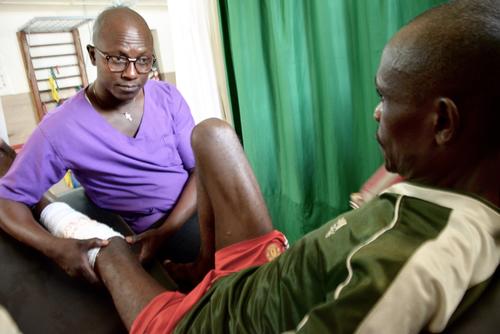
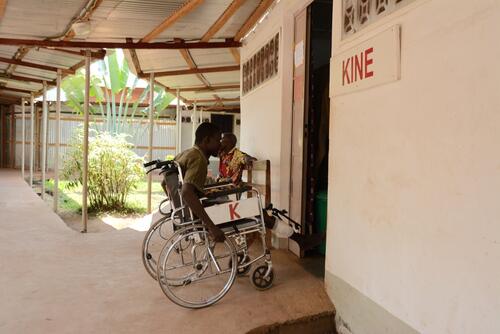
MSF physiotherapy staff Brice is working with 46 yo Jean Noel, a trauma patient who survived moto accident. Early physiotherapy care is essential to allow the patient the best recovery possible after a trauma and surgery and to mitigate long-term consequences. Rehabilitation often take month, even years.
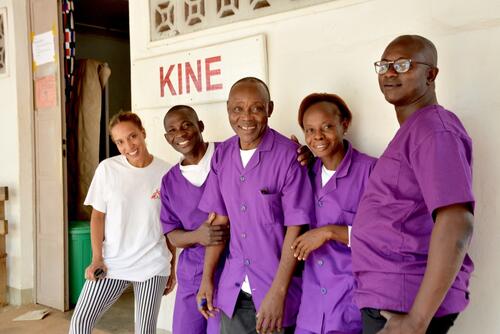
With their purple uniform, the physiotherapists of the SICA hospital are easily recognisable. In order to ensure optimal recovery for patients and to avoid disabling consequences, teams intervene as soon as the operation is over or as soon as they leave the emergency department.
Elise Mertens/MSF
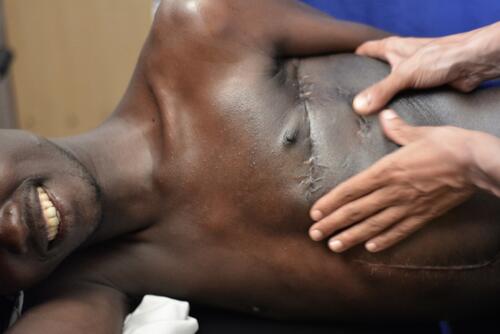
Complex fractures, resulting from road accidents or bullet or knives wound, usually require at least a cast, often an external fixator, and sometimes amputation.
Applying plaster, bandages, giving massages… but also listening and reassuring. Throughout the sessions, close links are forged between patients and physiotherapists. For many patients, mental acceptance of their new physical condition is also achieved through physiotherapy.
Elise Mertens/MSF
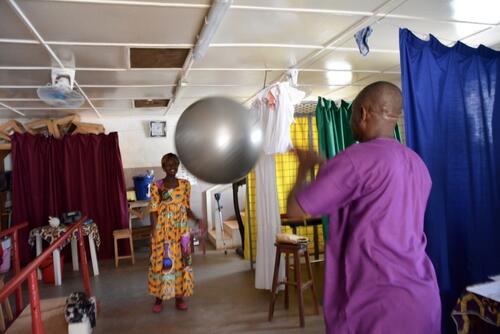
Teaching simple and reproducible exercises at home daily is the key to promoting rapid and effective rehabilitation of the patient. Here with 27 yo Stephanie who had a serious accident while travelling on a motorbike taxi in the streets of Bangui. The bones of her right leg were completely crushed in the shock with the car.
Some elastics, balls and weights are enough to teach patients how to regain motion. Using simple and easy to perform exercises at home daily is the key to promoting rapid and effective rehabilitation of the patient.
Elise Mertens/MSF
Moara, Seraphin, Bonaventure, Elsa and Brice form the physiotherapy team at SICA hospital. They perform an average of 150 consultations per week in hospital services and ensure weekly outpatient monitoring of more than a hundred people.
© Elise Mertens/MSF
Early physiotherapy care is essential to allow the patient the best recovery possible after trauma and surgery and to mitigate long-term consequences. Rehabilitation often takes month, even years.
Fractures due to road accidents or injuries due to weapons - which account for 75 percent of the patients in care at the SICA Hospital – are generally deep and complex. They often require the installation of an external fixator or even amputation. In CAR, only MSF offers prostheses for the lower limbs, but we aim to be able to offer prostheses adapted to fit the upper limbs as well by 2019.
Elise Mertens/MSF
Applying plaster, bandage, giving massages….but also listening and reassuring. Throughout the sessions, close links are forged between patients and physiotherapists. For many patients, mental acceptance of their new physical condition is also achieved through physiotherapy.
After orthopaedic or visceral surgeries, recovery often takes months or even years. In order to accompany the patient in their healing process, MSF offers psychological support to those in need, in parallel with physiotherapy.
Elise Mertens/MSF
25 yo Zakaria was injured by a grenade thrown by a group of young people as he has ventured out of his home with a few friends on 8 April following the disarmament attempt by the UN mission forces (MINUSCA) in the PK5 neighbourhood in Bangui. Dozens of wounded were admitted at the SICA Hospital that day and the following ones. For Zakaria, the medical verdict was particularly serious. Open fracture of both legs with the need to amputate the left leg.

“For the time being, I still have to wait for my stump to heal and especially, I have to learn how to stand on one leg. Balance is the most difficult to achieve” he explains.
The SICA Hospital physiotherapy team has treated 738 new patients and has already provided more than 6,500 physiotherapy sessions during the first six months of 2018.
Elise Mertens/MSF