




Ebola disease in DRC: find out how we're responding
Learn more
7998 Results
 
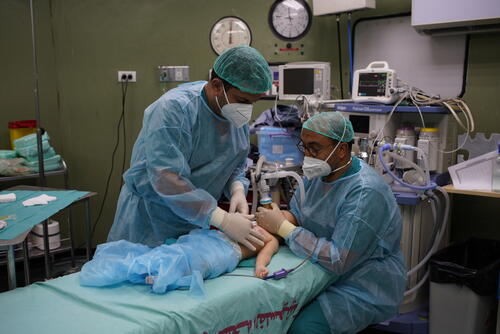
A COVID-19 patient receiving oxygen therapy while admitted at the MSF run inpatient ward of the Al-Shifaa 13 COVID-19 ward in Al-Kindi Hospital, Baghdad. MSF nurses checking up on the condition of the patient and giving instructions to the caretaker about how to support the patient -her mother- and assist her.
Iraq

The restless challenge of tackling COVID-19 in Iraq

Iraq's overwhelmed healthcare system remains fragile as COVID-19 continues to threaten the most vulnerable people in the country. Project Update - 21 Jan 2022
 
View of Rhoe Internally displaced people camp at sunset. 
As a result of successive attacks in the region, more than 40,000 additional people have been forced to take refuge in the Rhoe site in 2 months, bringing its population to more than 65,000 displaced.
Democratic Republic of Congo

Thousands of people in precarious conditions as violence set to repeat in Ituri

As cycles of violence return to Ituri province, tens of thousands of people have fled their homes and are living in precarious and dangerous conditions in displacement camps. Project Update - 19 Jan 2022
 
Brgy. New Nazareth, Basilisa, Dinagat Islands: Many villages along the coastal areas were hit by the typhoon, leaving damaged building and boats, and many without roofs over their heads. 

Doctors Without Borders/Médecins Sans Frontières (MSF) emergency teams will start providing medical and humanitarian assistance to communities on the remote islands of Dinagat, Siargao and other outlying areas, some of the worst affected by Typhoon Rai (local name: Odette), which struck the Philippines in December 2021 causing hundreds of casualties.
Philippines

MSF launches response after Typhoon Rai leaves hundreds of casualties in its wake

After Typhoon Rai battered the Philippines in December, leaving hundreds of casualties, our teams have begun medical and humanitarian activities in the worst-affected regions. Project Update - 18 Jan 2022
 
MSF translator Tedros gives instructions to women waiting with their children for a medical consultation at a mobile clinic in the village of Adiftaw, in the northern Ethiopian region of Tigray.
Ethiopia

Six months on, still no responsibility established for the killing of María, Tedros and Yohannes in Tigray

Six months after the murder of our three colleagues Maria, Tedros and Yohannes in Tigray, Ethiopia, the full circumstances of, and responsibility for, their killing remains unclear. Interview - 13 Jan 2022
 
A man drags a tarpaulin raft through the flood in Rubkona, Unity State.

Across Unity state people’s homes and livelihoods (crops and cattle), as well as health facilities, schools, and markets, are completely submerged by floodwaters.
South Sudan

Hundreds of thousands of people in dire conditions months after floods

In South Sudan, over 800,000 people have been directly affected by flooding, which has left them in precarious conditions, vulnerable to disease and malnutrition. Project Update - 7 Jan 2022
 
Much of the local economy depends on the rearing of livestock such as cows, goats and camels. Because of a lack of rain and a very bad harvest this year, it has become difficult for famers to feed their animals. Some have taken their cattle south to find pastures, or to sell their animals.
Chad

“If the rain abandons us again, we don’t know what we will do”

In Chad, malnutrition has become a chronic crisis, due to multiple causes, including poor harvests - linked to climate change - inadequate dietary choices as well as socio-cultural factors. Project Update - 6 Jan 2022
 
Forest in Podlaskie region, Poland. In the end of December temperatures dropped to -11 degrees ˚C.
Refugees, IDPs and people on the move

MSF leaves Polish border after being blocked from assisting people

Without permission to assist people in need on the Polish border, we have regrettably withdrawn teams from the area. Press Release - 6 Jan 2022
 
Sur les rives du fleuve Logone qui sépare le Cameroun du Tchad ; non loin du village de Ngueli (Tchad) où MSF propose des consultations médicales aux réfugiés camerounais. Novembre 2021
Chad

Tens of thousands of people flee Cameroon as violence spreads

As violence spreads on the Cameroonian border, thousands of people have fled to Chad where our teams respond to the needs of people caught in precarious conditions. Project Update - 4 Jan 2022
 
Iraqi father holding his child covered with a sleeping bag which they received from the Polish volunteers (from the NGO Fundacja Ocalenie) supporting migrants at the border. A family of 13 Iraqi Kurds including 4 children asked for asylum in Poland. The family was taken by the Polish border guards back to emergency state zone at the Belarusian border. On the next day, they sent their location indicating that were back on the Belarusian side of the border.
Belarus

8 things to know about the EU/Belarus border crisis

Here are eight things to know about the EU/Belarus border crisis, its effect on people on the move, and how MSF is responding. Project Update - 31 Dec 2021
 
MSF medical staff puts on PPE before entering the MSF COVID-19 ward at Yangon’s Aung San Tuberculosis Hospital on 16 August 2021 to treat patients affected by Myanmar’s third wave of the pandemic.
Myanmar

Responding to COVID-19 during political crisis in Myanmar

Political turmoil shook Myanmar and the COVID-19 pandemic brought the healthcare system to its knees - our teams look back at the successes and failures of our response to the pandemic. Voices from the Field - 30 Dec 2021
Four mothers posing in a corridor of the Hospital in Bili. All four of them are staying in the hospital with their child, that's suffering from a severe case of malaria. Since the beginning of the project in 2016, the pediatric ward already treated more than 4.000 cases of complicated/severe form of malaria.
Médecins Sans Frontières (MSF)

Independent medical humanitarian assistance

We provide medical assistance to people affected by conflict, epidemics, disasters, or exclusion from healthcare. Our teams are made up of tens of thousands of health professionals, logistic and administrative staff - most of them hired locally. Our actions are guided by medical ethics and the principles of independence and impartiality. We are a non-profit, self-governed, member-based organisation.

Learn more