


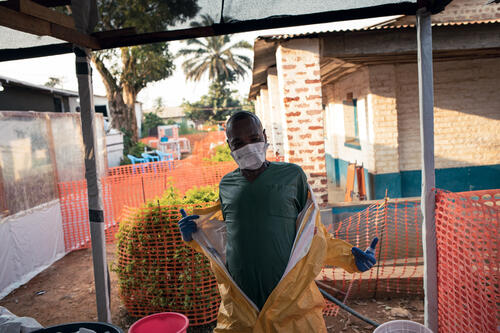
- The Ebola disease outbreak in Democratic Republic of Congo continues to outpace response efforts.
- In two months, this outbreak has become the third largest, and fastest growing, Ebola disease outbreak on record.
- Expanded international support is urgently needed to ensure the response is adequately resourced.
BUNIA — Two months after the Ebola disease outbreak was officially declared in Democratic Republic of Congo (DRC), there have been more than 2,000 confirmed cases and 750 deaths. Médecins Sans Frontières (MSF) is calling for an urgent scale-up of the medical response. The epidemic continues to spread at an unprecedented pace and into new areas, while efforts to control it remain insufficient.
“Every delay costs lives. We are still chasing the outbreak instead of staying ahead of it,” says Trish Newport, MSF emergency programme manager. “More people become infected, more families lose loved ones, and the epidemic becomes harder to contain. We need stronger, more coordinated international action to move faster and improve access to both Ebola care and other essential health services.”
In just two months, the current Ebola disease outbreak, caused by the Bundibugyo virus, has become the third largest, and the fastest growing, Ebola outbreak on record. In less than five weeks, the number of confirmed cases has tripled, from 650 to nearly 2,000 as of 12 July.
The number of deaths has increased more than fivefold, from 130 to over 700. The epidemic has already exceeded half the number of cases recorded during DRC’s 2018–2020 Ebola outbreak, which lasted almost two years.
Every delay costs lives. We are still chasing the outbreak instead of staying ahead of it.Trish Newport, MSF emergency programme manager
The situation is particularly alarming, as the outbreak continues to expand geographically. Limited access to medical care, an overstretched surveillance system, and increasing pressure on treatment centres mean that entire communities outside of major urban areas remain without adequate support.
MSF is calling on health authorities and humanitarian organisations to swiftly increase resources across all aspects of the Ebola response, including community engagement, surveillance, testing and diagnosis, patient care, survivor support, and the safe and dignified management of bodies and burials. This must be done while ensuring that other urgent health needs are also addressed.
Ituri province, the epicentre of the outbreak, accounts for approximately 90 per cent of all confirmed cases.
“In Mongbwalu [in Ituri], we are seeing the deadly human consequences of these gaps every day,” says Ayokunnu Raji, doctor and MSF medical program manager. “At the ebola treatment centre, we continue to see patients arriving in critical condition, little chance of survival.”
“Since MSF started its Ebola response activities, we have treated 57 survivors, but more than 110 patients have died,” says Raji. “Increased national and international resources would help prevent further transmission and loss of life.”
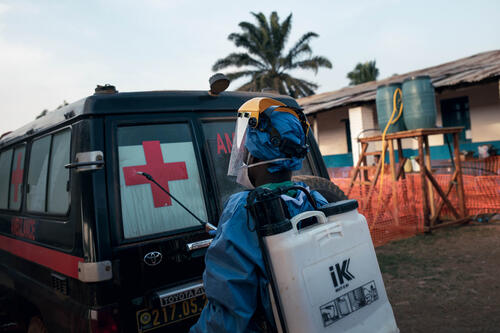
“In Bunia, the 90-bed Elikiya Ebola treatment centre is almost always operating at full capacity. People regularly tell us they prefer to wait at home and come only when a bed becomes available,” says Sylvie Kaczmarczyk, MSF emergency coordinator in Bunia. “As a result, we continue to receive patients who arrive late and are already critically ill.”
“It is devastating to know that many of these deaths could have been prevented through earlier diagnosis and timely access to care and treatment,” says Kaczmarczyk.
Bringing the response closer to communities
While other medical organisations are working alongside the Ministry of Health in eastern DRC, significant gaps remain.
DRC’s surveillance system is designed to detect cases early through strong community networks and the local health system. However, the current Ebola disease outbreak, combined with multiple other disease threats, has pushed the system to its limits.
The key to slowing and ultimately stopping the spread of the epidemic is to bring the response closer to communities while boosting the medical response and surveillance system, so that cases can be identified and isolated as early as possible. Efforts to expand testing, contact tracing, and community engagement must also continue.
The authorities in DRC and other countries are applying movement restrictions, including border closures, self-monitoring requirements and measures affecting humanitarian personnel, that create additional challenges for placing and rotating specialised Ebola staff.
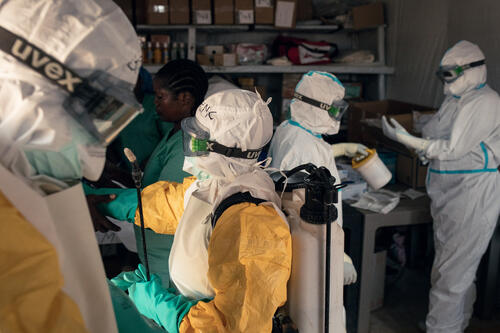
MSF currently runs seven Ebola treatment centres and more than 15 isolation units across Ituri, North Kivu, South Kivu, and Tshopo provinces, with a combined capacity of more than 430 beds. Since the beginning of the outbreak and up to 14 July, our teams had admitted more than 968 patients, including 357 confirmed cases.
We have also supported the recovery of 116 survivors, following treatment and care. In addition, MSF supports the Ministry of Health with surveillance and detection activities, community engagement, training, and efforts to ensure safe access to other essential healthcare services.
Ebola: a crisis amid multiple emergencies
The Ebola outbreak is unfolding in a context of armed conflict, displacement, and multiple concurrent health emergencies. Insecurity continues to restrict access to some communities, while MSF teams are simultaneously responding to other urgent medical needs, including cholera and malaria. The approaching rainy season is also expected to drive a surge in malaria cases, placing further strain on an already overstretched health system.
It is crucial to accelerate efforts to improve access to Ebola care while ensuring the provision of other basic humanitarian assistance, including healthcare and water and sanitation services.
“We cannot continue responding to the epidemic with the same limited resources while it continues to outpace us,” says Newport. “Only a robust, adequately resourced medical response that truly reflects the scale of needs on the ground can prevent this outbreak from becoming a crisis beyond our ability to contain. To achieve that, expanded international support is urgently needed.”
MSF’s Ebola disease outbreak response in DRC
Since the start of the outbreak, MSF teams in Ituri, North Kivu, South Kivu, and Tshopo provinces have established Ebola treatment centres in Bunia, Mongbwalu, Komanda, Goma, Butembo, Bukavu, and Lwiro, as well as more than 15 isolation units. Additional isolation and treatment facilities are being prepared across the affected provinces. MSF has also strengthened infection prevention and control measures in health facilities we support. In addition, we are carrying out a wide range of critical activities, including community engagement, support for surveillance activities, training health workers in infection prevention and control, supplying health facilities with medicines and equipment, and helping to ensure the continuity of essential healthcare services beyond the Ebola disease response. Hundreds of tonnes of medical supplies and equipment have been shipped from Kinshasa and abroad, and more than 2,200 staff are currently involved in MSF's Ebola response, including 800 Ministry of Health staff supported by MSF.
MSF activities in DRC
Alongside our support for the Ebola disease outbreak response, MSF remains committed to providing impartial medical care to people across DRC. We work in 16 of the country's 26 provinces. MSF teams respond to the needs of people affected by conflict, displacement, disease outbreaks, and sexual violence. Key activities include surgical care for people wounded by violence; malnutrition treatment; HIV and tuberculosis care; reproductive health services; paediatric care; malaria prevention and treatment; disease outbreak prevention, surveillance, and response; and mental health support. MSF teams are also responding to other preventable disease outbreaks, including cholera and measles.
DRC Ebola outbreaks
Children are being left behind in the current Ebola disease outbreak response
Press Release
15 Oct 2026
DRC Ebola outbreaks
What will it take to end the Ebola disease outbreak in Democratic Republic of Congo?
Project Update
30 Sep 2026
DRC Ebola outbreaks
Ebola disease outbreak spreads like a megafire in North Kivu as new hotspots multiply
Project Update
5 Oct 2026