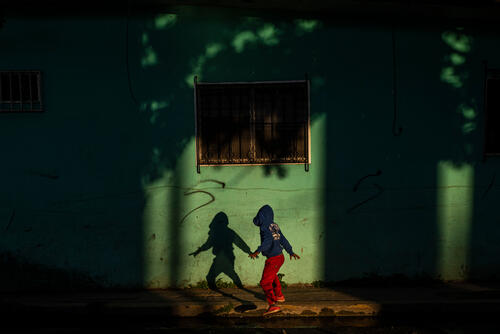
Ángel Alexis Ramirez Mejia, 9, plays under the Coatzacoalcos bridge on 25 March. Since leaving Comayagua, Honduras, he and his family have been travelling for 16 days, 14 of them on foot. 

MEXICO. Veracruz. Coatzacoalcos. March 25, 2021.
Nine-year-old Ángel plays under the Coatzacoalcos bridge. Since leaving Honduras, he and his family have been travelling for 16 days, 14 of them on foot. Veracruz, Mexico, March 2021.
© Yael Martínez/Magnum Photos

A year in pictures 2021

Nine-year-old Ángel plays under the Coatzacoalcos bridge. Since leaving Honduras, he and his family have been travelling for 16 days, 14 of them on foot. Veracruz, Mexico, March 2021.
© Yael Martínez/Magnum Photos
Ebola disease in DRC: find out how we're responding
Learn more

A year of responding to crises in images

In 2021, the COVID-19 pandemic continued unabated around the world, as did the work our teams undertook to respond to it. But the pandemic took a backseat in many countries, as other crises and needs overtook the concerns of the people we assist.

Our teams responded to crises of conflict and displacement. We cared for people with malnutrition and malaria. We supported people who were subjected to sexual violence and rescued those who were in danger crossing the Mediterranean Sea. We saw consequences of the climate emergency.

This collection of 54 images, taken between November 2020 and December 2021, was chosen from among an estimated 8,000, from among the around 75 countries we work in. In these images, staff and professional photographers from around the world have captured just some of the stories of people and patients, and our work with them, bearing witness to an essential humanitarian need – access to medical care.
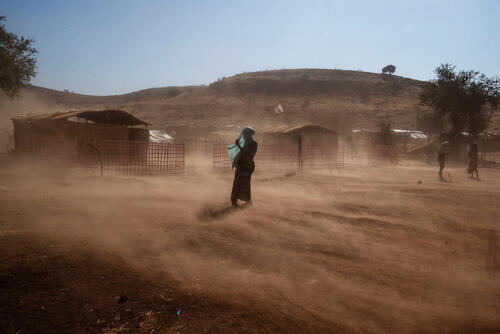
A refugee in the wind-blown dust in Um Rakuba refugee camp.

Ethnic Tigray, Ethiopian, refugees who fled the central government's military offensive against what is perceived as separatism by the Tigray regional government and its military branch TPLF. When crossing into Sudan the refugees are transferred and settled in Um Rakuba, which was already a site of camps during the 1984 famine.
MSF runs the water supplies and has an emergency clinic in the camp.

SUDAN, Gedaref Region, Eastern border with Ethiopia/Tigray Region. Um Rakuba Camp. 2020/12.
A refugee shields her face from the wind-blown dust in Um Rakuba refugee camp. People fled northern Ethiopia’s Tigray region starting in November 2020 to escape conflict between the military and the local Tigrayan People’s Liberation Front. Gedaref region, Sudan, December 2020.
Thomas Dworzak/Magnum Photos
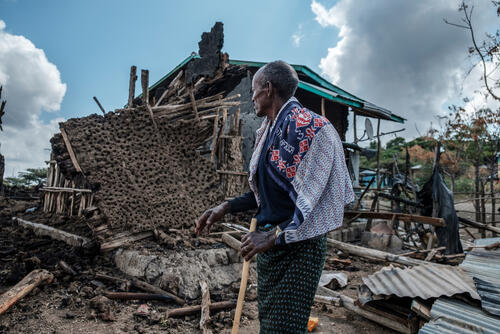
A man stands in front of his destroyed house in the village of Bisober, Ethiopia, on December 9, 2020.
A man surveys his destroyed house in the village of Bisober. Tigray region, Ethiopia, December 2020.
Eduardo Soteras Jalil


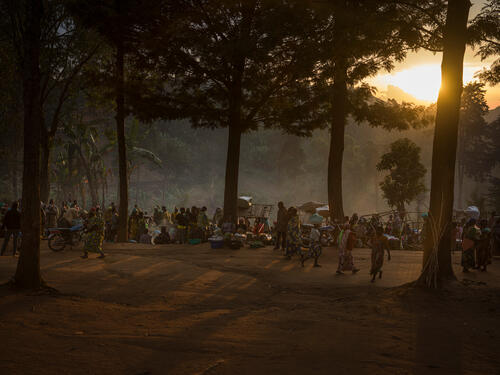
Around the Roman Catholic church of Drodro, a makeshift internally displaced people (IDP) camp named Tsuya has been in place for many years. Approximately 20,000 IDPs live there. 

DEMOCRATIC REPUBLIC OF CONGO. Ituri province. Drodro. 2021.
In the late afternoon sun, people carry on with their daily tasks in the makeshift Tsuya internally displaced people’s camp. The camp, which has been set up around the Catholic church in Drodro, accommodates approximately 20,000 people. Drodro, Ituri province, Democratic Republic of Congo, March 2021.
Newsha Tavakolian/Magnum Photos
Josias Madela was taking a shower in early January, when he unexpectedly experienced faintness and fell. Family members rushed him to hospital, where he was admitted, and tested for COVID-19. After his results came back positive he was transferred to the field hospital, where he says he was treated well. “I did not have the strength to do basic things, but nobody shouted at me.” He particularly appreciated the fact that his family were kept well informed. “I am blind, they could have worried but from the start they were reassured, and this made me feel I had nothing to fear,” he says.
Josias was taking a shower, when he unexpectedly fainted. Family members rushed him to hospital, where he was admitted, and tested for COVID-19. After his result came back positive, he was transferred to the field hospital, where he says he was treated well. Eastern Cape, South Africa, February 2021.
MSF/Chris Allan
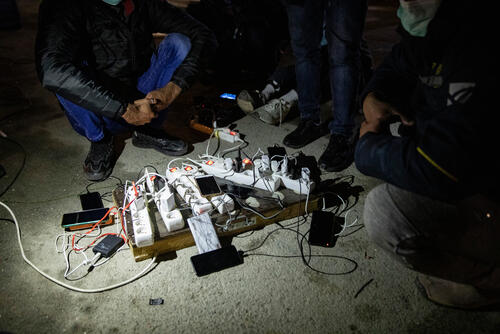
The “Talità Kum” refuge, located opposite Oulx railway station. The shelter is open from 6 pm to 10 am and it is managed by a network of volunteers.
People charge phones and power banks from electrical outlets in a shelter, managed by volunteers, for migrants crossing from Italy to France. Turin, Piedmont region, Italy, December 2020.
Francesca Volpi
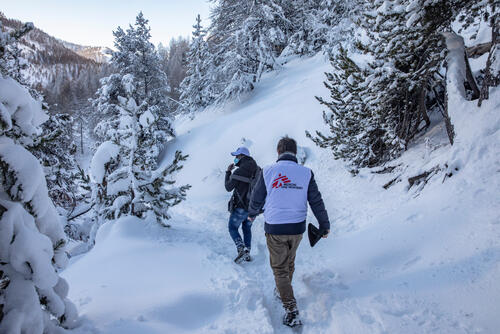
Even in winter, people head westwards across the snow-capped mountains towards France; many tell stories of being repeatedly turned back by the French police.
MSF staff walk part of the snow-covered trail in the mountains northwest of Turin, used by people seeking to cross from Italy to France. MSF teams monitor the situation and provide support to a number of volunteer organisations who support migrants making the journey along the trail. Italy, December 2020.
Francesca Volpi
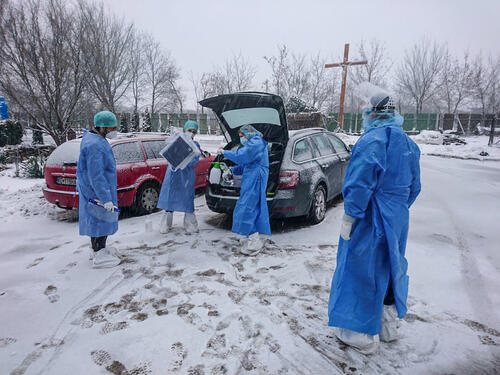
The MSF mobile team includes medical and non-medical profiles (Logistics, Administrators, Coordinators) and focuses on two pillars: (1) medical support and IPC trainings to nursing homes facing a high number of COVID-19 cases (2) medical support, mental health trainings, and health promotion trainings in Roma settlements.
An MSF mobile team, including medical and non-medical staff, unloads equipment to provide training to staff working in a nursing home on how to prevent the spread of COVID-19. Slovakia, March 2021.
MSF
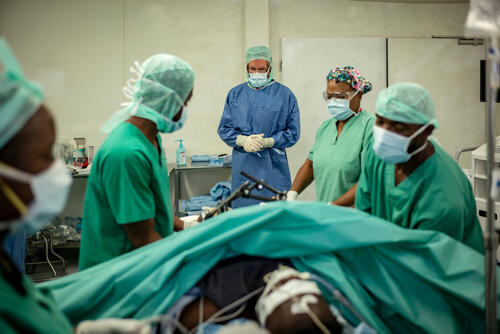
Doctors specialising in traumatology and vascular surgery amputate a patient with a leg injury.

“The mortality rate we have in Tabarre is low. The quality of care is high and there are very specialized medical staff. There is no other trauma center in Port-au-Prince that gives the necessary treatment for free. We face a lot of complex surgical cases here with patients then needing hospitalization.” – Stefano Zito, MSF medical activity manager, Tabarre Hospital
An MSF surgical team prepares to amputate the leg of a patient with a severe leg injury in Tabarre trauma hospital. Port-au-Prince, Haiti, December 2020.
Guillaume Binet/MYOP
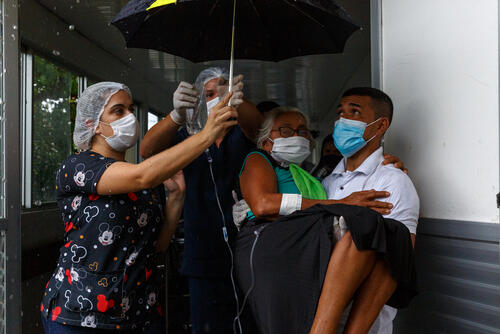
Patient is carried to the ambulance shortly after the start of a heavy rain in Tefé. She will go to the airport and from there to the state capital, Manaus, where there are more resources for her treatment of COVID-19. 

The transfer of this patient took place in late December 2020, before the health system in Manaus collapsed for the second time and referrals to the state capital were interrupted.
A woman with COVID-19 is carried out to an ambulance, which will take her to the airport to be then transferred to Manaus, the capital of Amazonas state, for further treatment. Tefé, Brazil, December 2020.
Diego Baravelli
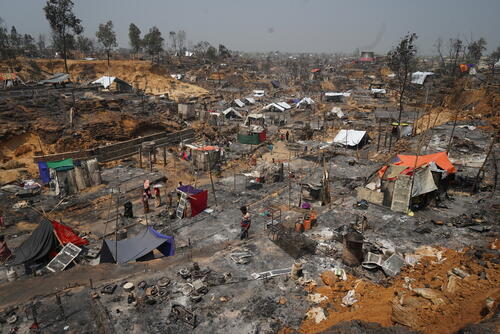
Fire destroyed thousands of shelters in several of the camps for Rohingya refugees. There are currently around 860,000 Rohingya refugees in Bangladesh and living conditions for them deteriorating due to several factors, including COVID-19 measures.
People start to rebuild shelters among the burnt-out remains of a part of Cox’s Bazar refugee camp for Rohingya people that was destroyed by fire. Bangladesh, March 2021.
Pau Miranda
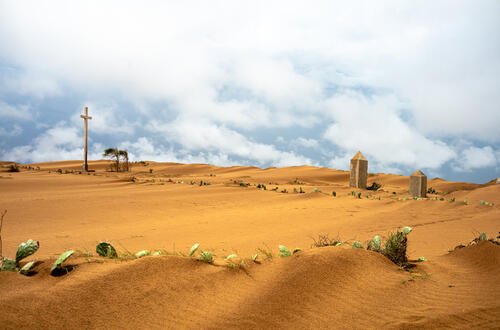
Formerly lined with cacti, the roads and paths are now buried under the sand.

The food hunger season, which usually ends in April, is becoming more critical each year in the desert regions of southern Madagascar. Three consecutive years of drought have severely affected harvests and access to food, in a context now marked by the Covid-19 pandemic, which has led to a drop in seasonal employment and other sources of income. From December onwards, violent sand winds also covered part of the arable land and food used during the lean season, such as cactus fruit. As a result, the chronic food and nutrition crisis, known on the island as kéré, is hitting the inhabitants even harder.

Since the last week of March, an MSF team of medical and logistical staff has been working in the Amboasary district in the Anosy region to assess the situation and the activities the organisation could implement to help respond to the emergency. The last MSF operation in Madagascar goes back to 2017 when we supported Madagascar’s Ministry of Health to tackle an outbreak of pneumonic plague.
Formerly lined with cacti, roads are now buried under sand, a legacy of three consecutive years of drought. The ‘hunger gap’ – the period between harvests when food becomes scarce – is becoming more critical in desert regions. Anosy region, Madagascar, March 2021.
Ainga Razafy/MSF
Commune of Ranobe, Amboasary District.

People in the south-east of Madagascar are facing the most acute nutritional and food crisis the region has seen in recent years. MSF began setting up mobile clinics in Amboasary district in late March to screen and treat acute malnutrition in remote villages like those of Ranobe commune, providing ready-to-use therapeutic food and medical care. 
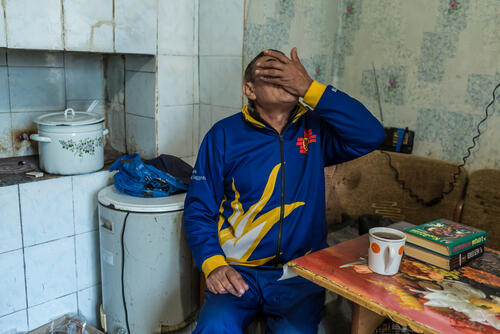
42-year old Vitasoa has six children. She’s brought four of them to the Médecins Sans Frontières mobile clinic. All the children are included in the nutrition programme launched at the end of March to respond to the food and nutrition emergency in southern Madagascar. 
 
“We live in Fenoarivo, and it took us five hours to walk here from Ranobe. During the rainy season, we live off cassava, mangoes and edible leaves. But, nothing’s growing because there’s been no rain. We make do with manioc tubers we find in the forest, cactus fruit and edible leaves. We have to dig in the sand for water as there’s also less surface water. Every day we pray for rain. We’re staying positive, but we really hope it’ll come soon.”
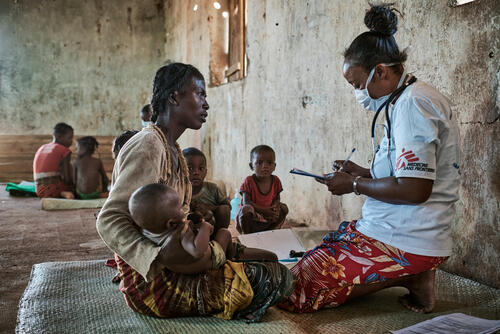
Vitasoa and four of her six children are seen by an MSF nurse after they walked five hours to reach an MSF mobile clinic in Ranobe to get help for malnutrition. People in southeastern Madagascar are facing the most acute nutritional and food crisis the region has seen in recent years. “During the rainy season, we live off cassava, mangoes and edible leaves. But nothing’s growing because there’s been no rain,” says Vitasoa. Amboasary district, Anosy region, Madagascar, April 2021.
iAko M. Randrianarivelo/Mira Photo
MSF medical staff helps France undress to check her chest wound and change her dressings, at the MSF’s SICA Hospital, on 2nd February 2021, in Bangui

France Beldo, 31, was wounded by a stray bullet on 13 January 2021 attack in the outskirts of Bangui, Central African Republic.
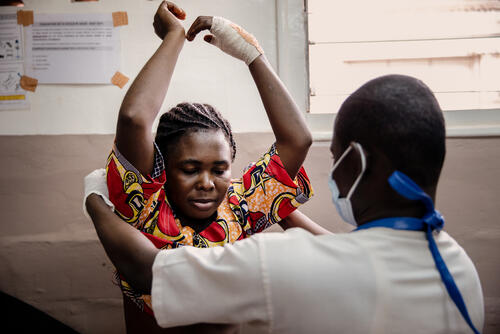
France receives help to get undressed, so that MSF medical staff at SICA hospital can change the dressing and check a chest wound, the result of a stray bullet. Bangui, Central African Republic, February 2021.
Adrienne Surprenant/Collectif Item for MSF
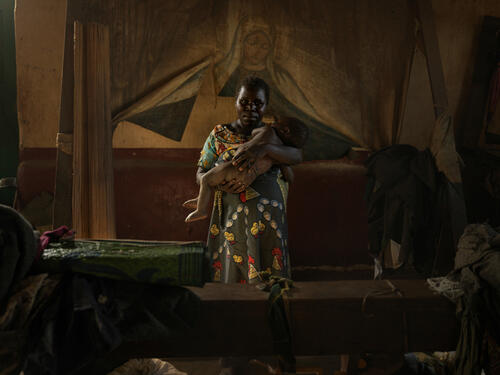
Christine, 30, holding up her baby, a boy. Her village was attacked by rebels, Christine ran away with her seven children and found shelter in the old church in Drodro.
Christine holds her baby son in the old church in Drodro, to where she fled following the attack on her village by armed groups. Ituri province, Democratic Republic of Congo, March 2021
Newsha Tavakolian/Magnum Photos
Nanette poses for a portrait in Bangui, CAR, on 11th December 2020. She went to investigate violence in her hometown in 2014. There, she saw pigs eating corpses, and the bodies of her parents in a river. She kept taking notes and images, knowing it was important to document this. When she was surrounded by a group of men, she was overpowered and they raped her. 

Nanette’s association, National Association for the Support of Free Women and Girls (ANAP) does social and economic reinsertion for survivors, as well as offers psycho-social support and eases the reference to MSF’s Tongolo centre. Compiling the testimonies and files of the survivors, Nanette also follows their cases with the Human Rights and justice organisations active in the Central African Republic.
Nanette, a survivor of sexual violence, poses for a portrait. In 2014, she went to investigate violence in her hometown where she saw pigs eating corpses, and the bodies of her parents in a river. While she was documenting the scene, she was surrounded by a group of men, overpowered, and then raped. Her association works with MSF’s Tongolo centre to care for victims and survivors of sexual violence. Bangui, Central African Republic, December 2020.
Adrienne Surprenant/Collectif Item for MSF
Amatou (lying down in the pirogue), 25 , has been a refugee in Ndu, Democratic Republic of the Congo, since the violent events of 2017 that occurred in Bangassou. She is pregnant and about to give birth but the midwives in the MSF-supported Ndu health centre identified some complications (hemorrhage) that cannot be managed from the health centre. Amatou is therefore referenced to the MSF-supported hospital in Bangassou, on the other side of the river, where she can be operated, if needed. 

Amatou is brought here by Odette, a midwife working in the small health center in Ndu, DRC. Facing the town of Bangassou, on the other side of the Mbomou river, the village has been hosting CAR refugees for years following spikes of violence. 

When the armed offensive started on Bangassou on January 3, more than 13,000 people fled the city and crossed the river to seek refuge in this village. The number of consultations at the health center exploded and MSF had to quickly increase its support to take care of women and children suffering from malaria, respiratory infections and diarrhea, not to mention the many pregnant women.

Today, Odette is alongside Amatou. The young woman is about to give birth but is bleeding. “She can’t deliver here, let’s bring her to Bangassou,” she says.

Amatou is then transported by stretcher to the river where a pirogue awaits her. She will make the crossing with Odette before being taken by the MSF ambulance to the university hospital, where our teams manage most serious cases.

For Amatou, the presence of MSF on either side of the river has made the difference today. The Bangassou hospital is the only one able to deal with obstetric complications in the district.

"Amatou is in good hands now", rejoices Odette after accompanying the mother-to-be to the delivery room, and heading back to the river to go back to the Ndu health center.
Midwife Odette accompanies Amatou (lying down in the pirogue), who is pregnant and about to give birth, across the river to be transferred to the MSF-supported hospital in Bangassou, to receive treatment following complications that can’t be managed in the MSF-supported Ndu health centre. Central African Republic, January 2021.
Alexis Huguet
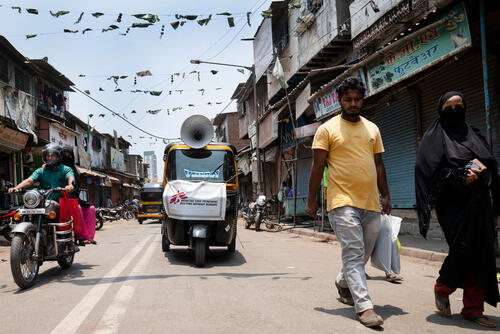
An Auto-Rikshaw (tuktuk) visiting alley lanes of Mumbai’s M-East Ward slums to generate COVID-19 Awareness
A tuk-tuk used by MSF to spread health promotion messages on how to avoid COVID-19 moves through the lanes of Mumbai’s M-East Ward district. India, May 2021.
Premananda Hessenkamp
"To avoid making the population suffer even more or making them sick, we do not sell water from the lake but that from the tap" - Jean-Claude Bazibuhe
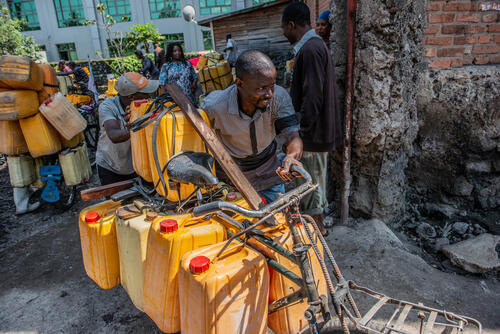
Selling water has been my job for 17 years, since I left the army. I am part of the association of water dealers on bicycles in Goma, a structure that allows us in this particular period to supply the population with drinking water to fight against cholera and other water-borne diseases. The demand for potable water is on the rise due to damage to the city's main water reservoir. We’re working hard to supply the households and match their critical needs. 

Since the eruption of the Nyiragongo volcano on May 22, water has become a scarce commodity. There is no question of leaving families without water: I have seven children, I understand their difficulty. In return, they pay me to provide food for my family. I cannot take advantage of the current crisis situation to make money and double the price of my services. The price has not changed: 250 Congolese Francs (0.10 euros) for a jerrycan of 20 liters of water. Sometimes I have to ask for up to 300 FC (0.14 euros) if I had trouble getting supplies. To avoid causing further suffering to the population or making them sick, we do not sell water from the lake but that from the tap. 

We are still living with the traumas of that night of May 22. When the night turned red, we rushed out of the house to escape the danger. Two of my children were injured and they are still in pain. They took shelter in Minova, in South Kivu. They are back in Goma and it is now hunger that grips them. “
Jean-Claude pushes his bike full of jerry cans for clean water; the need for clean water became critical in the wake of the eruption of the Nyiragongo volcano on 22 May. Goma, Democratic Republic of Congo, June 2021.
Moses Sawasawa
“We don't know where to go to escape this new danger. We too, in Goma, need assistance and medical care. ”- Dieudonné Bizimungu
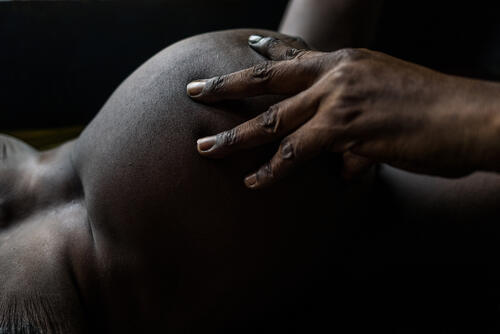
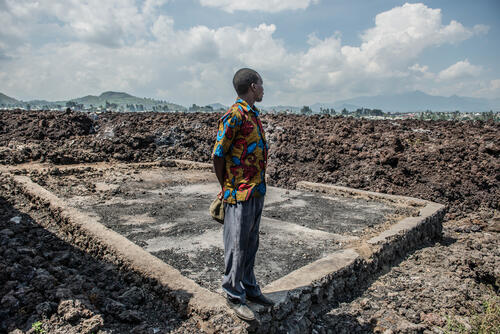
On the Saturday 22 May, the day of the eruption of the Nyiragongo volcano, I was at home, in the Kihisi area of Goma. I was resting with my family after a week of work at Kibumba primary school where I teach. In the evening, it started to get very hot. The lava was heading straight to us. 
We fled, without thinking, without bringing anything with us. In Birere, a neighborhood in Goma where we gathered with other families, I heard that lava was starting to reach my house. I decided to go see what was going on: the lava flow was about a hundred meters from our home. I returned there, very early in the morning: to my surprise, it had stopped a few meters from my house. My roof has remained intact. 
When the government decided that we had to evacuate, we left for the second time, this time to the Kibumba area, north of Goma. Two days later, we decided to come back, having no clean water to drink. The 20-liter can cost 1,000 Congolese Francs (0.46 euros) against the usual 250 (0.10 euros). We only ate potatoes and cabbage. 
Today, the situation remains critical for my family and those around us. Night and day, we continue to feel the heat of the lava. Carbon dioxide continues to exit the cooled lava flow. Scientists and authorities tell us it is dangerous for health, but we remain exposed. We don't know where to go to escape this new danger. Sake (25 km west of Goma) or Minova (in South Kivu) are not the only places where disaster victims find themselves. We in Goma, too, need medical assistance and care. “
Dieudonné surveys the ruined houses in his Goma neighbourhood, destroyed by lava flows following the eruption of the Nyiragongo volcano on 22 May. Democratic Republic of Congo, June 2021.
Moses Sawasawa
On Monday 10th of May, Médecins sans frontières / Doctors Without Borders (MSF) started supporting the Palestinian Red Crescent Society (PRCS) in Jerusalem to assess and stabilize hundreds of Palestinians injured by the Israeli police.
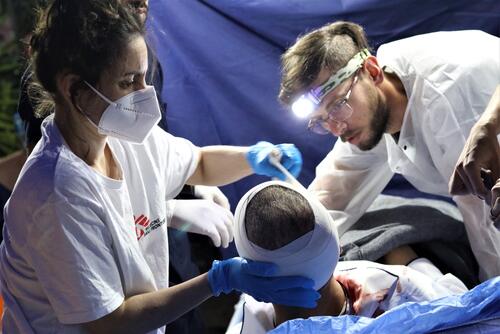
MSF medical staff bandage the wounds of a Palestinian man injured by Israeli police during clashes in Jerusalem. Palestine, May 2021.
Tetiana Gaviuk/MSF
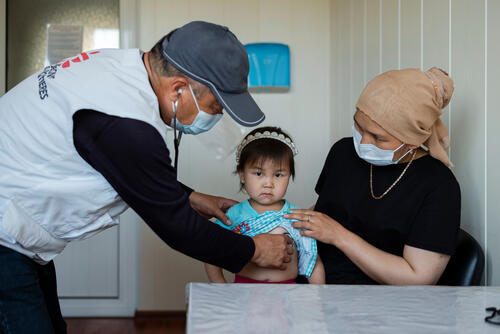
Anapiya, from neighboring village Kok-Terek, brought her daughter for consultation at Kok-Tash family medical center. Doctor Ergeshev Abdulamid is giving medical check. Kok-Tash, Batken Oblast, Kyrgyzstan.
Anapiya, right, reassures her young daughter as she gets a medical check-up at the Kok-Tash family medical centre. Batken oblast, Kyrgyzstan, May 2021.
Maxime Fossat
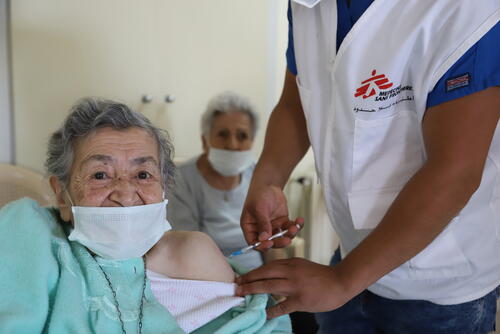
An elderly woman is being vaccinated against COVID-19 by a member of MSF’s mobile vaccination team at a nursing home in Shayle (Mount Lebanon).
An elderly woman is vaccinated against COVID-19 by a member of MSF’s mobile vaccination team at a nursing home in Shayle. Mount Lebanon governorate, Lebanon, June 2021.
Tracy Makhlouf/MSF
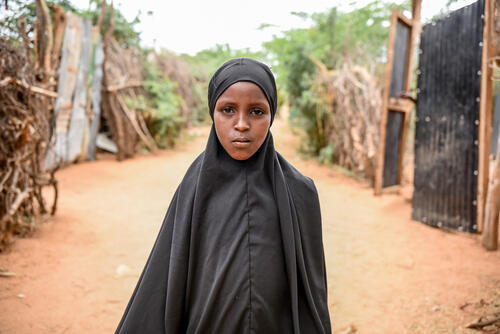
Ten-year-old Habiba lives with Type 1 Diabetes and needs to inject insulin twice every day. She was taught by MSF to inject herself and carries her insulin home, storing it in a portable cooler.
Ten-year-old Habiba lives with Type 1 Diabetes and needs to inject insulin twice every day. She was taught by MSF to inject herself and carries her insulin home, storing it in a portable cooler. Dadaab refugee camp, Kenya, May 2021.
Paul Odongo/MSF
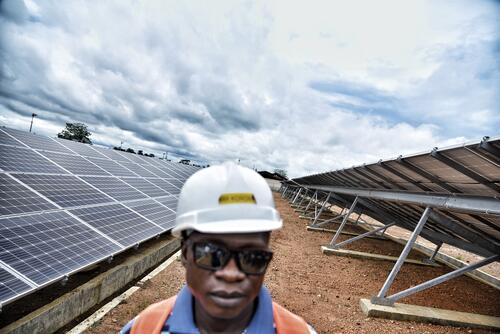
MSF logistics supervisor Mohammed Korma stands amid the solar panels that MSF has installed in Kenema district. MSF is aiming to run the Hangha hospital fully with clean energy in the future.
MSF logistics supervisor Mohammed Korma stands amid the solar panels that MSF has installed to run Hangha hospital with clean energy. Kenema district, Sierra Leone, June 2021.
Mohammed Sanabani/MSF
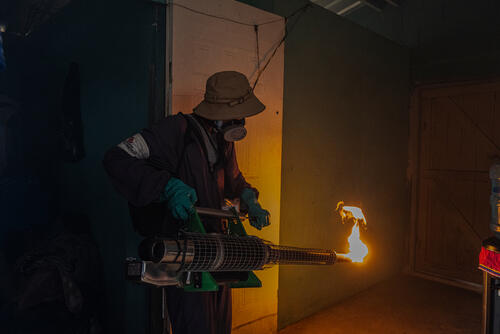
The MSF team spraying for pest control, Colonia Juan Orlando Hernandez. Coloma
Honduras April 7, 2021.
A member of the MSF team sprays for pest control, in the Juan Orlando Hernandez community of Choloma. Honduras, April 2021.
Yael Martínez V./Magnum Photos
MSF nurse Oleksandr Oleksandr Vovkogon observes Vitalii Gorbachov, 56, take his DR-TB pills at this home in Chudniv village, Zhytomyr region, Ukraine. In order to enhance patient autonomy, MSF’s programme offers a combination of directly-observed (DOT), video-observed (VOT) and self-administered (SAT) therapies, depending on the needs and capacity of the patients. In directly-observed and video-observed therapies, a trained health worker observes patients swallow prescribed drugs, either in person or through video-enabled smartphones.
Vitalii swallows his pills to treat drug-resistant tuberculosis at his home in Chudniv village. Zhytomyr region, Ukraine, June 2021.
Oksana Parafeniuk/MSF
Octavie Braza takes 5 hours to deliver and finally, at 17.30h a baby boy comes out alive despite all the complications and lack of material at Nzacko health center.
Midwife Sylvie feels the pregnant belly of Octavie, who, after complications and five hours of labour, delivers a healthy baby boy at Nzacko health centre. Central African Republic, July 2021.
MSF
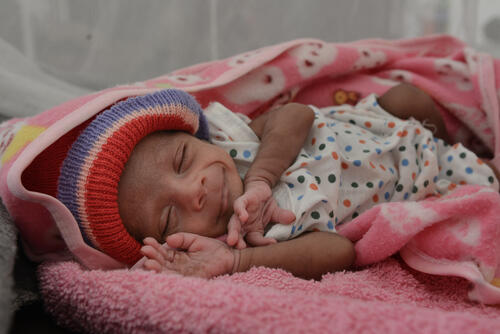
Baby Dawit Yonas was born prematurely, weighing only 1.2 kg. His mother, Mebruit Muruts, gave birth to Dawit at MSF’s maternity clinic in Al-Tanideba camp.
Baby Dawit was born prematurely, weighing only 1.2 kilograms. His mother, Mebruit, gave birth to Dawit at MSF’s maternity clinic in Al-Tanideba camp. Sudan, July 2021.
MSF/Dalila Mahdawi
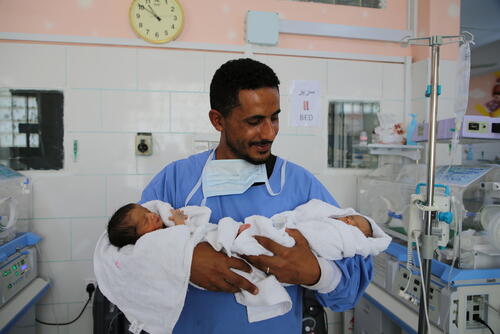
A happy father, Wael Abdul Jabbar Mahyub, lovingly holding his twin daughters Heba and Malath who are under treatment at special care baby unit supported by MSF at Al Jamhouri hospital in Taiz City, Yemen.
A happy father, Wael, lovingly holds his twin daughters Heba and Malath, who are receiving special care in the neonatal unit supported by MSF at Al-Jamhouri hospital. Taiz, Yemen, June 2021.
Nasir Ghafoor/MSF
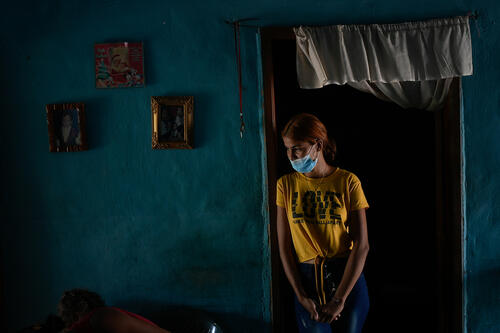
Bárbara tiene 20 años y un hijo de 24 meses. Quiere protegerse para no tener más bebés a corto plazo, pero la situación económica hace cuesta arriba el acceso a anticonceptivos orales. “Para comprar una caja de pastillas que dura solo un mes, tendría que pasar trabajando dos o tres semanas corridas, sin gastar en nada más”, explica. 


Barbara is 20 years old and has a 24-month-old son. She wants to protect herself from having more babies in the short term, but the economic situation makes access to oral contraceptives difficult. "To buy a box of pills that lasts only a month, I would have to spend two or three weeks working, without spending money on anything else," she explains.
Barbara has a 24-month-old son. She wants to protect herself from having more babies in the short term, but the economic situation makes access to oral contraceptives difficult. “To buy a box of pills that lasts only a month, I would have to spend two or three weeks working, without spending money on anything else,” she explains. Sucre state, Venezuela, May 2021.
Matias Delacroix
Ángel Alexis Ramirez Mejia, 9, plays under the Coatzacoalcos bridge on 25 March. Since leaving Comayagua, Honduras, he and his family have been travelling for 16 days, 14 of them on foot. 

MEXICO. Veracruz. Coatzacoalcos. March 25, 2021.
Nine-year-old Ángel plays under the Coatzacoalcos bridge. Since leaving Honduras, he and his family have been travelling for 16 days, 14 of them on foot. Veracruz, Mexico, March 2021.
Yael Martínez/Magnum Photos
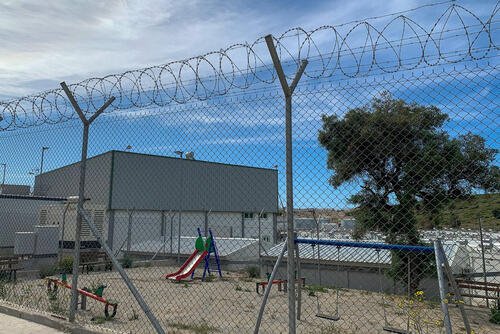
A brand-new reception centre, just 5km away from Vathy city, is being built in Samos island. Located in the middle of nowhere, it is designed to host up to 3,000 people, of which according to the Greek Minister of Migration, 2,100 will have a “controlled access” and 900 will be in detention waiting to be sent back to Turkey. Patients and people who live in Vathy reception center describe it as an open-air prison.
The empty playground behind the barbed wire of the brand-new migrant reception centre, just outside of Vathy. Samos, Greece, May 2021.
Dora Vangi/MSF
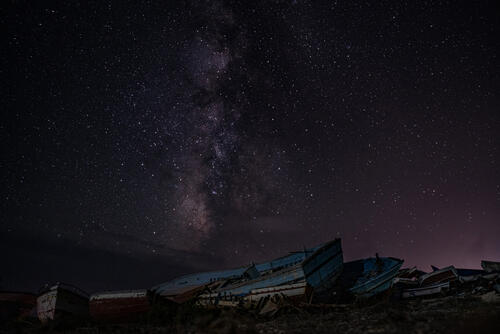
Milky Way rises on the remains of the “boat cemetery” of Lampedusa. The boats used by the migrants are pulled out of the water, brought to the mainland and piled up in strategic points on the island before being demolished.
The Milky Way rises on the remains of the ‘boat cemetery’ of Lampedusa. The boats used by people crossing the Mediterranean sea are pulled out of the water, brought on to the beach and piled up in strategic points on the island, before being demolished. Lampedusa, Italy, September 2021.
Giuliano Lo Re
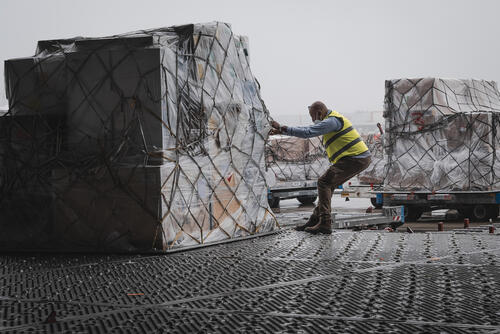
100 tons of material has been loaded into two cargo planes destined for Haiti. The fist plane took off from Brussels on Friday 20 August. The cargo includes items for setting up emergency medical structures and offices for our operations using tents; materials to install emergency drinking water supply systems for 30,000 people; and medical supplies for the care of 30,000 patients, including items for stabilisation, first aid, vaccination and blood collection.
Airport staff load the first of 100 tons of material onto two cargo planes destined for Haiti, to respond in the wake of a 7.2 magnitude earthquake. The cargo includes items for setting up emergency medical structures; materials to install drinking water supply systems for 30,000 people; and medical supplies for the care of 30,000 patients. Brussels, Belgium, August 2021.
Julien Dewarichet/MSF
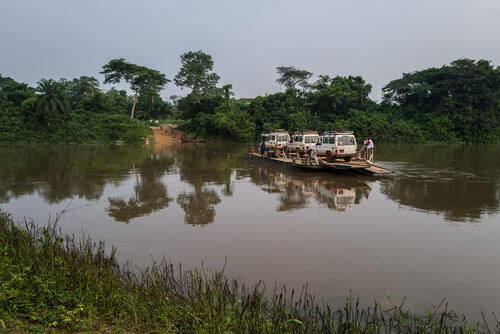
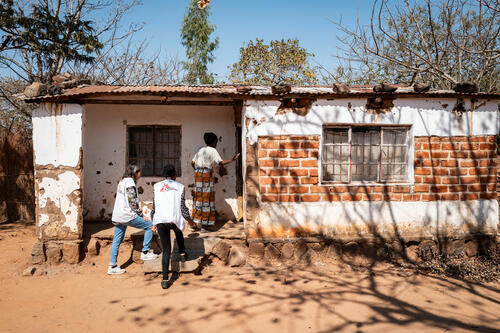
MSF convoy crosses the river on the way back to Bangassou. Thursday July 29, 2021
An MSF convoy crosses the river on the way back to Bangassou, following a mobile clinic session in Nzacko. Central African Republic, July 2021.
MSF
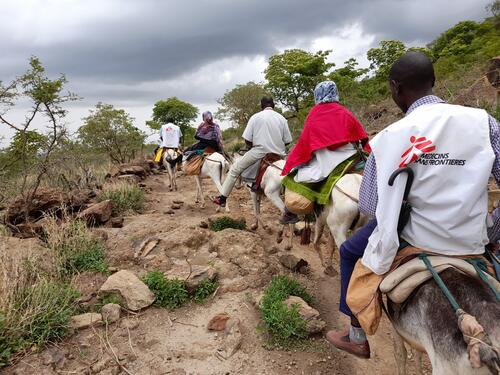
A MSF team comprising of medical assistants, a nurse, a nursing activity manager and project coordinator travel from Koya to Dilli, Jebel Marra region, South Darfur.
Together with the local community, the Ministry of Health and UN agencies, MSF in August 2021 launched an urgent measles vaccination and treatment campaign in Jebel Marra.
Since mid-July 2021, hundreds of suspected cases of measles have been reported across Jebel Marra, an isolated and mountainous region of Darfur. MSF received the first suspected measles patient at its Kalo Kitting clinic on 17 July. By 7 August, MSF’s clinics had received 849 children with suspected measles, of whom 824 were under the age of five years, as well as 11 deaths. Sudan’s Ministry of Health has so far confirmed seven cases by laboratory.
An MSF team comprising of medical assistants, a nurse, a nursing manager and project coordinator use donkeys to travel from Koya to Dilli, in the isolated and mountainous Jebel Marra region, to urgently respond to a measles outbreak. South Darfur, Sudan, July 2021.
Anna Bylund/MSF
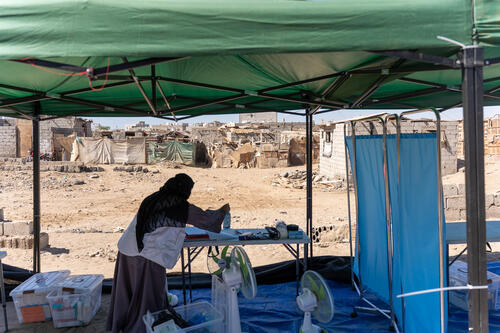
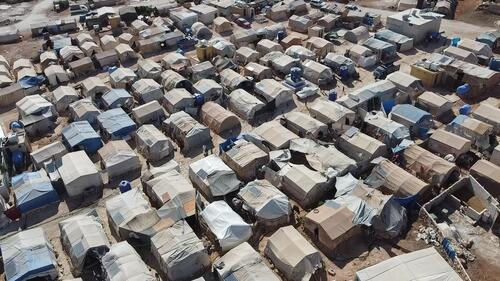
Northwest Syria is home to more than 1.7 million Internally Displaced Persons (IDPs). Most of them have been displaced by the conflict various times and are staying in displacement camps, with very poor living conditions.
The tents of internally displaced people stretch out across a camp in northwest Syria, in which very poor living conditions and a lack of clean water pose serious health risks. Syria, September 2021.
Abdurzaq Alshami
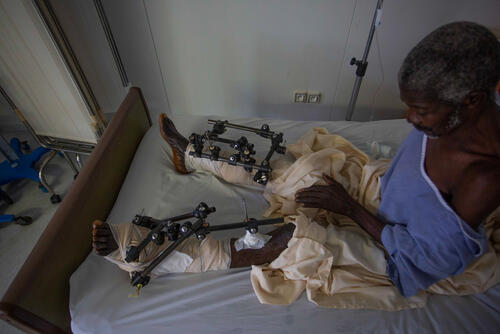
A victim from August 14 earthquake is being treated in Tabarre hospital after a referral from the South area, the most affected zone on Haiti.
A man looks down at the external fixators on his legs, severely injured during the 7.2 magnitude earthquake on 14 August. Tabarre trauma hospital, Port-au-Prince, Haiti, August 2021.
Steven Aristil
At Hôpital Immaculée Conception in Les Cayes, MSF staff provide physiotherapy for patients injured in the earthquake, helping people regain strength and mobility.
A patient at Hôpital Immaculée Conception receives treatment from an MSF physiotherapist, following injuries sustained in the 14 August earthquake. Les Cayes, Haiti, September 2021.
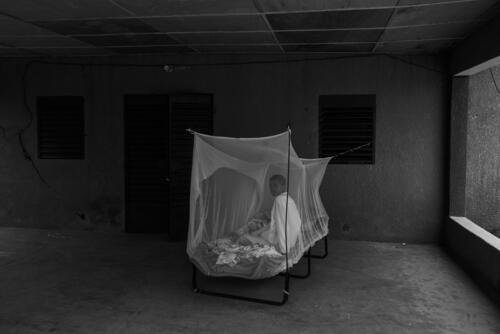
The use of mosquito nets to protect against malaria.
Belbeja, Zinder, Niger - 27 July 2021.
A man sits on a bed under a mosquito net, to help protect him from malaria-transmitting mosquitoes during the rainy season. Zinder, Niger, July 2021.
Zied Ben Romdhane/Magnum Photos
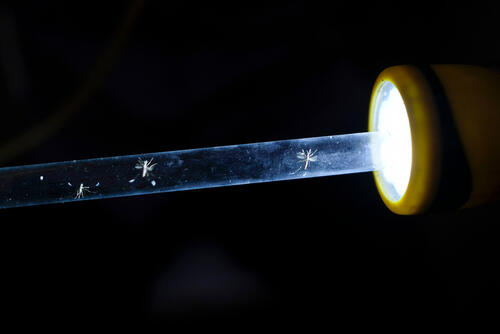
Mosquitos Anopheles capturados para su estudio. El análisis de los transmisores de la malaria permite diseñar estrategias eficaces para el control vectorial. Los equipos de MSF trabajan junto a autoridades locales, para prevenir la malaria en comunidades del estado Sucre, al noreste de Venezuela. 
 	
Anopheles mosquitoes have been captured to study them. The analysis of malaria transmitters supports the design of effective vector control strategies. MSF teams work with local authorities to prevent malaria in communities in Sucre state, northeastern Venezuela.
Anopheles mosquitoes caught in a trap are examined by the light of a torch. MSF epidemiologists capture and study the mosquitoes, which transmit malaria, to design strategies to control them and prevent malaria in communities in Sucre state. Venezuela, August 2021.
Matias Delacroix
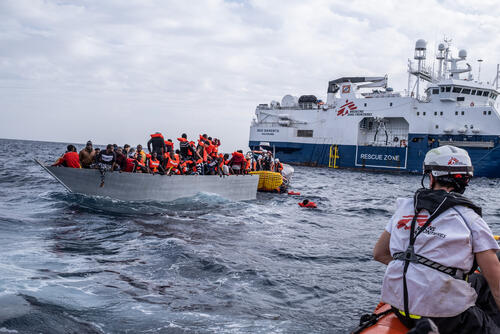
Night rescue of 188 people from an overcrowded wooden boat. Geo Barents, 15.08.21
188 people sit on an overcrowded wooden boat, as teams from the MSF search and rescue ship, the Geo Barents, approaches to rescue them. Central Mediterranean Sea, August 2021.
Vincent Haiges
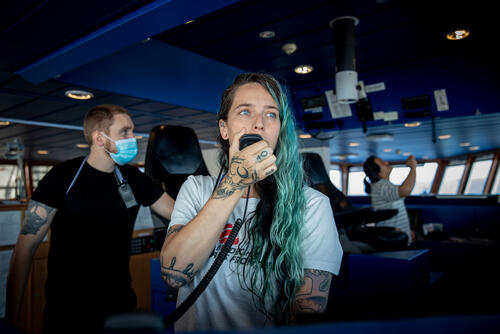
MSF teams communicating with the plane Colibri from Pilotes Volontaires before the rescue.
A member of the MSF team on board search and rescue ship the Geo Barents, communicates with the aerial observation plane Colibri, from Pilotes Volontaires, which has spotted a rubber boat in distress carrying 54 people. Central Mediterranean Sea, September 2021.
Pablo Garrigos/MSF
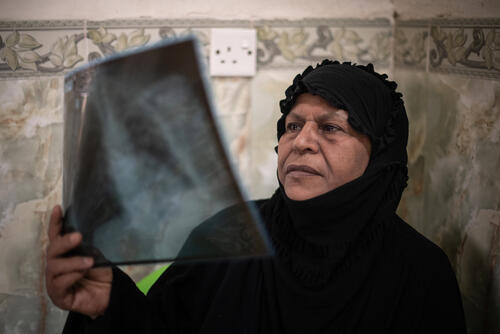
Hameeda looks at an x-ray of her lungs.
Hameeda, 65, photographed in her home, is Iraq’s first patient to be cured with the new oral treatment for multidrug-resistant tuberculosis. Before starting this treatment, she was having daily painful injections that had the potential of causing serious side effects; like hearing loss and kidney damage. Since her first diagnosis, Hameeda has relapsed several times.
Al-Fathilia, Baghdad, Iraq.
---
Hamida's testimony:
---
My name is Hameeda, I am 65 years old and I am from Baghdad (Iraq). I am a mother of six daughters and three sons.

The first time I was diagnosed with tuberculosis (TB) was in 2015. At that time, we didn’t know what was wrong with me. I was coughing, had night-time fever and I wasn’t feeling well. My blood pressure and blood sugar were both high. When I went to seek medical advice I was told that I had had a light stroke, and I was given treatments to better control my hypertension and blood sugar as well as medications for the stroke. But the coughing and the night-time fever didn’t go away. 

I started noticing that I was coughing up sputum and my overall health was not improving. My son took me again to be seen by doctors, who then sent us to the National Tuberculosis Institute in Baghdad. There, I was diagnosed with TB. The medical team at the institute prescribed injections for me that made me tired and weak. 

When I first got the disease, the doctors told us that TB was an infectious disease and that I had to isolate from others. I stopped going out, visiting others or seeing anyone outside. I took my medications for about eight months, after which point the doctors told me that I was cured. However, since then, I have had three relapses. The last one was at the beginning of 2020. I was told that it was a drug-resistant form of the disease this time around and I was put on a new drug regimen which involved taking pills.

During my previous infections, I was treated with daily injectable medications, which were giving me many side effects. For example, my body was itching a lot and I had developed bruise marks on my skin. But since I started taking oral tablets, I feel better. The tablets still hurt my stomach, but they are much better and I have fewer side effects compared to the injections.

At the beginning of the treatment, I was very tired. I couldn’t walk or even move. My son was taking care of me and only with his help was I able to go to the National Tuberculosis Institute for check-ups. He is the only provider for the family, and it was a hard time for him too. Sometimes he would have to take me to private clinics for consultations for my other chronic conditions, which would also need medications that he had to buy, and they were not cheap. All of that prevented him from going to work and that in turn affected our livelihood. But now, after almost 18 months of taking medication, I’m thankful I have finished my treatment and got rid of the disease and its hardships. Now I am in a better health and I don’t need care from others.
Hameeda looks at an x-ray of her lungs, following her successful treatment for multidrug-resistant tuberculosis using newer oral drugs. Baghdad, Iraq, September 2021.
MSF/CHLOE SHARROCK
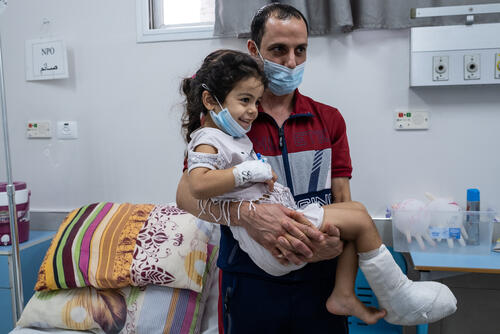
“When I started crossing the street, I saw a light. Then a yellow car hit me and suddenly I was in so much pain,” says four-year-old Hala, as she recalls the day of her accident. Hala’s right foot was crushed by the car and needs multiply surgeries to repair the damage. In 30 minutes, Hala will again go to the operating theatre for surgery. She is nervous and asks her father, Mohammed Aboud, to hold her.
Four-year-old Hala is carried by her father, Mohammed, before she goes in for surgery. Hala’s right foot was crushed by a car and she needs multiple surgeries to repair the damage. Treatment for trauma injuries can be challenging in the blockaded Gaza Strip. Palestine, August 2021.
Virginie Nguyen Hoang
Kuzal together with her son in her house.
She is a midwife in the Nablus MSF hospital.
The Islamic State Group forced her to work also during war. Her son would drive her to work everyday.

Mosul, Iraq. September 2021.
Kuzal (left) sits together with her son in her house; she is a midwife in the Nablus MSF hospital. The Islamic State group forced her to work during the war; her son would drive her to work every day. Mosul, Iraq, September 2021.
Nanna Heitmann /MAGNUM PHOTOS
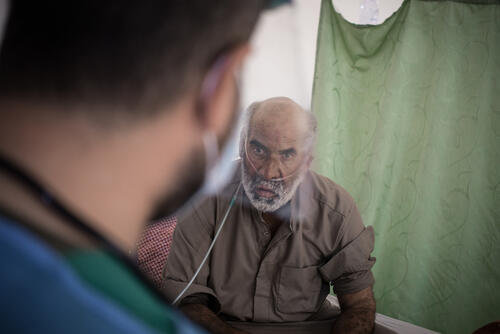
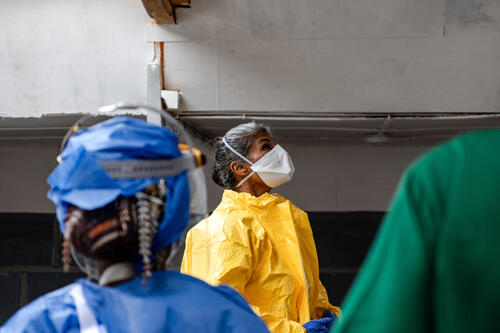
Abdul Harma, head nurse at the Hospital specialising in COVID-19 in Hassakeh, in northeast Syria, provides care to Mr. Ali, who lives two hours away from Hassakeh by road.
Mr Ali sits on his bed receiving oxygen, while head nurse Abdul Harma provides him with care, at the COVID-19 hospital in Hassakeh. Syria, June 2021.
Florent Vergnes
Polish volunteer from Fundacja Ocalenie organisation covers the refugees with sleeping bags. Narewka, Poland.

In October 2021, MSF team accompanied Fundacja Ocalenie, one of the local Polish organisations, along with several journalists, into a forested area near the secure zone where they met a group of 13 people. A family of 13 Iraqi Kurds including 4 children asked for asylum in Poland. The family was taken by the Polish border guards back to emergency state zone at the Belarusian border. On the next day, they sent their location indicating that they were back on the Belarusian side of the border.
A volunteer from Polish organisation Fundacja Ocalenie covers refugees with sleeping bags. An MSF team accompanied a team from Fundacja Ocalenie into a forested area near the Polish/Belarusian border, where they met a family of 13 Iraqi Kurds, including four children, on the Polish side. The family asked for asylum in Poland and were taken by the Polish border guards back to the emergency state zone at the Belarusian border. The next day, they sent their location indicating that they were back on the Belarusian side of the border. Narewka, Poland, October 2021.
Maciej Moskwa/Testigo
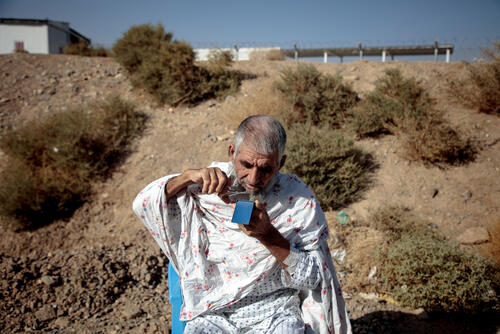
A patient have a sun bath, outside the building.
A man trims his beard in the sun outside the MSF COVID-19 hospital in Herat. Afghanistan, October 2021.
Sandra Calligaro
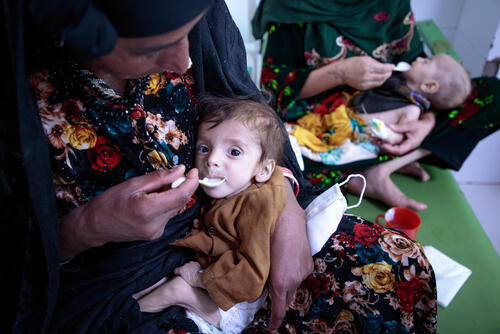
Mothers feeding their child in the rooms of MSF’s Inpatient Therapeutic Feeding Centre (ITFC) at Herat Regional Hospital. The centre is over crowded : there is actually 84 patients for 60 beds, mothers share sometimes one bed for 2 children.
Malnourished children are being fed by their mothers at MSF’s Inpatient Therapeutic Feeding Centre at Herat Regional Hospital. The centre is overcrowded: there are actually 84 patients for 60 beds, with some mothers having to share one bed for two children. Afghanistan, October 2021.
Sandra Calligaro
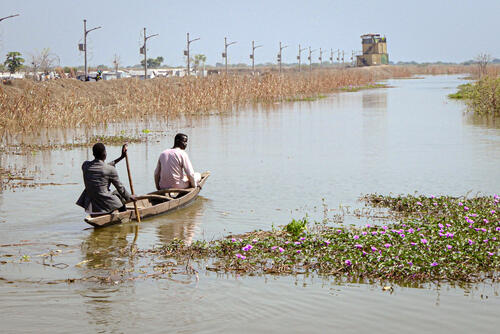
Two men use a canoe to navigate through floodwaters on the outskirts of Bentiu internally displaced persons camp.
Two men use a canoe to navigate through floodwaters on the outskirts of Bentiu internally displaced people’s camp. South Sudan, November 2021.
Njiiri Karago/MSF
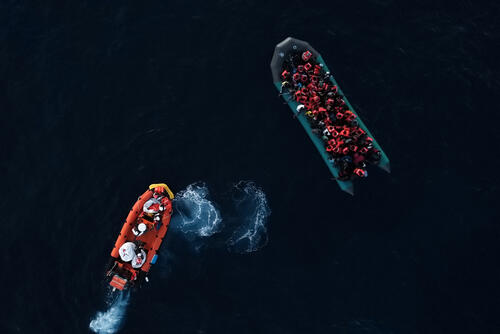
On the evening of the 23rd of October, a rubber boat with 95 people on board, was about to be intercepted by the Libyan Coast Guard, MSF teams arrived on time to carry out the rescue safely.
An MSF team from search and rescue ship the Geo Barents reaches a rubber boat with 95 people on board, just before it was intercepted by the Libyan Coast Guard. MSF teams arrived on time to carry out the rescue safely. Central Mediterranean Sea, October 2021.
Filippo Taddei/MSF
After a distress call from Alarm Phone, confirmed by Sea Bird, the afternoon of the 16th of November, 2021, 99 survivors were rescued by the Geo Barents at approx 30 miles from the Libyan shores. At the bottom of the overcrowded wooden boat, 10 people were found dead. 
10 persons who died from suffocation, after 13 hours adrift at sea. The deadly central Mediterranean route.
Currently on board, 186 people, many women and small children, the youngest one being 10 months old. Many of them seem traumatized by the horrendous ordeal. They were drifting at sea for hours, fearing for their lives.
The Geo Barents rescues 99 people from an overcrowded wooden boat, which had been adrift for 13 hours. At the bottom of the wooden boat, 10 people were found dead, having been asphyxiated by petrol fumes. Central Mediterranean Sea, November 2021.
Virginie Nguyen Hoang/ HUMA
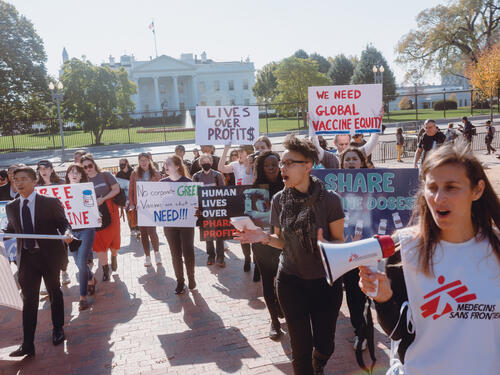
On November 10, MSF held a demonstration in front of the White House in Washington, DC, calling on the Biden administration—which gave pharmaceutical corporations billions of US  taxpayer dollars to develop COVID-19 vaccines—to do more to ensure global vaccine equity. 

The group carried a banner bearing the names of nearly 130,000 people who had signed a petition, and they staged a scene where mock supplies of the vaccines were chained and locked up and people posed as Pfizer, Moderna, and the World Trade Organization, guarding the doses. Later, participants “freed the vaccines” by removing the chains.
MSF staff and supporters demonstrate outside the White House, calling on the Biden administration to do more to ensure global vaccine equity for COVID-19 vaccines. Washington DC, United States of America, November 2021.
Christopher Lee