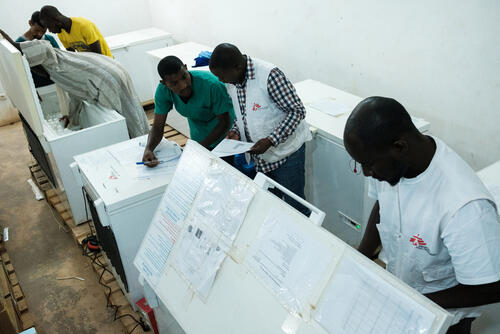
From centre left: Cheickh Ahmed Isselmou, Pharmacy Supervisor; Philemon Olivier, Project Pharmacist; and Kelly Thierno Moctar, a doctor and Assistant Medical Coordinator, readying vaccines at 6:30am at a Médecins Sans Frontières (MSF) facility in Bassikounou in the Hodh ech Chargui region of Mauritania on 7 August 2018. Located in Southeastern Mauritania, Bassikounou is the staging point for MSF operations in the Mbera refugee camp and the surrounding area.

Mauritania

Cheickh Ahmed Isselmou, pharmacy supervisor, Philemon Olivier, project pharmacist, and Kelly Thierno Moctar, doctor and assistant medical coordinator, prepare vaccines at the MSF facility in Bassikounou in Hodh ech Chargui, Mauritania, August 2018.
© Nyani Quarmyne
Ebola disease in DRC: find out how we're responding
Learn more

Following the arrival of refugees from Mali, we returned to Mauritania in 2024. Working in the Hodh El Chargui region, our mobile team is providing basic healthcare, mental health support, sexual and reproductive care, and treatment for malnutrition across four locations. We are also working to reinforce rescue operations at sea for people arriving in Mauritania via the Atlantic migration route.

Our activities in 2025 in Mauritania

Data and information from the International Activity Report 2025.

MSF in Mauritania in 2025 In 2025, Médecins Sans Frontières (MSF) scaled up medical and humanitarian assistance for Malian refugees and people on the move through Mauritania.
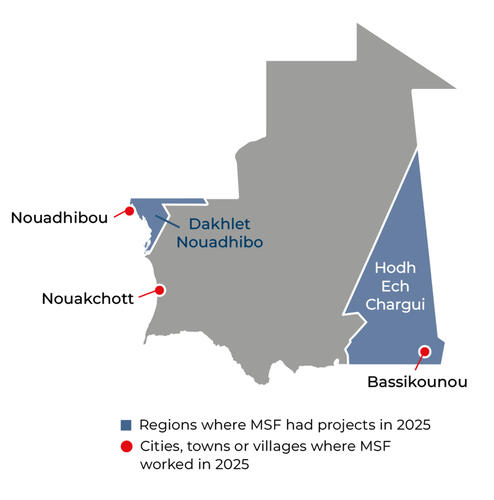
Country map for the IAR 2025.
© MSF

Our teams provided care to refugees, asylum seekers, and migrants attempting to make the perilous Atlantic crossing from the Mauritanian coast, and to Malians seeking safety in the southeastern region of Hodh Ech Chargui.  

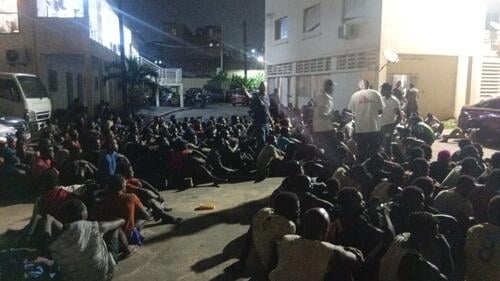
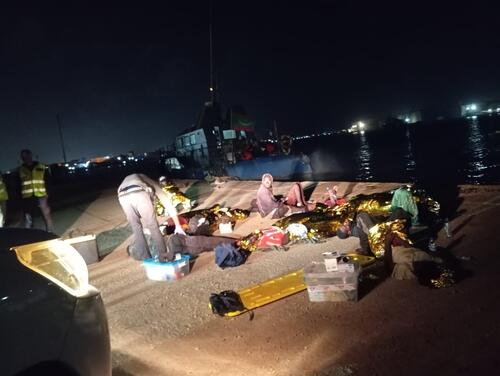
In Nouadhibou, MSF offered medical and psychological assistance to migrants on boats intercepted while heading towards the Canary Islands. While the Spanish authorities reported a drop in the number of arrivals from Mauritania during 2025,* in part due to increased maritime surveillance and stricter enforcement by Mauritanian authorities, many people continued to attempt the sea route, leaving from other West African countries to reduce the risk of interception. Some of our patients reported being on board for up to 15 days with no water, and fearful of drowning because they did not know how to swim. Others witnessed people dying during their boat journeys, and saw bodies being thrown into the sea. In Nouadhibou, our teams also ran outpatient activities, including mental health support and referrals for social services, for people transiting Mauritania on their way north to Europe.  

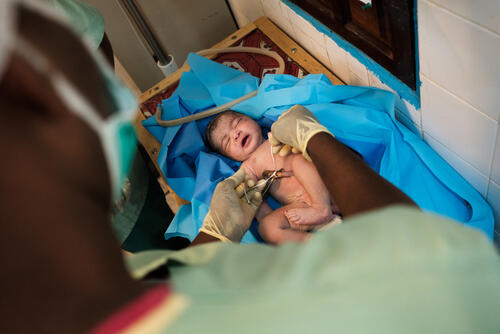
In southeastern Mauritania, there were repeated influxes of refugees from Mali, seeking respite from the extreme violence in their country. They often arrived in a state of exhaustion, traumatised by their experiences, and settled in villages and informal camps without adequate services. Our teams worked in these areas, providing general and specialised healthcare for victims of violence. We gradually added other services during the year, including mental health and social support, and a community network to identify and refer victims of violence. We switched from running a system of mobile clinics to supporting healthcare facilities in Douenkara, Fassala, Aghor, and Tinagwitine, with general and paediatric healthcare, reproductive and sexual health consultations, vaccinations, treatment for severe acute malnutrition, and specialist referrals to Bassikounou and Neima hospitals. These services were also open to Mauritanian patients.

* RTVE: https://www.rtve.es/noticias/20260102/desplome-ruta-canaria-caer-426-llegadas-irregulares-2025/16881023.shtml (in Spanish)


In 2025

Mauritania

Language
English