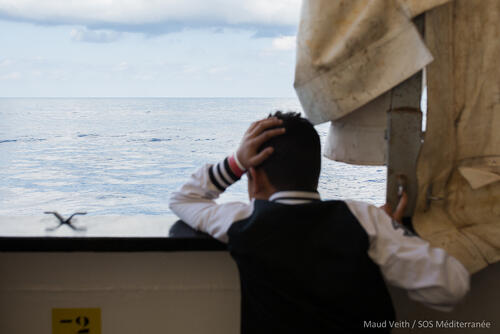
Madrid–Médecins Sans Frontières (MSF) expresses our support and solidarity with the 12 people rescued in the Central Mediterranean and the crew on board the Spanish fishing boat Nuestra Madre de Loreto who have rescued them, in pursuing humanitarian principles and following maritime law. The boat has been prevented from disembarking the rescued people by various European authorities. The passengers and crew are currently experiencing very difficult medical and humanitarian conditions.
“The humanitarian gesture of saving lives must be supported by the political will of a country to allow them to disembark the rescued in the closest safe port as soon as possible,” says David Noguera, president of MSF Spain. “In accordance with international law, these people have to be taken to a place where their lives are not threatened and where their rights and basic needs can be looked after. Libya is not a safe country for refugees, migrants, and asylum seekers, a fact that has been reaffirmed by UNHCR in September of this year.”
The situation of the fishing boat Nuestra Madre de Loreto is a mirror of the human drama unfolding in the Mediterranean Sea: violence, extortion, arbitrary detention, and other harmful conditions in Libya are pushing refugees and migrants to risk their lives at sea. Meanwhile, there is lack of search and rescue operations, and European Union countries are blocking these vulnerable people from seeking safety, and criminalising the organisations and individuals who seek to assist them.
In accordance with international law, these people have to be taken to a place where their lives are not threatened and where their rights and basic needs can be looked after.David Noguera, president of MSF Spain
This is occurring while our medical teams are blocked from providing lifesaving search and rescue operations in the Central Mediterranean. The Aquarius, the search and rescue vessel MSF operates in partnership with SOS MEDITERRANEE, has been forced to remain docked in Marseille, France, for over 55 days. This comes after the ship’s flag and registration was removed twice in the last two months as result of political pressure aimed at putting an end to humanitarian assistance in the Mediterranean Sea. Without a flag and registration, the Aquarius cannot sail.
“We rescue people because we are humans, and this is our way to express our humanity,” said Noguera. “That’s why we are asking the Spanish Government to provide the Aquarius with a Spanish flag as a matter of urgency, as requested via letter, to offer the legal framework to our search and rescue operations. It is increasingly necessary in the Central Mediterranean with each passing day.”

Refugees, IDPs and people on the move
Nine countries and 7,000km; Asad’s journey from Somalia to Europe
Voices from the Field
6 Feb 2019

France
Migrants trapped in relentless cycle of rejection on French-Spanish border
Project Update
6 Feb 2019