



Ebola disease in DRC: find out how we're responding
Learn more
7999 Results
 
A little girl waiting against the gates of the camp registration center of Domiz. This week, more than 300 families and 650 individuals arrived in the camp.
Since May 2012, MSF is the main healthcare provider in Domeez refugee camp where more than 55,000 people have settled. MSF is providing humanitarian assistance to Syrian refugees in the camp through general health, mental health, and immunization. So far, MSF medical teams have held over 40,000 consultations.   MSF is also providing targeted hygiene kits for refugees, safe water supplies and efficient sanitation.  As well as following up the health situation in case of any emergency break ups in the camp.
Syria

MSF speech at the UN Syria donor conference

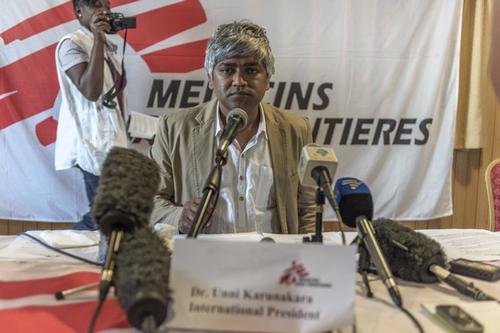
Speech delivered by Dr Mego Terzian, MSF president, at the UN donor meeting on Syria. Speech - 7 Jun 2013
 
Victorine and her family fled their home during four days of violent clashes in late May between the Congolese army and the M23 rebel group around the city of Goma, in eastern Democratic Republic of Congo (DRC). Along with 4,500 others, she has taken refuge in Sotraki stadium, on the outskirts of the city. 
Victorine left her home village of Kibati, north of Goma, with her husband and four children. “We heard bombing, we were scared,” she says. Bullets were flying and bombs were dropping on houses. A neighbour was killed by a stray bullet.
Tensions have been high in the village of Kibati for several months. “Life is dangerous and there is suffering,” says Victorine, who grew soya and haricot beans in the fields outside the village to feed her family. “When we want to go and work in the fields, there are rebels who harass us,” she says. Threats, extortion and rape were commonplace.
As she waits in the stadium for the situation to improve, Victorine's primary concern is to find food for her children. “If I had money,” she says, “I could buy food at the market.” All she managed to bring with her from home was a bundle of clothes. 
The previous day, she brought two of her children to MSF’s mobile clinic, set up in a tent to provide basic healthcare to those sheltering in the stadium. Both children were sick with malnutrition and diarrhoea, most likely as a result of their poor living conditions since they left the village, with not enough food, no toilets and no clean water. Last night, the family slept out in the open. “Right here,” says Victorine, pointing to the patch of dirt where she is sitting now.
Democratic Republic of Congo

"Life is dangerous, there is suffering"

Project Update - 7 Jun 2013
 
A Syrian Kurdish refugee stands in front of his tent home while his mother washes dishes in the Domeez camp in northwest Iraqi Kurdistan, January 25, 2013.  Most refugee families in the camp have water tanks and clean drinking water is regularly provided, although sanitation and hygiene are lacking in some parts of the camp.  Approximately 32,000 people who have fled conflict and economic insecurity in Syria live in Domeez.
Syria

Words must be turned into humanitarian action for Syrians

After more than two years of raging conflict in Syria, humanitarian assistance inside the country and in neighbouring states hosting Syrian refugees remains far below massive and growing needs. As the United Nations convenes in Geneva on June 7, MSF calls upon it and all relevant States to urgently increase the level of assistance to the Syrian population, and to fulfil their responsibilities towards the millions of victims of violence. Statement - 5 Jun 2013
 
Mantebaleng Ntelekoa
 “I delivered all my three children at a hospital, two in Roma and one in Maseru. To get there, I walked two hours to the main road and then continued by taxi. I usually started walking when my contractions started and it took a long time, because I had to sit down every time I had a contraction. One of my children was born premature at 7 months, so I am glad I made it to the hospital.”
Lesotho

Maternal mortality in the mountain kingdom

MSF supports maternal services in Lesotho
Project Update - 5 Jun 2013
 
In the Dar-al-Zahraa clinic in Tripoli, Dr Maha Naja from MSF examines a Syrian little girl who came with her mother. 

Dr Maha Naja, MSF: “We see many cases of enuresis (bedwetting) amongst children. We also see a lot of dermatological diseases, like leishmania and scabies that is linked to bad hygiene and the confinement of families in very small living spaces.  We also see other parasitosis, affecting primarily children. There are also nutritional disorders and deficiencies because of the refugees’ big financial problems. As of June, we can expect many gastro-enteritis cases during the period of high humidity and heat, with parasitosis.”
Lebanon

Abundant medical needs among Syrian refugees and victims of local conflict

More than 10,600 Syrian families who have fled their country have taken refuge in Tripoli, Lebanon’s second-largest city, located approximately 30 kilometres from the Syrian border. Its population includes 500,000 Lebanese citizens, Palestinian refugees living in the Baddawi and Nahr el-Bared camps, and, now, more than 42,000 Syrians who have sought refuge in the city. Project Update - 4 Jun 2013
 
The main entrance of the MSF maternity in Khost, Afghanistan
Like other MSF hospitals in Afghanistan, a strict no-weapons policy is enforced in the maternity to ensure the safety and security of patients.
Afghanistan

MSF strongly condemns violence against humanitarian workers and facilities

Following the attack on an office ICRC in Jalalabad, eastern Afghanistan, MSF strongly condemns violence against humanitarian workers and facilities. Statement - 30 May 2013
 
Mostafa is a seven month-old baby from El-Sheikh Miskeen, a small village near Dara’a. He arrived at Zaatari camp a month ago with his father, mother and other five siblings. Mostafa's mother was very concerened about her baby, she said:  “Ever since our arrival at Zaatari camp, my children have been constantly sick for different reasons. We brought Mostafa came to the MSF hospital because of a high fever. The doctors are still checking him up to see why he is so ill. Mostafa also suffers from asthma and has difficulties breathing because of the dust in the camp."
Syria

Syrian refugee narratives: "We had been trying to avoid leaving our country but eventually we had no other choice"

Mostafa is a seven month-old baby from El-Sheikh Miskeen, a small village near Dara’a. He arrived at Zaatari camp a month ago with his father, mother and other five siblings. Mustafa’s mother, Om Mostafa, shared their story with us. Voices from the Field - 30 May 2013
 
Zaatari Camp, close to the Syrian border, where over 100,000 Syria refugees reside.
Syria

Syrian refugees in Jordan: The limits of assistance

Nearly half a million Syrians are now refugees in Jordan, making up a third of the 1.5 million people who have fled the conflict in Syria to neighboring countries. More than 100,000 of them live in Zaatari camp, situated in the North of the country, less than 20 km from the Syrian border. Press Release - 30 May 2013
 
People take bath at the water pump in a refugee camp on the outskirts of Sittwe, February 2, 2013. photo by Kaung Htet

Government restrictions severely impact access to healthcare in Rakhine state

Nearly a year since deadly inter-ethnic clashes in Rakhine state first broke out, conditions in the displaced persons camps, combined with movement restrictions and ongoing segregation of Rakhine and Muslim communities, are severely impacting on healthcare. Press Release - 28 May 2013
Four mothers posing in a corridor of the Hospital in Bili. All four of them are staying in the hospital with their child, that's suffering from a severe case of malaria. Since the beginning of the project in 2016, the pediatric ward already treated more than 4.000 cases of complicated/severe form of malaria.
Médecins Sans Frontières (MSF)

Independent medical humanitarian assistance

We provide medical assistance to people affected by conflict, epidemics, disasters, or exclusion from healthcare. Our teams are made up of tens of thousands of health professionals, logistic and administrative staff - most of them hired locally. Our actions are guided by medical ethics and the principles of independence and impartiality. We are a non-profit, self-governed, member-based organisation.

Learn more