


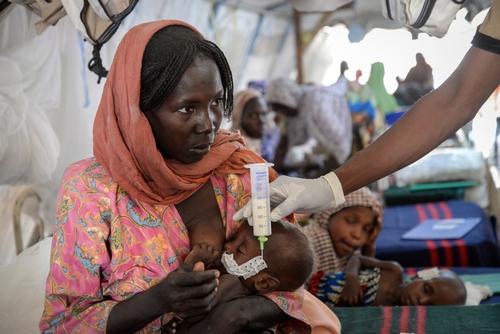
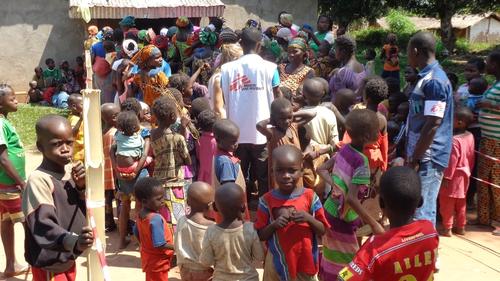
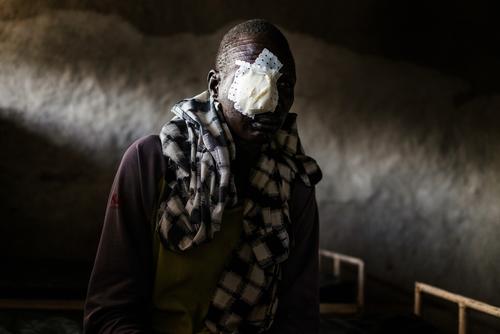
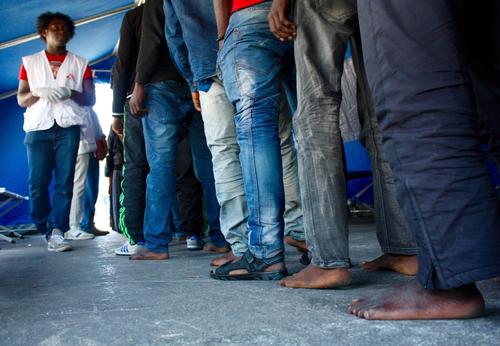


Ebola disease in DRC: find out how we're responding
Learn more
7999 Results
 
When prices are hidden, you can essentially set the price as high as you'd like. No one would know, right? It's absurd, but unfortunately, this is the way pharmaceutical companies set prices for their life-saving pneumonia vaccines.

Sign our petition to ask Pfizer & GSK to lower the price of the pneumonia vaccine to $5/child.
http://afairshot.org
Pneumonia

MSF launches global action against Pfizer and GlaxoSmithKline to cut the price of the pneumonia vaccine

MSF launched a global petition on 12 November 2015, World Pneumonia Day, calling on pharmaceutical companies Pfizer and GlaxoSmithKline (GSK) to reduce the price of the pneumonia vaccine to US$5 per child (for all three doses) in all developing countries and for humanitarian organisations. Press Release - 12 Nov 2015
 
Agnes, 30, and her husband escaped Eritrea with the aim of reaching Europe. Unable to raise enough money for both their journeys, her husband was forced to stay in Sudan, and Agnes and her two-year-old daughter continued alone.

“I left Eritrea four years ago with my husband. My husband was made to serve in the army, and he couldn’t provide for us. If he left the army, he’d be put in jail. Many people go to jail for no reason in Eritrea. 

When we left we went to Sudan. We spent three years going from place to place, looking for work and trying to make enough money to come to Europe. Finally we made a bit of money, but it wasn’t enough for all of us, so I left with my daughter. My husband couldn’t come with us. 

Crossing the desert between Sudan and Libya was very difficult. It took seven days, non-stop, in an overcrowded car. 

After crossing the border, we moved from one town to the next until we arrived in Tripoli. We travelled in containers, like animals or objects. It was very dark and hot in the containers. Many people fainted because of the heat and some died. 

Libya is a very dangerous place. There are a lot of armed people. Some of them are Da’esh [Islamic State]. They kill a lot of people and carry out a lot of kidnappings. 

When we arrived in Tripoli they put us in a house with 600 to 700 other people and locked us in. We had no water to wash ourselves, we had very little food and we were forced to sleep one upon the other. It was very difficult for my daughter – she fell sick many times. 

There was a lot of violence. I was beaten with bare hands, with sticks, with guns. If you move, they beat you. If you talk, they beat you. We spent two months like that, being beaten every day. 

They asked us to pay to go to Europe, so I paid US$1,700 for me and my daughter. We were lucky because women and children were put on the deck of the boat. The people below were in the dark and it was really hot down there. I could hear some of them saying they couldn’t breathe.

I knew that the journey would be very dangerous and difficult, especially for my daughter. But what was the alternative? We could not survive in Eritrea or Sudan. Our government does not allow people to leave. With our documents in Eritrea, there was no other way for us to get to Europe.”

ENDS
Mediterranean migration

"The only way you can leave is by sea"

Testimonies collected during search and rescue operations in the Mediterranean. Voices from the Field - 11 Nov 2015
 
msf-placeholder
Iraq

Crisis Update – October 2015

Humanitarian response has so far been insufficient, concentrated in safer areas and short term. Recent cuts in funding have been increasingly affecting the level of assistance offered to Syrian refugees, displaced populations and host communities. Crisis Update - 11 Nov 2015
 
OCA Emergency Manager - Liberia
Speaks Dutch and English
Dutch Nationality
Yemen

"The children have a game called airstrike in which they fall to the ground"

The situation in Taiz city is devastating. It’s a large city of 600,000 people. There is active fighting and daily airstrikes. The sense of fear is big. People are terrified that their children will get wounded or killed. And they have a good reason to be frightened. Voices from the Field - 11 Nov 2015
 
Health promoter Joseph Fofana talks to villagers about health issues during a MSF outreach mission to treat survivors of Ebola. Many Ebola survivors still suffer from physical, social and psychological problems after beating the virus. Kumrabai, Sierra Leone, 3/11/2015.
Ebola and haemorrhagic fevers

Reaching out to Ebola victims: Coercion, persuasion or an appeal for self-sacrifice?

The 2014–2015 Ebola crisis has highlighted the practical limits of upholding human rights and common ethical principles when applying emergency public-health measures. The role of medical teams in the implementation of quarantine and isolation has been equivocal Journal article - 10 Nov 2015
 
A view of part of the MSF Trauma Centre in Kunduz, 14 October 2015, damaged and burnt-out following the 03 October 2015 airstrike on the facility. Photo: Victor J Blue.
Attacks on medical care

Kunduz, Afghanistan, 36°43’4.91’’N, 68°51’43.96’’

"We say: if there's no room for humanity in times of war, human civilisation as a whole will lose out in the long run. So, it's up to all of us to mobilise and urge politicians, governments and non-state armed groups to respect medical facilities. Together we shout loudly and clearly:“Stop bombing hospitals!” Opinion - 10 Nov 2015
 
msf-placeholder
Yemen

Crisis update – 10 November 2015

The human cost of the conflict keeps on increasing since the beginning of the conflict. Since March 19, MSF active in 8 governorates treated 15,587 war wounded. Bombing and shelling disproportionately target civilians. Crisis Update - 10 Nov 2015
 
Ebola survivor Isatu Tholley draws a picture during a counseling session as part of a MSF outreach mission to treat survivors of Ebola. Many Ebola survivors still suffer from physical, social and psychological problems after beating the virus. Isatu lost her father to Ebola and has been left with eye problems. Kumrabai, Sierra Leone, 3/11/2015.
Ebola and haemorrhagic fevers

“Science should be at the service of survivors”

Sierra Leone may be declared Ebola-free in early November, but caring for the country's 4,051 Ebola survivors remains a big challenge. Many survivors report joint pain and vision problems. Voices from the Field - 7 Nov 2015
 
msf-placeholder
Yemen

Press briefing from Kabul on Kunduz attack

MSF presents initial findings of internal review on Kunduz attack. From Kunduz, Nov 5 2015. Press Release - 5 Nov 2015
 
Infographic of the Kunduz MSF Hospital with satellite image that shows the state of the building after the attack.

ILLUSTRATOR FILE ON MSF155042
Kunduz hospital attack

MSF releases internal review of the Kunduz hospital attack

MSF today released an internal review of the 3 October US air strikes on its hospital in northern Afghanistan. The chronological review of the events leading up to, during, and immediately following the air strikes shows no reason why the hospital should have come under attack. Press Release - 5 Nov 2015
Four mothers posing in a corridor of the Hospital in Bili. All four of them are staying in the hospital with their child, that's suffering from a severe case of malaria. Since the beginning of the project in 2016, the pediatric ward already treated more than 4.000 cases of complicated/severe form of malaria.
Médecins Sans Frontières (MSF)

Independent medical humanitarian assistance

We provide medical assistance to people affected by conflict, epidemics, disasters, or exclusion from healthcare. Our teams are made up of tens of thousands of health professionals, logistic and administrative staff - most of them hired locally. Our actions are guided by medical ethics and the principles of independence and impartiality. We are a non-profit, self-governed, member-based organisation.

Learn more