



Ebola disease in DRC: find out how we're responding
Learn more
7999 Results
 
msf-placeholder
Kunduz hospital attack

Interactive map of our Trauma Hospital in Kunduz before and after the attack

Hover over the interactive images showing satellites images of the Kunduz Hospital before and after the attack. Project Update - 4 Nov 2015
 
Expectant mothers at the Waiting Mother's Lodge, St. Joseph’s District Hospital, Roma, Lesotho.
Lesotho

Free maternal care has an impressive return on investment

Free maternal healthcare is a relatively cheap measure that has a large impact in saving lives of women and newborns. Press Release - 3 Nov 2015
 
A tarp stating no guns, knives, grenades, bombs, or rifles are allowed inside, hangs from one of MSF supported hospital gates on July 21, 2015 in Qataba, Yemen.
Global

Primer: Protection of medical services under International Humanitarian Law

An introduction to the main principles guiding the protection of medical services under international humanitarian law. Journal article - 3 Nov 2015
 
msf-placeholder
Ebola and haemorrhagic fevers

Crisis update - 2 November 2015

The emergency is not over – the Ebola epidemic in West Africa continues in Guinea where three new cases were recorded last week. Crisis Update - 3 Nov 2015
 
Three-year-old Atiel Akech lies in his mother's lap in the yard outside the government-run (Ministry of Health) community health center at Aquem town, Aweil Center county. Patients here lie on mattresses outside, with IVs hanging from trees, because the wards have very few beds and it is very hot inside. Severe cases are supposed to be referred to the MSF hospital in Aweil city, a one-hour drive away. The center has a very low supply of ACT, and has rapid detection tests (RDTs) and quinine in stock. These should be given for free to patients; however, Achol Ariath, the little girl's mother, said that she had been asked to pay 10 SSP for the RDT, but she did not have the money. So Atiel was clinically diagnosed with malaria based on the symptoms she was experiencing: vomiting and fever. The nurse then told Achol to go purchase quinine from the pharmacy in town and bring it back to the health center so that it could be administered to Atiel intravenously. Atiel had no money for this either, so Achol was only given an IV of glucose. Achol has two children.  She lost three other children in miscarriages. Her family lives in Mayiel village, which is an hour's walk away. She first brought Atiel to the health center at Aquem yesterday. After receiving one IV treatment of glucose, she went home. They returned again today for another IV as Atiel is still quite sick. This doesn't come as a surprise if indeed Atiel is only receiving glucose intravenously, as the IV bottle indicates.  The hospital administrator said there was quinine in the IV, but Achol told us she hadn't been able to purcahse any and quinine wasn't noted on the bottle. Other patients at Aquem had stories identical to that of Achol and Atiel, indicating that patients who weren't able to afford the RDT test or malaria medication at the parmacy rate would receive no treatment. Even if Atiel were receiving a dose of quinine every day, the treatment would not be completely effective because quinine is supposed to be administered in three 8-hour doses in one uninterrupted 24-hour period.
South Sudan

Searching for malaria care in South Sudan

South Sudan’s Northern Bahr el Ghazal State sits in the remote northwestern corner of the country. It is South Sudan’s poorest state and it has only one full service hospital—a facility in the town of Aweil run by MSF, in conjunction with the Ministry of Health—serving an estimated population of 1.2 million people. Photo Story - 2 Nov 2015
 
msf-placeholder
Syria

At least 550 wounded in horrific market-bombing in Damascus besieged area

At least 70 people have been killed and 550 injured in an airstrike on a marketplace in the Douma neighbourhood near Damascus, Syria. "This was an extremely violent bombing," says the director of a nearby MSF-supported hospital who assisted in the first wave of mass-casualty response. "The wounds were worse than anything we've seen before, and there were large numbers of dead." Press Release - 31 Oct 2015
 
From the grounds of the bombed hospital, the MSF staff in Kunduz send their deep appreciation to everyone around the world who stood in solidarity with them. Three weeks after the event this is the first time they see each other again.
Afghanistan

MSF staff gather In Kunduz

Three weeks after the bombing in Kunduz, Afghanistan, our MSF colleagues gathered together for the first time on the grounds of the ruined hospital. Project Update - 30 Oct 2015
 
Namiel's husband, Biel, thirty years old, was wounded by a gunshot during a cattle raid. The bullet entered by his neck and exit by upper lip. He was refered in Agok by the Mayom's MSF health center, 85 km away. He is really lucky to be alive, but he cannot be operated here because he needs a maxilofacial surgery.
South Sudan

Trapped by violence in Unity state

Spiralling violence in Unity state is having a devastating effect on the civilian population and leading to an unprecedented humanitarian crisis. “The civilian population is being subjected to repeated and targeted violence,” says MSF emergency manager Tara Newell. “MSF has not seen this level of violence and brutality before.” Press Release - 30 Oct 2015
 
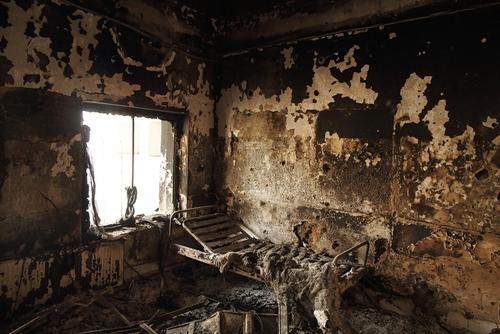
Overview of what is left of Haydan hospital after october 26th airstrike.
Yemen

Denial of hospital bombing by Saudi-led coalition contradicts all facts

Despite denials by the Saudi-led coalition, it is beyond doubt that it struck and destroyed a hospital supported by MSF in Haydan on 26 October.
Press Release - 29 Oct 2015
 
Mahmoud is 30 years old and worked as an emergency doctor in the city of Aleppo. He fled from Syria with a group of 13 people, 6 of them medical personnel.
Syria

The tough decision to leave your country

Testimonies from MSF staff who made the tough decision to leave Syria. Voices from the Field - 29 Oct 2015
Four mothers posing in a corridor of the Hospital in Bili. All four of them are staying in the hospital with their child, that's suffering from a severe case of malaria. Since the beginning of the project in 2016, the pediatric ward already treated more than 4.000 cases of complicated/severe form of malaria.
Médecins Sans Frontières (MSF)

Independent medical humanitarian assistance

We provide medical assistance to people affected by conflict, epidemics, disasters, or exclusion from healthcare. Our teams are made up of tens of thousands of health professionals, logistic and administrative staff - most of them hired locally. Our actions are guided by medical ethics and the principles of independence and impartiality. We are a non-profit, self-governed, member-based organisation.

Learn more