



Ebola disease in DRC: find out how we're responding
Learn more
7996 Results
 
Andrés Aquino Villalobos, 32, descansa en una hamaca junto a dos de sus tres hijos en lo que queda de su casa, que fue totalmente dañada tras el terremoto del 7 de septiembre. Actualmente vive con su familia extensa en tiendas o bajo lonas.

Andrés Aquino Villalobos, 32, rests in a hammock with two of his three children in what remains of his house, which was totally damaged after the earthquake of 7 September. He is currently living with his extended family in tents or under canvas.
Mexico

Voices after the earthquake

Photo Story - 8 Dec 2017
 
Auto mechanic, Holger Hornauf, in Bangui, Central African Republic, December 2017.
Central African Republic

My first week in Bangui: A warm welcome!

Holger Hornauf is a trained auto mechanic and in 2016 he went on his first assignment with MSF in the Central African Republic. One year later he’s back in Bangui as our workshop manager and is blogging about his experiences. blogs.msf.org - 7 Dec 2017
 
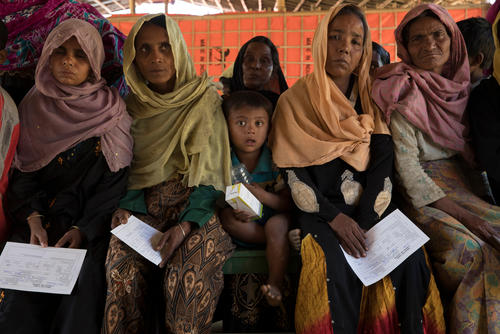
Rohingya outpatient area at the Kutupalong clinic
Rohingya refugee crisis

“This is still a population teetering on the edge.”

Emergency medical coordinator for MSF, Kate White, reflects on how the Rohingya refugee crisis in Bangladesh has changed in recent weeks. Voices from the Field - 6 Dec 2017
 
Fatima sits on the bed next to her 18-month-old son Ishaq, who is being treated at one of MSF's cholera treatment centres in Kilo, southern Ibb governorate. 

Fuel costs have risen dramatically since the imposition of a blockade by the Saudi-led Coalition in November, and Fatima cannot afford the cost of transport to and from the hospital.
Yemen

“There is food in the shops but no money to buy it”

Fatima sits on the bed next to her 18-month-old son Ishaq, her legs bent under her chin in front of her. They arrived the day before to the cholera treatment centre (CTC) operated by MSF in Al Qaeda city, Ibb governorate, after a four-hour journey from Shokan, a village located in Mawia district, in Taiz governorate, south-western Yemen.
Voices from the Field - 6 Dec 2017
 
In the early hours of 4 December, an airstrike damaged the MSF-supported Al Gamhouri hospital in Hajjah city. The emergency room, operating theatre and intensive care unit were damaged and 12 ER patients were evacuated. Despite the damage, Al Gamhouri hospital received 22 casualties from the airstrikes in Hajjah shortly after. Al Gamhouri also received a total of 38 war-wounded patients between 2 and 3 December. 
“Health services have been repeatedly attacked over the course of this conflict. Yet again warring parties are not taking measures to spare medical facilities, endangering the lives of patients and medical staff,” says Steve Purbrick, MSF Field Coordinator in Hajjah. “Civilians must be able to flee or seek medical care, ambulances must be allowed to reach the injured and hospitals must be protected”.
Yemen

Intense fighting and blockade further reduce access to healthcare

A week of heavy violence, coupled with a crippling blockade preventing vital supplies entering into Yemen, shows new levels of disregard by warring parties for the civilian population, medical facilities and patients, says Médecins Sans Frontières (MSF).
Press Release - 6 Dec 2017
 
While settling in the hospital in Batangafo might seem the safest in terms of security, it also contains hidden risks such as contracting contagious diseases. A hospital is still a place to treat sick people.
Central African Republic

“In Batangafo, people are afraid for their lives. It’s the only thing they have left.”

Since late July 2017 fighting between ex-Seleka and Anti-balaka factions has once again set Batangafo and its surroundings on fire. The fighting in the area, in the north of the Central African Republic, has forced tens of thousands of people to abandon the temporary shelters where they had been seeking refuge since the crisis began in 2013-2014. Many have found refuge in the compound of the hospital supported by MSF.
Project Update - 6 Dec 2017
 
Trapped in the island of Samos, asylum seekers are forced to live in dire conditions in the Reception and Identification Center (RIC).

Due to a new wave of increased arrivals, newcomers are forced to stay in an extended area of the camp, and many of them are not allocated a space in the tents, many of which host both men and women.

Many people, including families with children, are only given a blanket to use either to cover themselves at night, sleep on or use as a makeshift tent in the nearby bushes.

Among the camp's residents, many victims of torture and violence as well as of SGBV , pregnant women, children, elderly, sick and disable people wait very long to get their vulnerability assessed and before they can see a doctor.

Food is not sufficient, toilets are too dirty to be used and dangerous to reach at night for women.

Violent fights among residents and protests fueled by frustration erupt every now and then.

Most residents have no information over their asylum application and they wait in the camp for months before they get a final verdict.
Greece

Activity update – December 2017

Voices from the Field - 5 Dec 2017
 
As the temperatures get lower every day, people have no choice than to live in summer tents in Moria camp or in the olive grove nearby.
Greece

Families trapped on islands on the brink of a humanitarian emergency

For the second consecutive winter, authorities in Greece are trapping thousands of men, women and children on the Greek islands, leaving them on the brink of a humanitarian emergency, warns Médecins Sans Frontières (MSF). Press Release - 5 Dec 2017
 
MSF supports a network of health centres (Mpati, Bibwe, Kalembe, Kashuga and Bukama) and has significantly expanded its programme to provide assistance to people affected by the conflict, especially victims of sexual violence at MSF Tumaini clinics in Mweso and Kitchanga.
Democratic Republic of Congo

MSF strongly condemns violent robbery of compound in North Kivu

During the early morning of 4 December, several armed men broke into the Médecins Sans Frontières (MSF) compound in Mweso, in Masisi territory, North Kivu Province, Democratic Republic of Congo.
Project Update - 4 Dec 2017
 
"I have a lot of pain, especially in the stomach, and I am constantly tired. I don’t know how long I am going to stay in the hospital and what will be afterwards." Cynthia DOUNKEL receives medical care in the HIV/TB unit of the Hôpital communautaire of Bangui. She is hospitalized for the second time within a month in Hôpital communautaire in Bangui. She was referred from the MSF clinic in the displaced camp Mpoko at the airport of Bangui. She is HIV positive, has Tuberculosis and suffers from Kaposi's sarcoma. She is three months pregnant.12 July 2016 - Hôpital communautaire, Bangui, Central African Republic.
HIV/AIDS

Delivering differently to reach people living with HIV in West and Central Africa

This week, researchers, policy makers, clinicians and activists involved in the HIV response will attend ICASA 2017, in Abidjan, Côte d'Ivoire. Statement - 4 Dec 2017
Four mothers posing in a corridor of the Hospital in Bili. All four of them are staying in the hospital with their child, that's suffering from a severe case of malaria. Since the beginning of the project in 2016, the pediatric ward already treated more than 4.000 cases of complicated/severe form of malaria.
Médecins Sans Frontières (MSF)

Independent medical humanitarian assistance

We provide medical assistance to people affected by conflict, epidemics, disasters, or exclusion from healthcare. Our teams are made up of tens of thousands of health professionals, logistic and administrative staff - most of them hired locally. Our actions are guided by medical ethics and the principles of independence and impartiality. We are a non-profit, self-governed, member-based organisation.

Learn more