



Ebola disease in DRC: find out how we're responding
Learn more
7999 Results
 
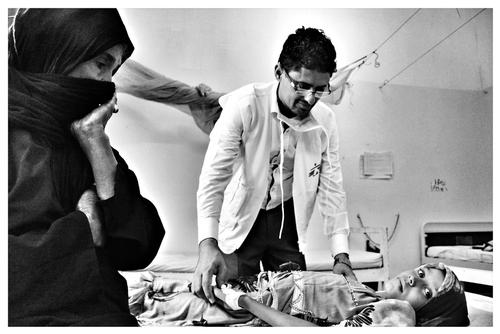
MSF Inpatient Department (IPD) Mansour Al-Ezzi is checking on Ghalia Qaboos who is diagnosed as Kala Azar in MSF supported hospital in Abs on 12th June,2016
Yemen

“Some pregnant women and sick children arrive so late, we can’t save them”

Interview with Gisela Vallès, medical team leader at the MSF hospital in Abs, Yemen, explains the challenges and obstacles her team face in providing assistance to the displaced groups and host communities as increased fighting in the region causes new waves of displacement. Interview - 18 Oct 2018
 
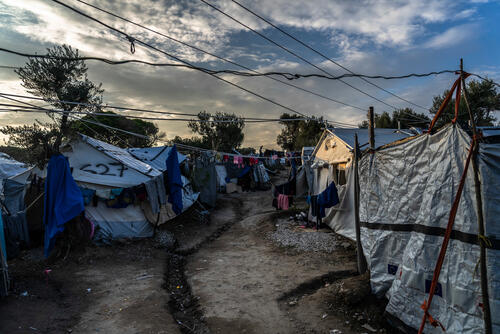
A general of the olive grove next to Moria camp. Due to overcrowded camp of Moria about 2000 asylum seekers have moved to the area next to Moria camp where they have created makeshift shelters. Due to the recent rains residents in the olive grove had nowhere to sleep as the tents were usually flooded.
Greece

No roof, no recovery

A victim of torture's first-hand account of how homelessness and inappropriate living conditions act as a barrier to torture survivors’ rehabilitation in Greece. Voices from the Field - 17 Oct 2018
 
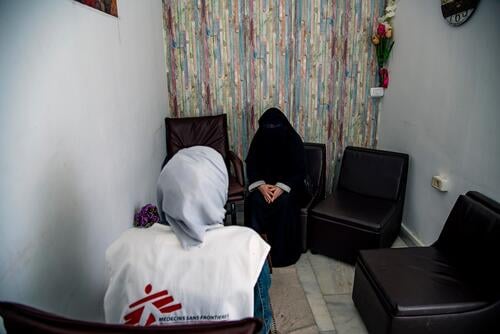
During a Mental Health session at MSF NCD clinic in northern Jordan.
The MSF Non-communicable disease project in Irbid, Jordan, works with Syrian refugees living outside camps since December 2014. MSF opened this project to respond to the massive needs of the Syrian refugee living in non-camp settings and vulnerable Jordanians.
Jordan

Mental health and the work of planting hope

Amal Bani Khalaf, a Jordanian psychologist who has worked with MSF since 2014, gives an account of her work in MSF’s non-communicable diseases (NCD) project in Irbid, Jordan. Voices from the Field - 17 Oct 2018
 
Bilal an MSF psychologist during one of the Mental Health counselling sessions in the MSF NCD clinic in Irbid city,  northern Jordan.
“One of the main complaints we receive at the NCD clinic is related directly to problems like the family conflicts, which is caused by the challenging financial status Syrian families are going through, which leads to having more than one family in the same house.  These problems are usually triggered by other prolonged problems and complains such as the NCD, displacement/migration, and sometimes age.” Says Bilal.
The MSF Non-communicable disease project in Irbid, Jordan, works with Syrian refugees living outside camps since December 2014. MSF opened this project to respond to the massive needs of the Syrian refugee living in non-camp settings and vulnerable Jordanians.
Jordan

The less visible humanitarian crisis: Refugee mental health needs in urban Jordan

MSF mental health activities manager Heidi Mitton explains the mental healthcare needs and services in Irbid, Jordan, where MSF runs a non-communicable diseases (NCD) project for Syrian refugees and vulnerable Jordanians. Voices from the Field - 17 Oct 2018
 
As part of MSF's mental health program in Liberia, outreach workers identify patients in need of treatment for mental health disorders.
Liberia

An innovative approach to mental healthcare

Greg Keane, an MSF psychiatrist and mental health adviser, explains how and why our community-based approach to mental healthcare in Liberia works. Voices from the Field - 16 Oct 2018
 
Parfait Dosséli, is a nurse supervisor at Bossangoa’s hospital and he is working in the nutrition department. Every day, he provides treatment to malnourished children. He is pictured here giving intravenous treatment to a child suffering from a form of malnutrition called marasmus.
Central African Republic

With improved access, malaria and malnutrition cases sharply rise in Bossangoa

In Bossangoa, CAR, MSF has seen an increase of malnutrition and malaria cases during the first half of 2018, compared to the same period last year. People have better access to health facilities, meaning more are seeking treatment. Project Update - 12 Oct 2018
 
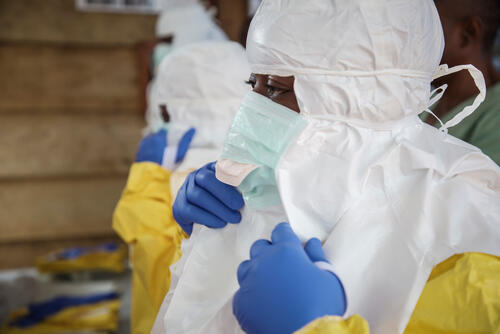
Seraphine is a MSF nurse who’s preparing herself together with her colleagues to go into the high risk zone of the Ebola Treatment centre (ETC). She’s from the region (North-Kivu) and has been working several years for MSF. She’s currently detached by the “Pool D’urgence de Congo” to help out in the Ebola project of Mangina. She got her first ebola experience earlier this year during the epidemic in the equator province. “During the first intervention I was really afraid to get sick (ebola),” she says. “At night I was all the time thinking about what I touched that day in the High risk zone of the ETC, worried that I might get Ebola. Now, I’m way more relaxed and I have more confidence!”
As an adolescent Seraphine wasn’t too keen to become a nurse, but she did because her aunt asked her.
“My aunt always complained that the people working in hospitals never smiled. That’s why she didn’t feel comfortable there. She literally asked me to become a nurse so she would encounter at least one person with a smile in the hospital. So that’s what I do now, I treat people in the best way I can, but more importantly, I also give them a big smile!”
DRC Ebola outbreaks

“Ebola is about human beings and trust”

Dr Hilde De Clerck is one of MSF’s most experienced Ebola doctors and has just returned from North Kivu, in eastern Democratic Republic of Congo (DRC), where the latest outbreak has proven hard to control.
Interview - 12 Oct 2018
 
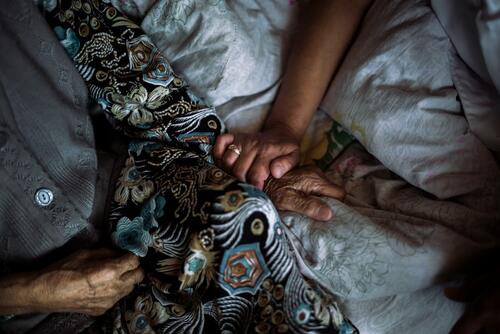
An elderly Uzbek women under palliative care is visted by an MSF health promoter.  She decided not to take medication due to her advanced age. She prefers to take palliative care drugs and medication to treat her symptoms. Osh.
Mental health

Palliative care: "Our mission is also to alleviate suffering"

Interview with Amin Lamrous, MSF’s palliative care specialist, on how MSF provides palliative care to our patients in the countries we work.
Interview - 12 Oct 2018
 
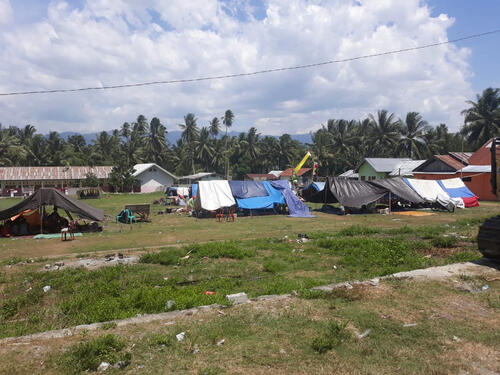
Emergency tents established by the community affected by the 7.7 magnitude earthquake which hit Central Sulawesi on 28 September 2018, in Sigi Regency, Central Sulawesi.
Indonesia

Getting healthcare and safe water to remote areas in Central Sulawesi

An MSF team from Indonesia is helping health centres in remote parts of Central Sulawesi get back on their feet and working to ensure communities have access to safe water, having assessed the medical and humanitarian needs in areas affected by the earthquake and tsunami that hit the island on 28 September. Project Update - 11 Oct 2018
Four mothers posing in a corridor of the Hospital in Bili. All four of them are staying in the hospital with their child, that's suffering from a severe case of malaria. Since the beginning of the project in 2016, the pediatric ward already treated more than 4.000 cases of complicated/severe form of malaria.
Médecins Sans Frontières (MSF)

Independent medical humanitarian assistance

We provide medical assistance to people affected by conflict, epidemics, disasters, or exclusion from healthcare. Our teams are made up of tens of thousands of health professionals, logistic and administrative staff - most of them hired locally. Our actions are guided by medical ethics and the principles of independence and impartiality. We are a non-profit, self-governed, member-based organisation.

Learn more