


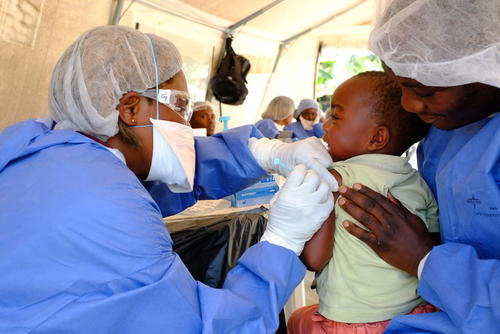
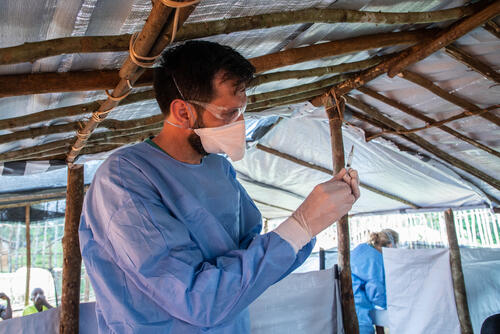

Ebola disease in DRC: find out how we're responding
Learn more
7996 Results
 
A supervisor for MSF cutaneous leishmaniasis treatment centre in Peshawar, Faqeer Hussain, examines 11-year-old patient Mohammad Asif’s lesion under the eye. Mohammad travels with his father for more than two hours every day to get treatment for cutaneous leishmaniasis at Naseerullah Khan Babar memorial hospital in Peshawar.
Pakistan

The only option for cutaneous leishmaniasis treatment in Khyber Pakhtunkhwa

Cutaneous leishamaniasis - a skin infection caused by a parasite - is endemic in northwestern Pakistan. With the number of cases rising, and treatment expensive or difficult to access, MSF has opened one specialist clinic and plans to open another. Project Update - 9 Jul 2019
 
YANGON, MYANMAR – A patient attends a counselling session at MSF's Insein clinic in Yangon.
Myanmar

Clinic closure marks milestone for HIV treatment in Myanmar

MSF teams have been treating people living with HIV in the Insein clinic, in Yangon, Myanmar, since 2014. With the national HIV programme able to continue treatment programmes, we've now closed Insein; MSF counsellor Ko Myo Kyaw explains life at our clinic. Project Update - 8 Jul 2019
 
Abbas, 4 years old, playing inside MSF’s Kids Zone.
Abbas & his brother Youssef are both Thalassemia patients receiving treatment at MSF’s paediatric ward at the Elias Hraoui Government Hospital in Zahle. MSF’s Thalasemia services include, medical consultation and follow up, medical treatment and blood transfusion in addition to social and educational follow up for the children and their families.
A children’s visit to the hospital to receive treatment for Thalassemia could last for a full day. To make it an enjoyable experience, MSF prepared a Kids’ Zone, a safe space for thalassemia children to play, draw and have fun with their friends, as the mental well-being of the kids are an important factor in their physical health.
Lebanon

Treating Syrian children suffering from thalassemia

Thalassemia is a hereditary blood disorder which affects primarily people from the Mediterranean basin, including Syria. In Lebanon, MSF is treating Syrian refugee children with the disease, who usually lack access to treatment. Project Update - 5 Jul 2019
 
Haitian protesters run near burning tires during a demonstration in Port-au-Prince calling for the departure of President Jovenel Moïse on 9 June, 2019.

For months, Haitians have seen a steady decline in their purchasing power as the national currency devalued and fuel prices increased, against a backdrop of seemingly endless political stalemates and scandals. 

Since 9 June, tensions have escalated and there have been almost daily demonstrations and outbursts of violence in cities including Port-au-Prince, Les Cayes and Gonaïves.
Haiti

People’s healthcare in danger amidst worsening anger and despair

The streets of Haiti have spiralled even deeper into violence in recent weeks, jeopardising the ability of both MSF teams and the Haitian healthcare system to provide emergency medical care. Project Update - 5 Jul 2019
 
NUEVO LAREDO, NOT A SAFE PLACE
Central American migration

Northern Mexican city too dangerous to send back people seeking asylum

MSF has denounced the extension of a US and Mexican policy that sees refugees and asylum seekers from Central America, hoping to find a new life in the US, sent back to Nuevo Laredo, a dangerous border city in Mexico. Press Release - 3 Jul 2019
 
Daily life scene at the ISP camp for internally displaced people in Bunia. Thousands have fled their homes due to intercommunal violence in Ituri.
Democratic Republic of Congo

Urgent humanitarian response needed on unprecedented crises in northeast DRC

We are urging international organisations to come the aid of people in Ituri province, Democratic Republic of Congo, as hundreds of thousands are people are in need of assistance following four concurrent humanitarian crises. Press Release - 27 Jun 2019
 
Activities such as water disinfection, fumigation to reduce the presence of mosquitoes, cleaning days or first aid courses are some of the activities carried out by the new Health Committee, in which MSF also participates.
El Salvador

La Peralta: a community organised by health

La Peralta, a community in the capital of El Salvador, has been affected by violence, which has hindered access to health services. MSF teams began making regular visits to the neighbourhood and the community has organised a health committee, which has managed to get healthcare activities starting again. Project Update - 27 Jun 2019
 
ENG - The visits of the parish priests are also suspended. Despite this, women continue to maintain the church adorned and unpolluted.

ESP - Las visitas de los párrocos también se suspenden. Pese a ello, las mujeres siguen manteniendo la iglesia adornada e impoluta.
Mexico

Life amidst the violence: the strong women of Guerrero

Guerrero is one of Mexico’s most violent states, fought over by myriad criminal gangs, police and military authorities. Many rural communities have been isolated by the violence. But the women in this state are strong. MSF teams discovered this while running a mobile clinic in the region, providing medical and mental healthcare. Voices from the Field - 27 Jun 2019
 
Nsanje, Malawi: Chrissy Kamanga, 37 years, a mother of three daughters was referred to Nsanje district hospital with late stage AIDS. He has advanced HIV with opportunistic infections TB and cryptococcal meningitis. She couldn’t talk or walk but is feeling better now. She has been on antiretrovirals for five years. Chrissy is an expert client at Tengani health center under Partners in Hope, a local nongovernmental organization. She helps in tracing patients who drop out of treatment.

Chrissy’s husband Wisted Simbi, 44 years is caring for Chrissy. He says: “here I support my wife’s sister to shift, feed, wash or take her to the bath room. We relieve each other of these daily duties. My wife complained of backache and headache. We went to Tengani health centre and they referred us here. By this time, she couldn’t walk or talk. They welcomed us well and all the tests were done.”

In 2016, an MSF survey of 1183 admissions in hospital over six months revealed that HIV inpatients accounted for 26 % of all admissions in male and female wards, and HIV deaths made up 54 % of all deaths.  Over 80% of HIV admissions arrived in advanced stages of the disease (defined as a CD4 count
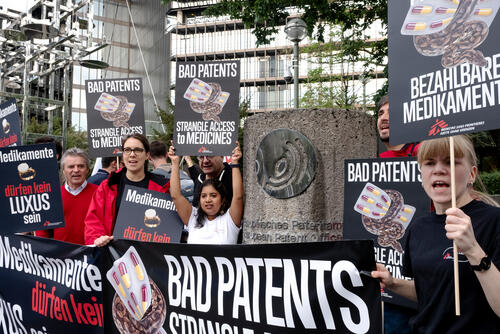
Access to medicines

Gilead fails to keep promise on access to lifesaving drug for people living with HIV

Inaction by US pharmaceutical corporation Gilead to follow through on its so-called ‘access initiative’ leaves people unable to access a vital drug to treat a deadly co-infection for HIV. Press Release - 27 Jun 2019
 
Dhi Sufal district is located at the south of Ibb governorate, in borders with Taiz governorate. In addition to MSF supported hospital, and due to the increase of the cholera cases in the area. MSF started Cholera treatment centre at the same district. MSF cholera treatment centre is receiving patients from Ibb, Taiz, and other IDPs from Hodeidah as well. Since Jan 2019, MSF has received 5466 of patients, between moderate and severe cases and has been working since the opening on 2017.
Yemen

The indirect consequences of war for people in Yemen

More than four years since the start of the war in Yemen, the indirect consequences of the conflict on ordinary Yemenis are high. Among them, people struggle to reach medical care and hospitals in time, which can have serious repercussions on their health. Project Update - 25 Jun 2019
Four mothers posing in a corridor of the Hospital in Bili. All four of them are staying in the hospital with their child, that's suffering from a severe case of malaria. Since the beginning of the project in 2016, the pediatric ward already treated more than 4.000 cases of complicated/severe form of malaria.
Médecins Sans Frontières (MSF)

Independent medical humanitarian assistance

We provide medical assistance to people affected by conflict, epidemics, disasters, or exclusion from healthcare. Our teams are made up of tens of thousands of health professionals, logistic and administrative staff - most of them hired locally. Our actions are guided by medical ethics and the principles of independence and impartiality. We are a non-profit, self-governed, member-based organisation.

Learn more