Ebola disease in DRC: find out how we're responding
Learn more
8000 Results
 
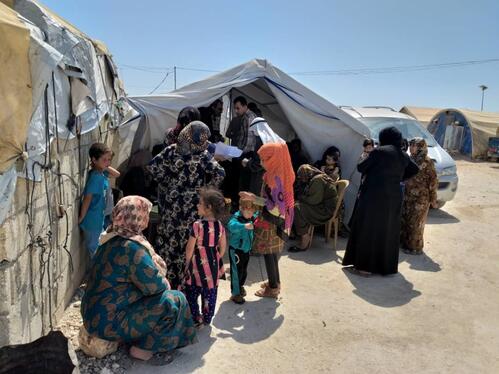
In northern rural Idlib, MSF is running a mobile clinic in a camp in Deir Hassan where the number of IDPs has increased by 10 500 people in two months, following the bombing and shelling on the southern Idlib and northern Hama countryside.
Syria

Escalating conflict in Idlib leaves increasing numbers dead, wounded or displaced

The level of conflict in Idlib and Hama governorates has increased exponentially over the last three months, resulting in hundreds of deaths, thousands of people injured, and forced nearly half a million from their homes and into camps in appalling conditions. Project Update - 31 Jul 2019
 
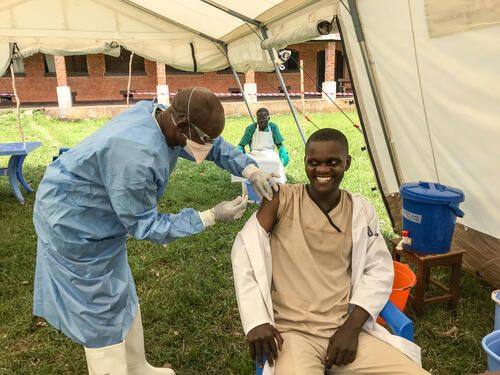
Frontline worker been vaccinated in Bikoro, Equateur Province, DRC.
Participants to the vaccination receive information on the vaccine before consenting, and will be carefully monitored over a period of time. Participation is voluntary and the vaccination is free.
DRC Ebola outbreaks

Not contained, new cases: three questions on vaccines and the Ebola outbreak in DRC

MSF director of operations Dr Isabelle Defourny answers three questions on what’s currently happening and what needs to happen next in the Ebola outbreak. Interview - 31 Jul 2019
 
Kim Kholling (50) in her home talking to an MSF counsellor. Kim is an MDR-TB patient and started treatment on 22 March 2019, so is only a few months into her treatment. She is still system positive and therefore contagious for others, so has to stay home. The MSF team in Churachandpur is treating her.

MSF started providing specialised care for HIV and TB in Manipur in 2005 and 2007, respectively. At its three clinics in Chakpikarong, Churachandpur and Moreh, MSF provides screening, diagnosis and treatment for HIV, TB, Hepatitis C and co-infections.  MSF, which is the only international NGO in Manipur, has put a patient-focused model of care at the heart of its operations in order to improve outcomes and minimise the spread of the diseases.
 “One of the simple ways we’ve tried to reduce the spread of drug-resistant strains of tuberculosis is to bring care to the patient, instead of making them come to us,” says Edoardo Nicolotti, MSF Project Coordinator. “When someone is newly diagnosed, we visit them at home to carry out an infection prevention and control assessment. If they live with family, we offer to build a simple house for them near to the house. This greatly minimises the risk of transmission to others but keeps the patient close enough to maintain normal interaction.” MSF has built nine such houses in 2018- 2019. MSF also sends a nurse to the patient’s house every day to carry out tests and ensure they are sticking to their treatment, which involves a challenging cocktail of drugs over roughly two years. Since DR-TB medication causes significant side effects, making it difficult for patients to complete treatment, MSF also provides counselling to encourage better outcomes.
India

Putting people at the centre of TB, HIV and hepatitis treatment in Manipur

For MSF in Manipur, India, people and their needs are at the centre of how treatment is provided for tuberculosis, HIV and hepatitis C. Photo Story - 30 Jul 2019
 
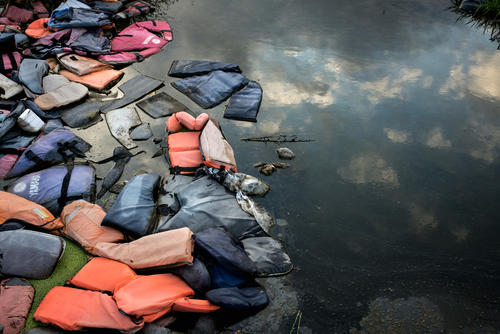
Thousands of life jackets left behind by arriving migrants are gathered at a dump on Lesbos Island, Greece. 
Thousands of people seeking safety after fleeing countries such as Syria, Afghanistan, Iraq, Sudan, and Congo continue to risk their lives to reach Europe. Those who try to arrive via Turkey and the Aegean Sea have been trapped for an indefinite period of time on islands in Greece as part of the EU/Turkey deal and its deterrence and containment approach. 
In Moria refugee camp, on Lesbos island, there are currently more than 7,500 people in a camp made for a maximum of 2,500. With the camp so full, refugees are now staying in an informal extension of the camp known as Olive Grove. The awful conditions at Moria camp/Olive Grove and arbitrary administrative situations have had a dramatic impact on their health and in particular their mental health. 
Médecins Sans Frontières teams provide medical and mental health support outside Moria camp and run a clinic for severe mental health cases in Mytilene, the capital of the island.
Mediterranean migration

Libya shipwreck: “There are no words to describe their suffering”

Anne-Cecilia Kjaer, MSF nurse activity manager describes the scene on assisting people who had survived a horrific shipwreck off the Libyan coast. Voices from the Field - 26 Jul 2019
 
Dr. Roamba does the rounds in the Centre de Santé Mère-Enfant (CSME) [Mother and Child Health Centre] in Diffa, Niger, with patients suffering from hepatitis E.
Hepatitis E

Hepatitis E should be considered a neglected tropical disease

Types of hepatitis E that primarily affect people with poor access to safe water and sanitation has received little attention and funding. By classifying hepatitis E as a neglected tropical disease by the World Health Organization, the spotlight could highlight the resources needed to address the disease. Journal article - 26 Jul 2019
 
Hepatitis C treatment in Mykolaiv
Ukraine

Effective drugs and patient support to combat Ukraine’s hepatitis C epidemic

A combination of generic drugs coupled with a comprehensive patient support model has shown promising results in a pilot project run by Médecins Sans Frontières (MSF) in Ukraine. Project Update - 25 Jul 2019
 
Dirkou area, Agadez region.
Dirkou is one of the locations across Agadez región where MSF is running mobile clinics to assist people on the move and vulnerable host communities
Niger

“Imagine being dumped in the desert, in the middle of nowhere, with no food or water”

Interview with Aiva Noelsaint on the increasing dangers faced by migrants, refugees, asylum seekers, traders and seasonal workers in Niger’s Agadez region. Interview - 25 Jul 2019
 
Khen Sophea carries out information and education activities during an active Hepatitis C case finding campaign in a village in Moung Ruessei district in Cambodia. 
Active case finding helps identify patients with Hepatitis C before symptoms develop. If tested positive, people go for a second screening to the local health center and receive subsequent treatment if necessary.
Cambodia

Affordable drugs and new hepatitis C treatment method save lives

MSF is working with the Cambodian Ministry of Health to increase access to care for people with hepatitis C and has introduced innovative ways of diagnosing and treating the disease. Project Update - 24 Jul 2019
 
Local volunteers, health workers and MSF staff members celebrated the opening of mental health activities in West Point, Liberia.
Liberia

Providing psychiatric care close to home

MSF is expanding its free treatment programme for people with mental health disorders in Liberia with activities beginning this month in the densely populated township of West Point in Monrovia. Project Update - 24 Jul 2019
 
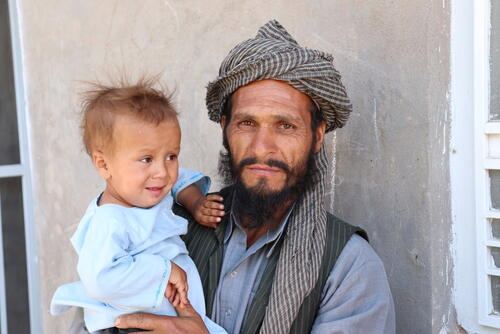
Mohammad Naeem, 35, is with his two year-old son, Yousuf, who has fever and is suffering from tongue rashes. He brought his child to the MSF clinic in Kahdistan camp. He left Shakh, a remote village in Qaisar district of Faryab, a year ago and is now living in a tent in the camp.

“I came to this clinic twice. My child received a good treatment here, and we are very happy with this clinic,” he says.
Afghanistan

Living conditions deteriorate for displaced people in Herat

With humanitarian assistance being reduced and water supplies running out, conditions are becoming increasingly difficult for some 100,000 displaced Afghans in Herat. Project Update - 24 Jul 2019
Four mothers posing in a corridor of the Hospital in Bili. All four of them are staying in the hospital with their child, that's suffering from a severe case of malaria. Since the beginning of the project in 2016, the pediatric ward already treated more than 4.000 cases of complicated/severe form of malaria.
Médecins Sans Frontières (MSF)

Independent medical humanitarian assistance

We provide medical assistance to people affected by conflict, epidemics, disasters, or exclusion from healthcare. Our teams are made up of tens of thousands of health professionals, logistic and administrative staff - most of them hired locally. Our actions are guided by medical ethics and the principles of independence and impartiality. We are a non-profit, self-governed, member-based organisation.

Learn more