



Ebola disease in DRC: find out how we're responding
Learn more
8000 Results
 
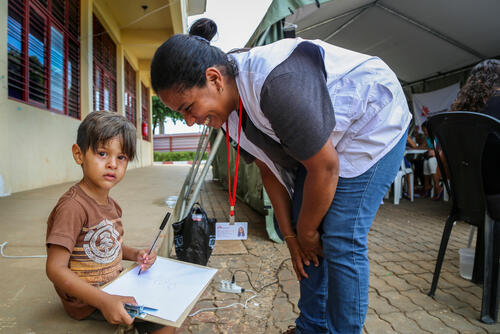
CENTRAL AFRICAN REPUBLIC, BAMBARI, 27 SEPTEMBER 2014 An MSF staff takes the temperature of a young boy. In the villages around Bambari MSF has established so called 'points palu' or malaria stations, where people get examined to detect malaria in an early stage, especially children. Between 80 and 90% of the patients are tested positive to malaria.
Medical resource

International medical guides: practical tools for the field

MSF has launched new editions of "Clinical guidelines" and "Essential drugs", available in several languages for use in MSF projects and beyond. MSF medical resource - 17 Oct 2019
 
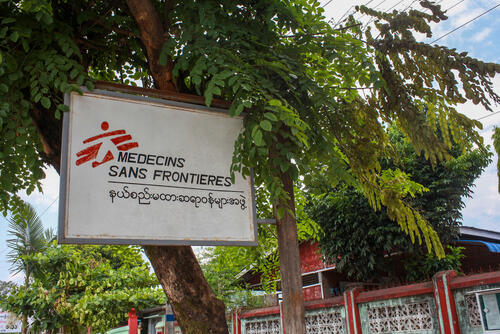
The sign indicating MSF’s clinic in Lashio, Shan state. MSF opened its first clinic in Shan state in 2001, and today provides HIV, TB (including DRTB), Hepatitis C care, as well as primary health care. In addition to its two clinics in Lashio and Muse, MSF also runs mobile clinics at Lashio and Hsipaw prisons and has emergency response capacity in case of natural disasters or population displacements as a result of fighting in Shan’s longstanding conflict.
Myanmar

Displaced couple cured of multidrug-resistant tuberculosis in Shan state

Treatment for multidrug-resistant tuberculosis patients is rare in Myanmar's conflict-affected communities. This story illustrates hardships patients face. Project Update - 17 Oct 2019
 
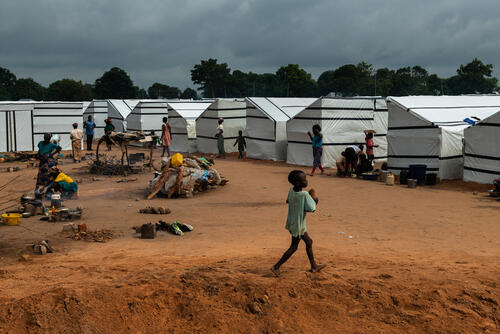
As the only actor in the area, MSF has built these shelters for the internally displaced families in Mbawa Camp, where currently about 3,800 people are sheltering.

MSF is also running a daily mobile clinic, offering basic health care to the displaced population in Mbawa Camp, near the state capital of Makurdi in Benue state.
Nigeria

Working with displaced people in Benue state, Nigeria

Interview with Simona Onidi, MSF project coordinator in Benue state, Nigeria, where our teams support some of the thousands of people displaced by violence. Voices from the Field - 16 Oct 2019
 
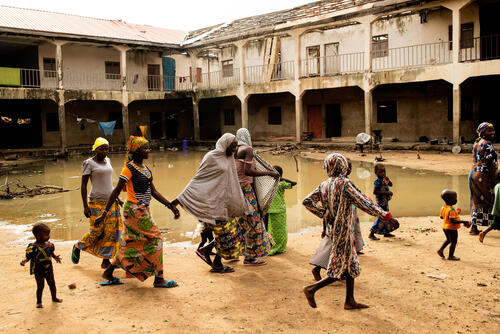
Displaced families now live in an abandoned building in Anka. Parts of the roof have collapsed and need reparation for people to stay dry during the rainy season.

In the town of Anka, around 7,000 displaced people have found shelter in abandoned buildings, schools and construction sites, such as the unfinished new palace of the local traditional ruler, the Emir. Mainly women and children live in the unofficial settlements, as the husbands often return to their looted villages to work on the fields.
Nigeria

On the run from violence in Zamfara state

Violence in Nigeria's Zamfara and Benue states has forced thousands of people from their homes. Their medical and humanitarian needs are great. Project Update - 15 Oct 2019
 
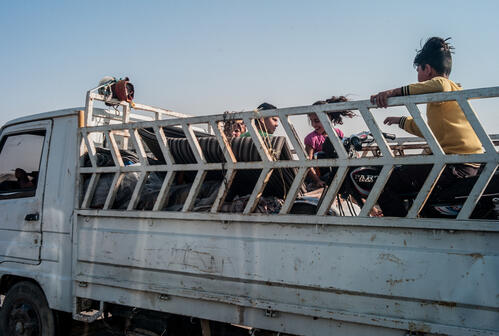
A family managed to flee the frontlines towards Tal Tamer and to either Hasakah or Qamishli . Fortunately, they managed to hire a truck and brought some of their dire possessions with them. During the conflict it is often quite high prices to rent a truck to bring their possessions with them.
Syria

Northeast Syria: MSF forced to evacuate staff due to extreme volatility in the region

Volatility in northeast Syria has forced Médecins Sans Frontières (MSF) to suspend most of our activities there and evacuate all international staff. Press Release - 14 Oct 2019
 
Over 18 Schools have been opened up so far in Hasakeh city to provide for the steady influx of IDPs  fleeing the frontline conflict between Turkish and the Syrian Democratic Forces. Each school houses from 150 to 270 people but lack water and hygienic facilities. The Syrian Humanitarian Coordinating Office expect 30,000 refugees to come to the city in the next coming days and to be-housed in these schools. They are beginning to set up for at least a hundred schools. Most of these refugees have no documentation or identification cards due to the conflict that has been raging over the last eight years. Local humanitarian organizations have highlighted the dire need of water supply as a major need.
Syria

Northeast Syria: Turkish military operation results in displacement and hospital closure

Shelling by Turkish military has displaced many people from villages and towns along Syria's northeast border. A hospital has closed. Press Release - 11 Oct 2019
 
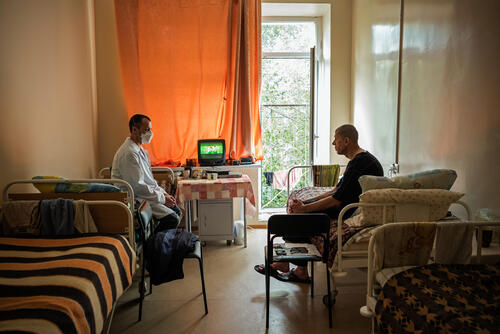
Dmitry, a patient at the TB Institute in Minsk, Belarus, visiting Andrey an MSF counsellor.  Andrey (counsellor): "During the seven months that we’ve known each other you were not an easy one. You were tough and thorny. But now it’s changed. It’s interesting with you." Andrey visits him almost every day and spends time with him, talking about different topics. 

Andrey (when Dmitry has left): “He doesn’t like it when somebody says nice things about him. They are used to living in tension, they are not used to such an attitude”. TB Institute, Minsk, Belarus, August 2018. Dmitry has been in this Institute for 7 months. Before this, he was in another hospital for 2 years.
Belarus

TB patients improve treatment adherence with psychological and social support

TB patients in Belarus have been shown to adhere - or stick to - their treatment better when they receive specialised psychological and social support. Project Update - 10 Oct 2019
 
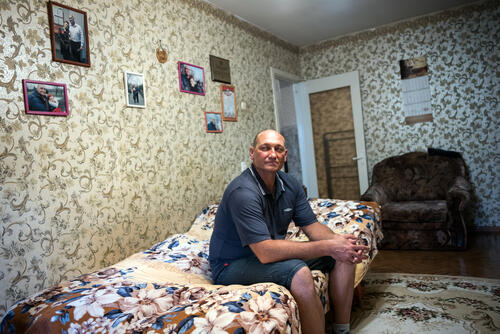
Portrait of Oleg in his living room which is also the bedroom he shares with his partner Alyona, whom he met while undergoing treatment for TB. "I was on treatment for TB, and I was not getting better. In July 2016 I was feeling worse. I would take a job but I wouldn’t be able to work for more than 2 hours. When people would give me a hand for a handshake I wouldn’t shake hands because it was painful as if my hand was breaking. 
My condition was deteriorating. In August they did an x-ray and the spot (in the lung) was growing. 
I was tired. I’d been through many things in my life – surgeries, an oncological condition, but I’d never experienced anything like it. I was told I should approach MSF, Doctors Without Borders, and that they could help. I approached them and they helped me. I felt sunshine inside me. So the decision had been approved to support my treatment. I’m very grateful to MSF because they offered me a helping hand. 
In April 2017 I was transferred to outpatient treatment here, in the TB Dispensary 2. On new treatment, with the new drugs I felt more or less ok in a month. I had an appetite again. MSF staff would call me and visit me, we would talk, joke together and I felt better. All this support has a very good impact. So I was transferred here, I was taking these drugs, and I started gaining weight. 
My mother was supporting me during the treatment. I was single then." Oleg says, in Minsk, Belarus, in August 2018.
Tuberculosis

TB drug delamanid must be more affordable and made available in more countries

Drug manufacturer Mylan will introduce a lower price for newer TB drug delamanid in South Africa - but it is still too expensive for those who need it and must be made available at a lower price in other countries Statement - 10 Oct 2019
 
Palestine: The invisible mental health crisis plaguing the West Bank
Palestine

The invisible mental health crisis plaguing the West Bank

Much-needed mental health consultations are among the services Médecins Sans Frontières (MSF) offers civilians in Hebron, in the occupied West Bank of Palestine since 1996. Project Update - 10 Oct 2019
Four mothers posing in a corridor of the Hospital in Bili. All four of them are staying in the hospital with their child, that's suffering from a severe case of malaria. Since the beginning of the project in 2016, the pediatric ward already treated more than 4.000 cases of complicated/severe form of malaria.
Médecins Sans Frontières (MSF)

Independent medical humanitarian assistance

We provide medical assistance to people affected by conflict, epidemics, disasters, or exclusion from healthcare. Our teams are made up of tens of thousands of health professionals, logistic and administrative staff - most of them hired locally. Our actions are guided by medical ethics and the principles of independence and impartiality. We are a non-profit, self-governed, member-based organisation.

Learn more