



Ebola disease in DRC: find out how we're responding
Learn more
431 Results
 
District Matam, Zone Carriere, Site Secteur 2

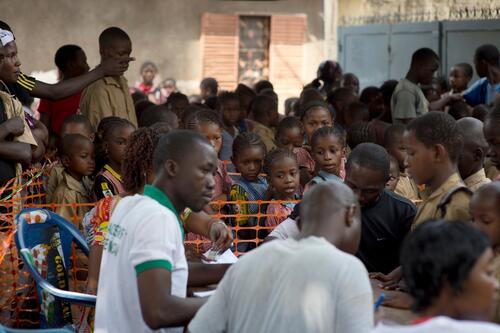
Children returning from school to get vaccinated. First they register to obtain their vaccination card.

MSF launched a vaccination campaign against measles in an attempt to control the epidemic that was declared by the government of Guinea on 14 January 2014. Together with the Ministry of Health, the teams of MSF should vaccinate around 400 000 children, ages 6 months to ten years, in 3 districts (Matoto, Ratoma, Matam) of the capital Conakry. 400 personnel will be working for two weeks to orchestrate this emergency response.
Guinea

The challenges of a vaccination campaign

MSF logistician, Grégoire Putz, describes the challenges of vaccinating 500,000 children. Voices from the Field - 20 Feb 2014
 
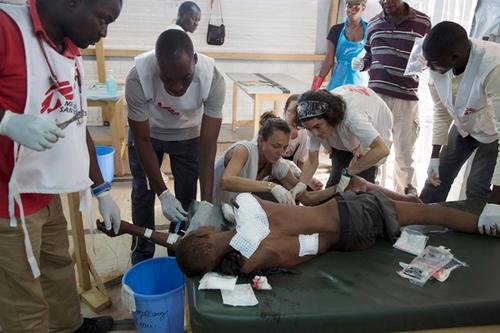
MSF medical staff are treating a man in Mpoko airport camp who was hit by an arrow. The fighters are often using homemade weapons like clubs with spikes, axes, and machetes. Due to lack of protection, the displaced people at the airport camp are too scared to return home, fearful of getting attacked.
Central African Republic

"We saw the ugly consequences of the fighting every day"

Lindis Hurum, MSF coordinator, speaks about her experiences in the camp in Bangui airport. Voices from the Field - 10 Feb 2014
 
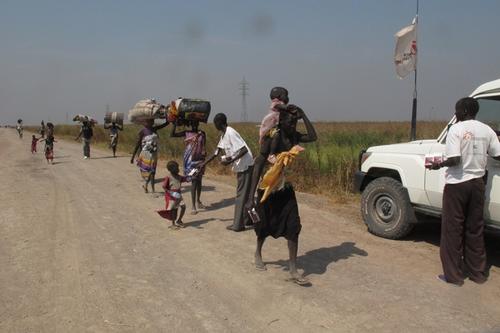
Ongoing insecurity in South Sudan has forced tens of thousands of people to flee their homes. This picture was taken by emergency coordinator, Jean-Pierre Amigo, who was forced to evacuate Bentiu, amid insecurity, along with the MSF team and thousands of displaced South Sudanese people. For ten days MSF returned to the road between Bentiu and Leer to distribute high energy food to the 10,000-15,000 people who walking along it.
South Sudan

The day MSF left Bentiu

MSF emergency coordinator Jean- Pierre Amigo describes what happened when MSF was forced to evacuate Bentiu. Voices from the Field - 7 Feb 2014
 
And yet another wave of displacement in the town of Bouca, (Ouham region) northeastern Central African Republic (CAR), after clashes between reported anti-balaka elements and ex-Séléka forces took place last week. For the second time in over two months, people had to flee to the bush running away from the fighting. Bouca was the center of attacks in September in which the civilian population, both Christians and Muslims, were targeted by the armed groups. Around 80 people were killed. The video shows, through interviews with direct an indirect victims of violence, the consequences of the fighting, forcing thousands of people to hide in the bush or to look for protection in churches, schools or airstrips.
Central African Republic

Rain does not wash the blood away (Part II)

José Mas Campos, MSF Emergency Coordinator in Bangui, describes what he saw in CAR. Voices from the Field - 6 Feb 2014
 
And yet another wave of displacement in the town of Bouca, (Ouham region) northeastern Central African Republic (CAR), after clashes between reported anti-balaka elements and ex-Séléka forces took place last week. For the second time in over two months, people had to flee to the bush running away from the fighting. Bouca was the center of attacks in September in which the civilian population, both Christians and Muslims, were targeted by the armed groups. Around 80 people were killed. The video shows, through interviews with direct an indirect victims of violence, the consequences of the fighting, forcing thousands of people to hide in the bush or to look for protection in churches, schools or airstrips.
Central African Republic

Rain does not wash the blood away (Part I)

José Mas Campos, MSF Emergency Coordinator in Bangui, describes what he saw in CAR. Voices from the Field - 6 Feb 2014
 
Recovery room of the Community Hospital.
Central African Republic

"This was my most difficult mission”

Jessie Gaffric, MSF project coordinator at Bangui Community Hospital describes the situation there. Voices from the Field - 5 Feb 2014
 
View of a Médecins sans frontières (MSF) clinic set up at the Tomping camp for  displaced people in the grounds of the United Nations Mission to South Sudan (UNMISS) base in Juba, South Sudan. MSF is currently carrying out around 230 consultations per day in the camp since three weeks.  Between 13,000 and 17,000 people are residing at the camp. The main diseases include respiratory diseases, acute diarrhea and malaria.
South Sudan

"Living in impossible conditions"

MSF’s emergency coordinator, Forbes Sharp, gives an update on the dire conditions for people in Tomping camp. Voices from the Field - 5 Feb 2014
 
View of a Médecins sans frontières (MSF) clinic set up at the Tomping camp for  displaced people in the grounds of the United Nations Mission to South Sudan (UNMISS) base in Juba, South Sudan. MSF is currently carrying out around 230 consultations per day in the camp since three weeks.  Between 13,000 and 17,000 people are residing at the camp. The main diseases include respiratory diseases, acute diarrhea and malaria.
South Sudan

What we need to save lives in South Sudan

MSF General Director describes harrowing situation in South Sudan Voices from the Field - 30 Jan 2014
 
msf-placeholder
Mali

New MSF bacteriology laboratory will save lives of children

New MSF bacteriology laboratory will help prevent fatal malnourishment Voices from the Field - 28 Jan 2014
 
Waiting room and patient registration. *** Local Caption *** Since mid-december 2014, more than 40,000 South Sudanese refugees have arrived in northern Uganda to flee the violence in Jonglei and Unity states. And the influx of people has not stopped. From an average of 2,500 new arrivals per day, the number of new arrival has dropped early January to about 700 persons per day. Dzaipi transit camp, located at about 7km from the border - was initially set up for 3,000 persons and was rapidly overcrowded. Refugees lived under the trees or at best in the school building. The local health centre was overwhelmed by the number of patients coming in. Refugees were lacking the basics such as clean water, food and latrines. MSF has set up an emergency operation to respond to their needs : water and sanitation, outpatient and inpatient consultations, maternity, vaccination and screening for malnutrition. MSF teams currently work in the three refugee camps and will adapt their activities according to the evolution of the situation.
Uganda

"Conflict is part of these people's story"

Fredericke Dumont describes how MSF team in Uganda has got medical services for South Sudanese refugees up and running in the space of a week. Voices from the Field - 23 Jan 2014
Four mothers posing in a corridor of the Hospital in Bili. All four of them are staying in the hospital with their child, that's suffering from a severe case of malaria. Since the beginning of the project in 2016, the pediatric ward already treated more than 4.000 cases of complicated/severe form of malaria.
Médecins Sans Frontières (MSF)

Independent medical humanitarian assistance

We provide medical assistance to people affected by conflict, epidemics, disasters, or exclusion from healthcare. Our teams are made up of tens of thousands of health professionals, logistic and administrative staff - most of them hired locally. Our actions are guided by medical ethics and the principles of independence and impartiality. We are a non-profit, self-governed, member-based organisation.

Learn more