


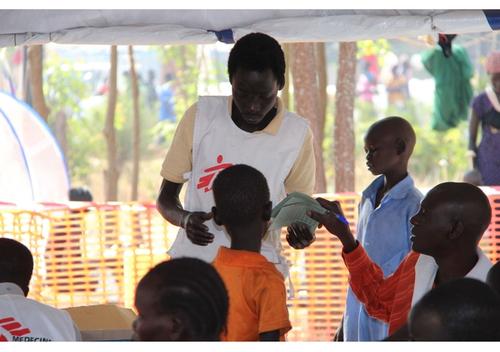
Dr Fredericke Dumont describes how MSF’s emergency team in Uganda has got medical services for South Sudanese refugees up and running in the space of a week
“We are working in a health centre in Dzaipi transit camp, Uganda, near the border with South Sudan. Dzaipi is a dusty place, in the bush, and about 38,000 people are sheltering here after fleeing the conflict in South Sudan: 15,000 are in Dzaipi and 23,000 are in Numanzi camp, five or six km away. Many come from Jonglei and Unity states and the city of Bor. Most are women and children.
People walked for a long time before arriving here. They brought a lot of things with them – cooking equipment, clothes, plastic bags full of possessions, personal stuff. You get the sense that they had time to bring luggage. But there are others who brought nothing.
The UNHCR has provided tents, and for the moment they have food. They have drinkable water – MSF brings several trucks of water from the Nile every day, then treats the water in the camp so it is safe to drink before distributing it to the refugees.
Support to the Ministry of Health
The Ugandan Ministry of Health was running the health centre, but they were very busy, overwhelmed by the numbers of people arriving. So we came to provide them with support.
MSF arrived here two weeks ago, and quickly opened an outpatient tent – with room for consultations, a waiting area, triage, counselling, a dispensary and an outpatient feeding centre.
We started running mobile clinics in Numanzi, a small camp about five or six kilometres away from here. We refer serious cases from there to the clinic here in Dzaipi, and if they are very serious, we refer them to Adjumani district hospital, where they have the capacity for doing surgery.
Inpatient ward
Yesterday, we opened an inpatient ward in an existing building here in Dzaipi, and hired local staff from Uganda and South Sudan – nurses, cleaners, nurse assistants, clinical officers, midwives, ambulance drivers. At present I’m the only doctor in the camp. We organised lists of duties and rotas, and stocked the ward with drugs and medical supplies. Conditions in the health centre are pretty basic.
We’ve seen some serious cases: a lot of malaria, diarrhoea, vomiting. There are women suffering complications during pregnancy; people with fever and lower respiratory tract infections; and some cases of malnutrition, so we will set up an intensive therapeutic feeding centre for the malnourished children who need inpatient care.
The cases we’re seeing, and the medical management of them, are similar to elsewhere in Africa. Although conflict is a part of these people’s story, for the moment they don’t really talk about the conflict.
Numanzi camp is becoming overcrowded, so a second camp is to be opened in Baratuka, 10 km from Dzaipi . We plan to run a second mobile clinic in Baratuka, and will install a 30,000-litre water tank to provide the refugees with clean drinking water. We’ll expand our medical activities according to the needs of the refugees.”