


Why we need a revised pay approach
Previously, MSF lacked a common approach to pay across entities and staff groups, which hindered joint operational initiatives, fuelled internal competition, and created challenges for staff retention and mobility within the organisation. Furthermore, in certain contexts, there were concerns about whether salaries at the lower end of the pay scale were sufficient to cover basic living costs.
The MSF Global Pay Policy Framework
To address these challenges, MSF developed a global pay policy framework.
Key elements of the Global Pay Policy Framework include:
- Living Wage Standards: A minimum standard for pay at lower levels supported by an updated Living Wage policy.
- Attractiveness for Country-Based Coordination Positions: Guidance to enhance the attractiveness for country-based coordination positions in programmes.
- Guidance for Salary Grid Development, including benchmarking specifications to compare MSF salaries with similar organisations, including guidance to ensure consistency in pay differentiation.
- Individual Pay Components: A consistent approach to determine elements of individual pay (those pay components that recognize previous experience).
Benefits of the Framework
The MSF Global Pay Policy Framework provides a structure for setting salaries for MSF staff, ensuring consistency, transparency, and accountability across the MSF Movement. This Framework outlines the principles, methods, and components involved in determining pay, supporting decision-making and resource management.
It aims to promote consistency in salary practices across the organisation, avoid unjustified differences in pay and increase transparency in how salaries are set and support accountability in the use of MSF funds for staff rewards.
- Improved Living Wage policy reflects MSF's agreed-upon responsibility, role, and limitations, while accounting for the diversity of contexts in which MSF operates.
- Consistent salary review schedule establishes consistency in how MSF benchmarks salaries compared to other employers and in the differentiation of pay through pay structures.
- Transparency in Pay Differences: Ensures transparency regarding the reasons and locations for pay differences, including to attract senior staff in agreed-upon strategic locations or to limit higher salaries.
- Standardised Implementation: Supports consistency in implementation through standardised benchmarking approaches and the availability of consistent data.
The Global Pay Policy Framework is underpinned by more detailed policies and implementation guidance including:
LIVING WAGE
MSF’s revised definition for living wage is the full-time wage necessary to support the purchase of necessary goods and services to provide a healthy and comfortable standard of living for the staff member in modest surroundings. MSF uses this as a critical indicator to check and/or set starting pay during salary reviews.
INDIVIDUAL PAY
Individual pay relates to the component of pay that recognizes previous experience.
Key changes include:
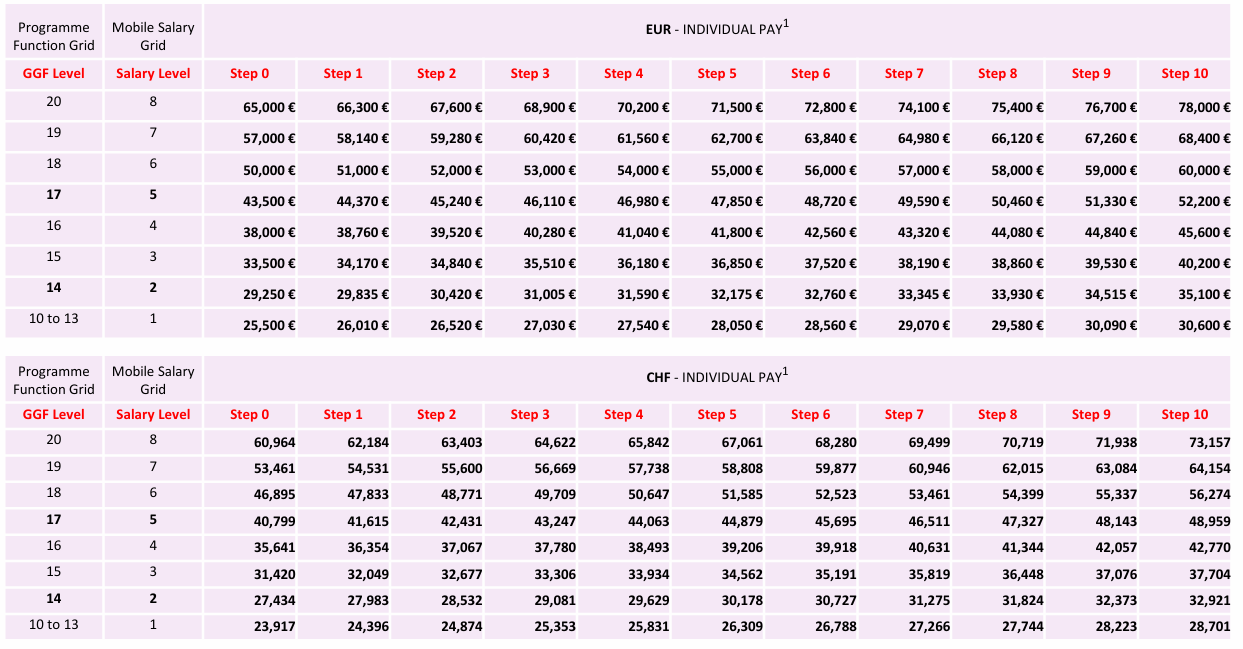
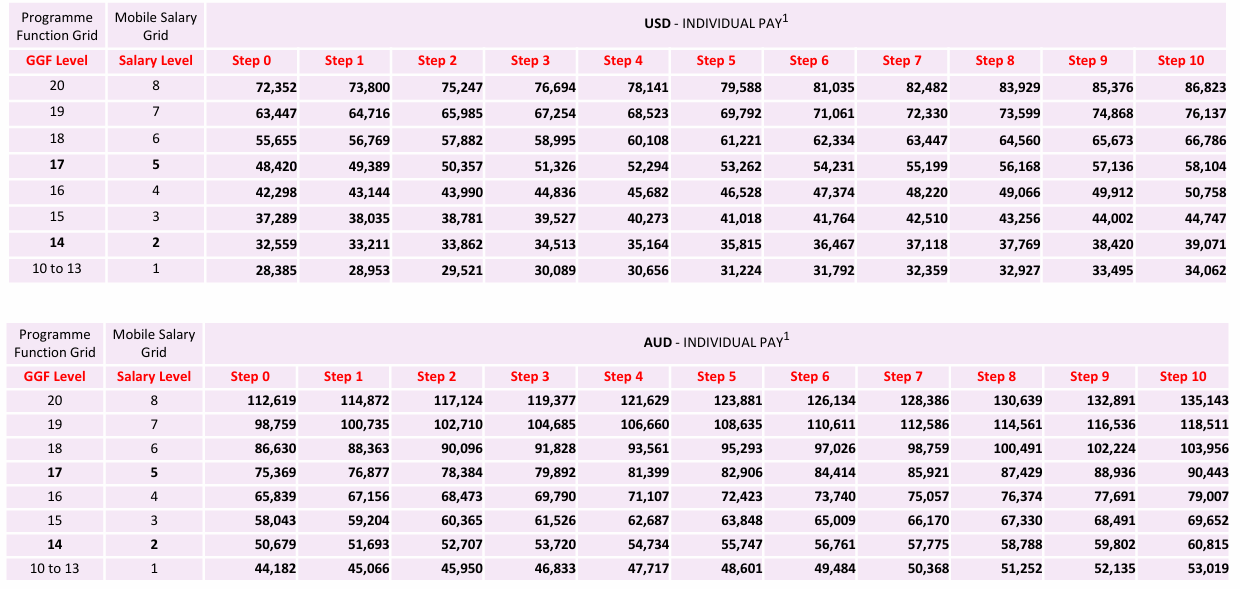
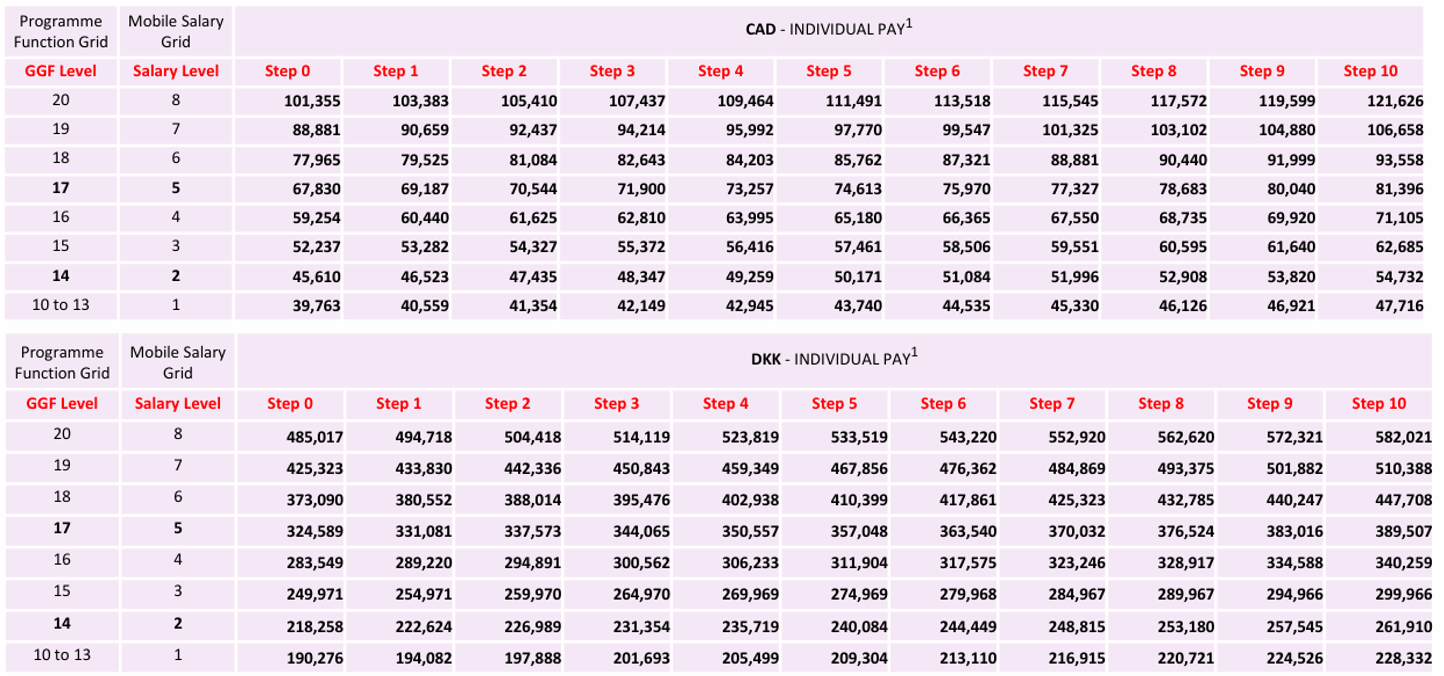
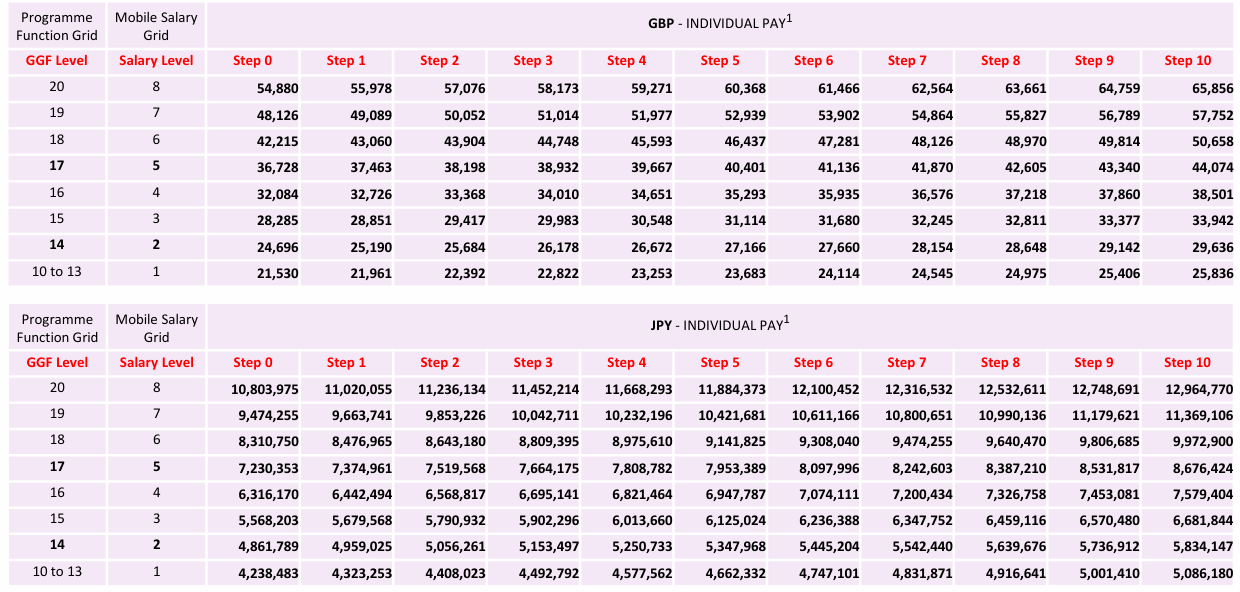
- Each level will now have a 20% salary range, divided into 10 steps of 2% each of base salary, replacing the current system for mobile staff of 3 steps. This provides more gradual progression. Steps can be gained through:
- Time worked in any capacity within MSF, including roles in programmes and MSF offices. For mobile staff, this is a shift from the current “loyalty” system which only considers work in programmes.
- Relevant external experience which is assessed for jobs in level +15 of the Programme Function Grid. This global definition of individual pay, which is broader than the current definition, reduces differences in pay approaches for all staff, building more equity. Relevant external experience of mobile staff will be more broadly recognized when joining MSF.

ATTRACTIVENESS FOR COUNTRY-BASED STAFF IN COORDINATION POSITIONS
MSF has improved attractiveness of pay for country-based staff in senior programmes i positions by introducing renewed criteria to address both internal and external attractiveness in contexts where MSF salaries are not sufficiently attractive. This approach includes cost modelling to allow salary increases of up to the 75th percentile in identified contexts.
Mobile Staff Rewards policy
MOBILE SALARY GRID
A new mobile salary grid will be implemented in November 2026, establishing pay for all mobile staff regardless of their country of origin.
The new Mobile Salary Grid will benchmark salaries at the median level compared to similar organisations (European-based INGOs). Additionally, salaries will no longer be adjusted to the country of domicile.
The Mobile Salary Grid has eight salary levels and more regular steps which allow for salary progression when people take on more senior roles.
Most mobile staff will see an increase in their total remuneration. A small number of mobile staff have current salaries higher than the new Mobile Salary Grid, because they receive 'top-ups’ that will no longer exist. These staff will have their salary protected. No mobile staff will see a reduction in current salary.
Per diem will no longer exist (see below). To enable access to cash, mobile staff will have access to salary advances while on assignment in countries where needed.
Note regarding “Indemnity” : As of October 2023, the "indemnity period" - during which mobile staff received a lower 'indemnity' payment instead of a full salary for their first 12 months - has been removed. Mobile staff are now compensated based on the salary level corresponding to their position and experience.

Pay and Benefits Guide for Mobile Staff
The following guide is available for mobile staff to describe the changes that will be implemented as per November 2026.
Mobile Salary Grid
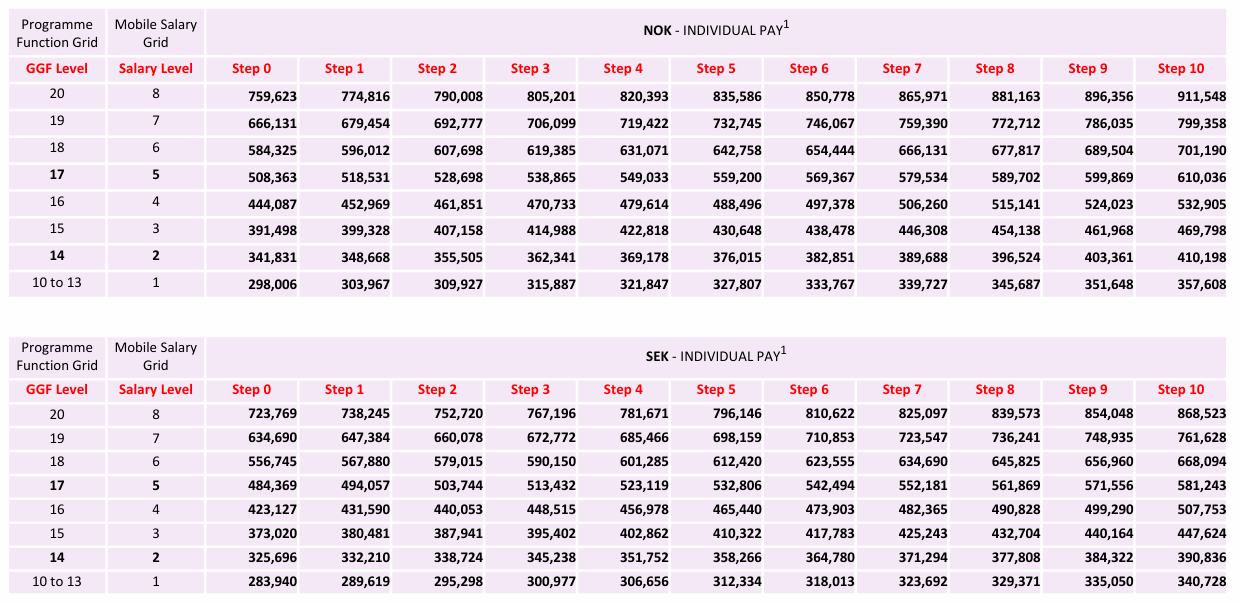
Below find the Mobile Salary Grid effective as per 1 November 2026 in different currencies.
The amounts listed below are stated as annual gross figures. They do not reflect any minimum legal salary which may apply for individual staff members based on each contracting entity’s local legal framework. For exact salary amounts applied in a particular contracting entity, and/or a salary for a specific individual, please contact the relevant contracting entity directly.
Removal of Per Diem
Per diem has long been identified as problematic. It is an increasingly obsolete rewards practice that is left over from a time when mobile staff received basic allowances rather than salaries. Now that staff receive salaries its purpose is unclear. It is a payment reserved for a single staff group and is disproportionately high compared to full salaries of country-based staff. As such, it is perceived as inequitable and a badge of privilege. These reasons led MSF General Directors to unanimously decide that per diem for mobile staff and accompanying dependents will be removed as of November 2026.
What does this mean for Mobile Staff?
Before your next assignment
- Prepare to access funds with debit of credit cards and consider other digital payment methods or accounts. Please read MSF's guide to personal finances while on assignment (below) for more information. This is important before departure because costs of accessing money will be borne by the individual mobile staff.
- In recognition that MSF works in many locations where it is difficult to access other payment methods mobile staff will have access to salary advances when needed and possible. (For more info, go to Salary Advance Process.)
MSF strongly encourages you to manage your finances independently while on assignment. Because salary advances are optional, intended for when mobile staff do not have access to other payment methods and do not offer flexibility in terms of amount, mobile staff should prefer to access funds through their own means. - Make sure to take note of the information MSF will provide on availability of cash or other payment methods in the location of your assignment and follow any tips to access your funds remotely.
During your assignment
- In many programme locations, shops accept payment with international cards or electronic funds transfers (EFTs). There is also a network of money transfer agencies across the world.
- Many countries where MSF operates have ATMs or banks that accept most international debit and credit cards. Follow security rules and avoid carrying large sums of money beyond what is allowed or recommended.
- If you need a salary advance, submit requests for the standard amount before the confirmed deadline.
- If there is a food box, mobile staff are expected to contribute to it through salary advance or through cash or transfers from other means.
After your assignment
- Prepare for future assignments by considering other digital payment methods. Please read MSF's guide to personal finances while on assignment (below) for more information. Costs of accessing money will be borne by the individual mobile staff.
- As a reminder, mobile staff continue to be responsible for complying with requirements to pay income tax according to the fiscal rules in the country where they reside. These requirements vary from country to country. This is described in more detail in the Frequently Asked Questions.
Below find Advice to Mobile Staff on how to manage personal finances while on assignment.
Scenario-based examples of rewards changes for mobile staff
The case studies below show the potential impact on individual mobile staff pay with the future Mobile Staff Rewards Policy.
Please bear in mind the following points when reading the below scenario-based case studies:
- All personas are fictitious. Remuneration and calculations are based on
assumptions. Calculation and communication of salary packages for individual staff is the responsibility of the relevant entity. - The comparisons are based on gross salaries and are calculated in the contracting
section of the given scenario. Please note remuneration will continue to be paid in the
currency of the individual mobile staff's contracting section. - Please consult with your HR team in your contracting section for additional information
on specific individual examples.
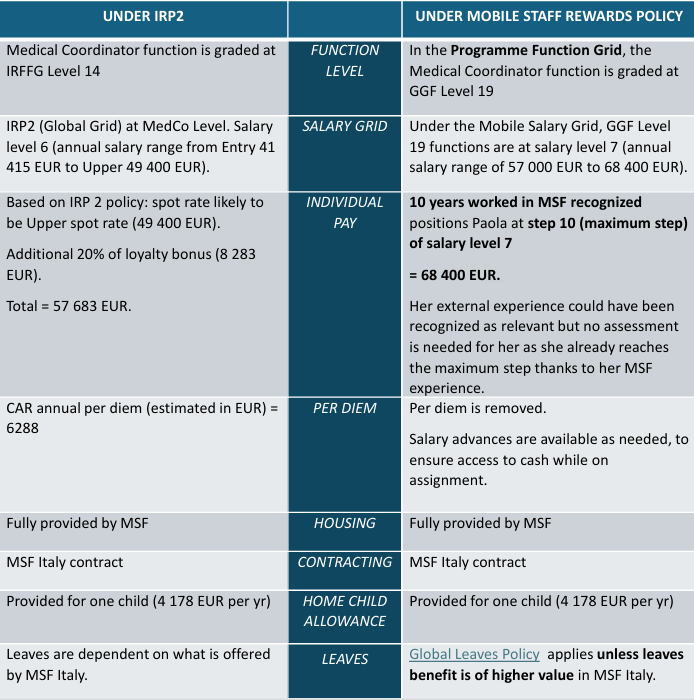
Paola is a mobile staff from Italy who will begin an assignment in Bangui, Central African Republic (CAR) for 12 months as Medical Coordinator. She has a child who does not accompany her in the assignment. At the beginning of her contract in CAR, she has 10 completed years of MSF experience in programmes and 5 completed years’ experience as Field Coordinator with another INGO.
*Other global policies not listed here may apply to various scenarios.
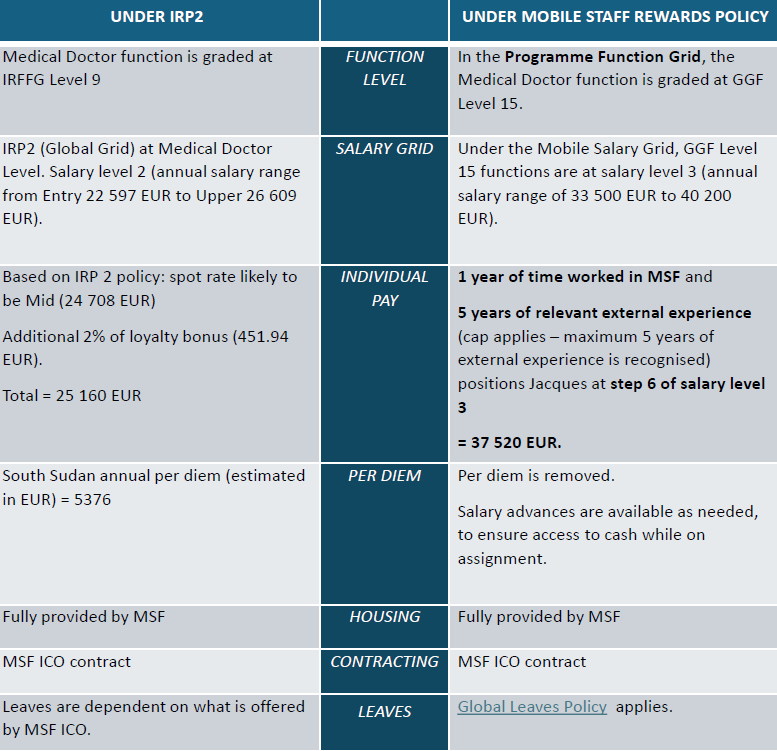
Jacques is a mobile staff from DRC who will begin an assignment in Malakal, South Sudan with OCBA for 6 months as Medical Doctor. He will be contracted by the International Contracting Office (ICO). At the
beginning of his assignment in South-Sudan, he has 1 completed year of MSF experience as mobile staff and 6 completed years’ experience as a Medical Doctor in DRC and with another INGO.
*Other global policies not listed here may apply to various scenarios
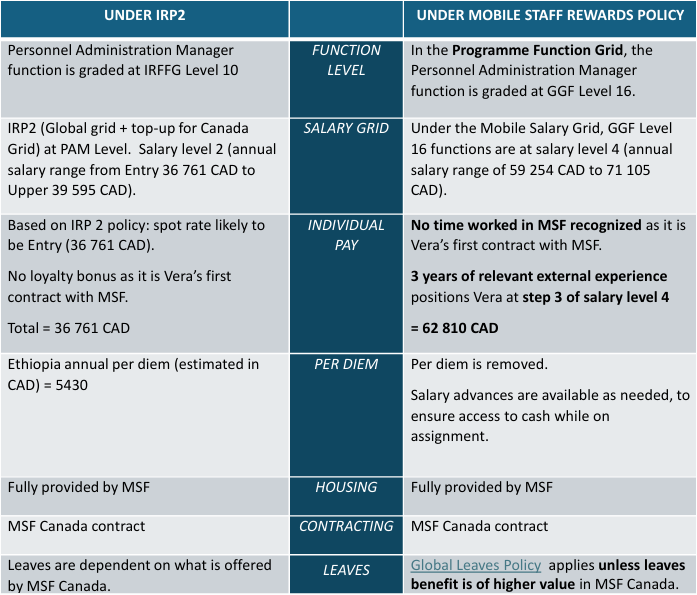
Vera is a colleague from Canada who will begin an assignment in Addis Abeba, Ethiopia for 12 months as Personnel Administration Manager (PAM).
This is her first contract with MSF. At the beginning of her assignment in Ethiopia she has 3 completed years of previous experience in administration management
in the private sector.
*Other global policies not listed here may apply to various scenarios
Mathieu is a colleague from Switzerland who will begin an assignment in Myanmar for 12 months as Logistics Team Leader.
At the beginning of his assignment in Myanmar he has 4 completed years of MSF experience in programmes and 3 completed years of MSF experience in an MSF office. He also has 2 completed years of relevant external experience in logistics management with another INGO.
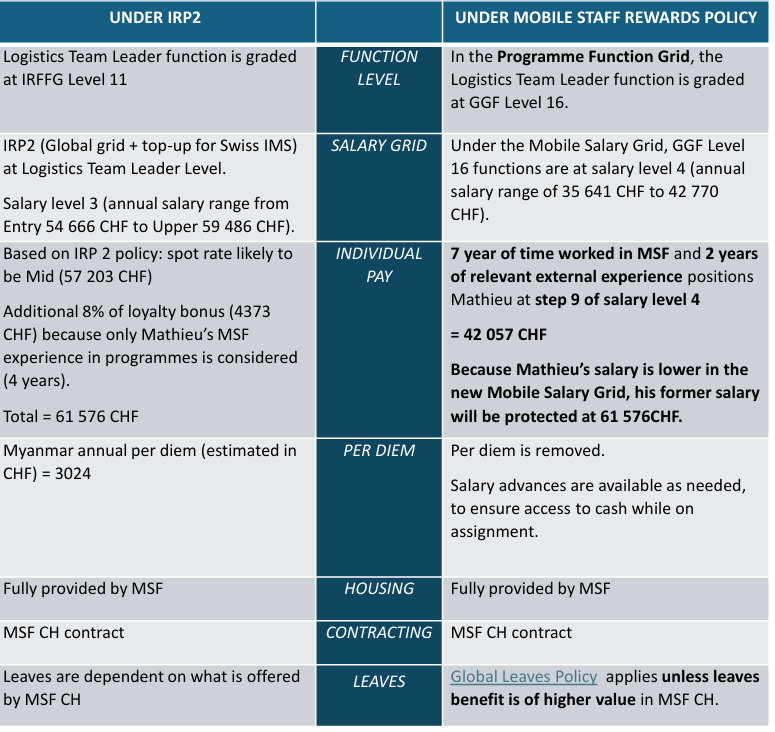
*In this scenario, if the assignment began before November 1st 2026 the mobile staff would also be
entitled to transition measures until the end of this assignment.
Geraldine is a colleague from France who will begin an assignment in Niamey, Niger for 24 months as Head of Programmes (Head of Mission).
At the beginning of her assignment in Niger she has 12 completed years of previous MSF experience in various position in programmes and 5 years in leadership roles in the public sector. Her husband and two children will accompany her on the assignment.
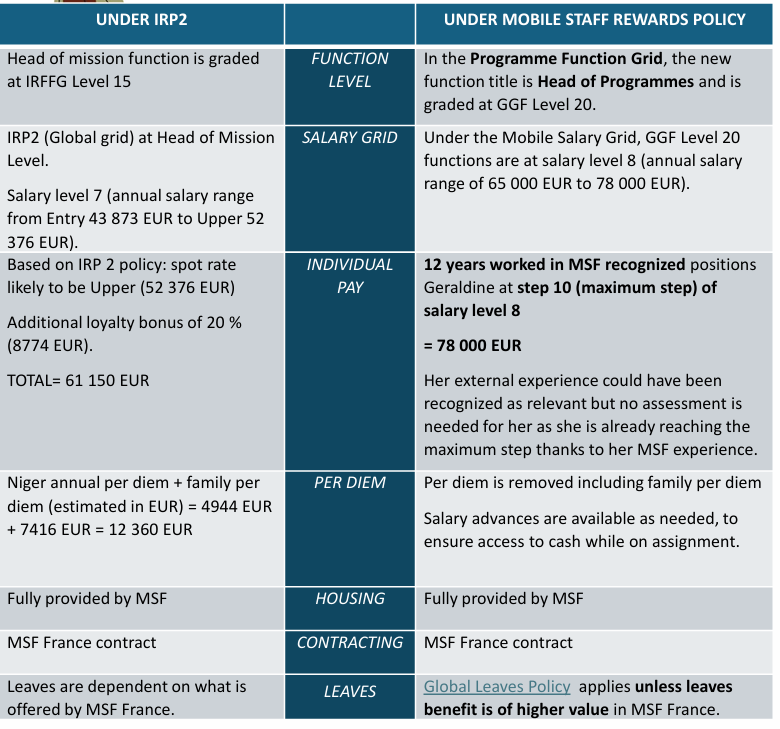
*Other global policies not listed here may apply to various scenarios
Paloma is a colleague from MSF Germany who has begun an assignment in Guatemala before November 1st for 12 months as Health Promotion & Community Engagement Manager.
Paloma has 3 years of previous MSF experience in various positions in health promotion and 3 years in health promotion in Germany. Her partner and 1 children have joined her on assignment.
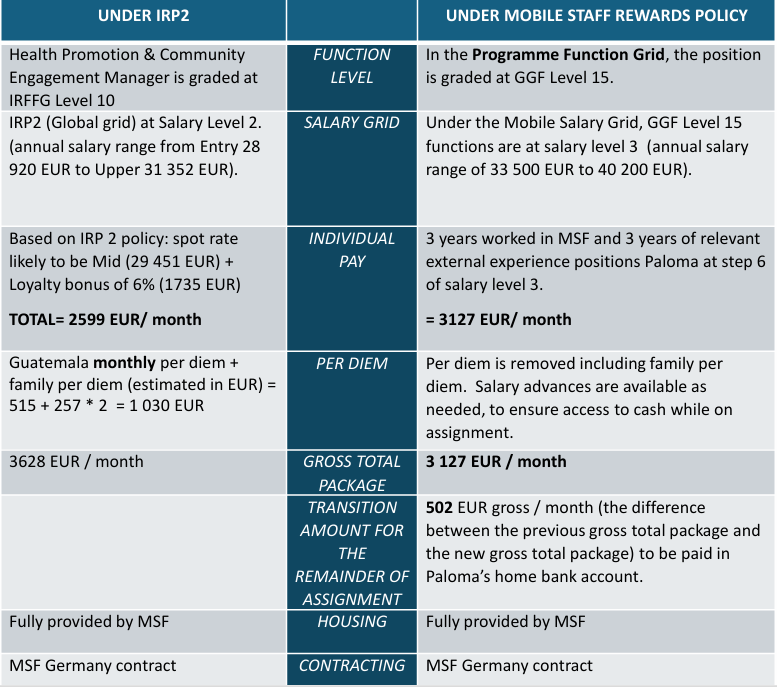
*Other global policies not listed here may apply to various scenarios