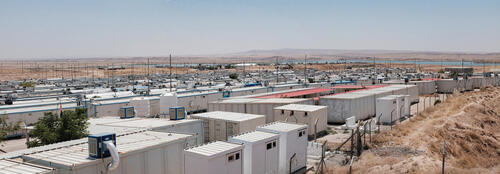
Outside the city of Khanaqin in Diyala governorate, eastern Iraq, on a hill next to a dirty river, dozens of rows of caravans bake in the 47-degree heat. Inside the camps, known as Alwand 1 and 2, live approximately 827 multi-generational families. They were first displaced in 2014, when the IS group briefly held towns and villages in Diyala governorate. They and their worldy belongings are crammed so tightly together that there is virtually no privacy or personal space at all.
Video
Khanaqin, Iraq
With no real possibility to return to their homes, no job opportunities, and savings that dried up years ago, almost every family relies entirely on ever-decreasing humanitarian aid to survive. The uncertainty and hopelessness of their situation, combined with the trauma they experienced during the displacement and the monotony and purposelessness of camp life is having a negative effect on their mental health.
“The mental health of the people living here is not good,” says Abdulrazzaq, an MSF mental health counsellor working inside MSF’s clinic at Alwand 1 Camp and a displaced person himself.
“It’s because of the traumatic events that they gone through, like the loss of their loved ones, lands and houses, and the difficult living conditions here in the camp. The two biggest issues we hear about in our sessions are finances and the fact that the security situation doesn’t allow them to return to their home town. The longer they live here, the more their financial situation suffers and the more their mental health deteriorates.”
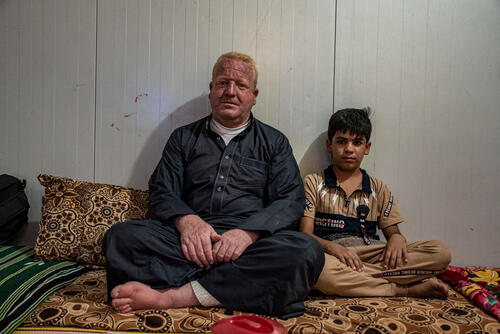
Wissam, a 34-year-old man from Saadiya – a town around 37 kilometres from Khanaqin that was recaptured from the IS group in November 2014 – has been visiting MSF’s clinic in Alwand camp. He wants to know how he can best support his and his family’s mental wellbeing so they can cope with their everyday struggles and stress.
“No one would die of hunger here but we are not used to be living in such conditions,” he says. “We want security to improve so that we can go back home, but for now it’s not secure in my village and we don’t have jobs that would allow us to rebuild our houses. We used to work as farmers – we had orchards and cattle but here we are living in containers. How can we make a living here?”
For the past few years since the Iraqi government recaptured the area from IS group, it has been encouraging displaced families to return to their towns and villages of origin. While many have been able to do so, the rate of returns has slowed in recent months. More than 55,000 men, women and children remain displaced within Diyala governorate and fear the conditions will never be right for them to return home.
The reasons for this are multiple. Among them are fear or direct threats that the changed communities in their areas of origin will not welcome them back; fear of tribal ban or collective punishment for crimes allegedly perpetrated by members of the same tribe, including those accused of IS affiliation; fear of arbitrary arrest or a lack of freedom of movement once they return, as well as extreme poverty and a lack of financial and essential means to support them in rebuilding their damaged houses and surviving back at home.
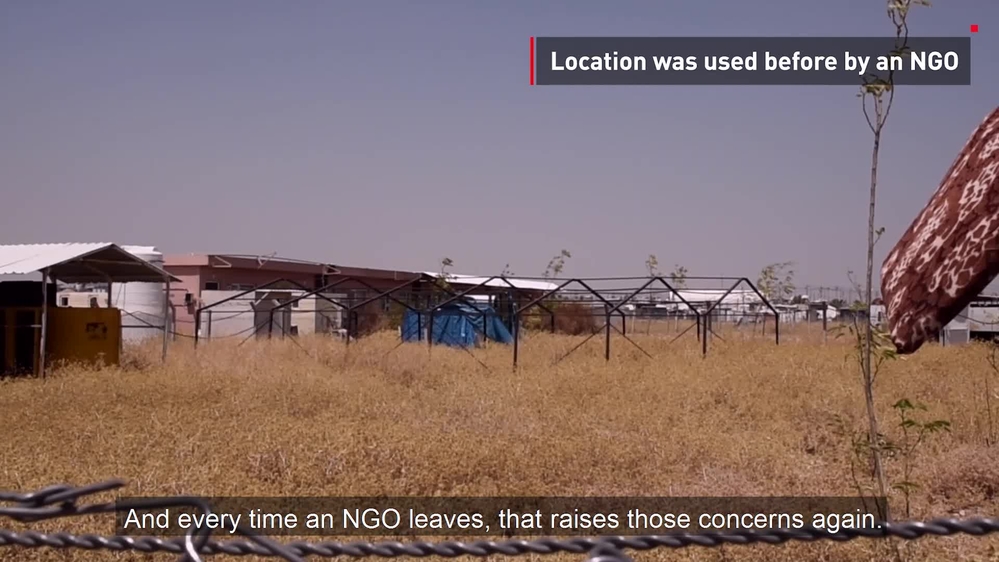
Money is a preoccupation for all camp residents, with the poverty of the last few years causing a strain on all families and relationships. As non-government organisations leave one by one and services dry up due to a lack of funding, fear is spreading that the camp will soon be forced to close or that the residents will be abandoned without financial, medical or food aid and left to fend for themselves.
“Financially, we are broke and that is affecting our mental well-being,” says Hassan, who was displaced from his home in Saadiya in 2016.
“Sometimes I sell some of the food we receive to be able to spend money on my family. If anyone in my family gets sick, I can’t afford their treatment. I can’t be blamed for being sad and angry. [My house is destroyed] so if I want to go back to Saadiya, I don’t know where to live. I don’t have a house anymore so where should I live? In the street?”
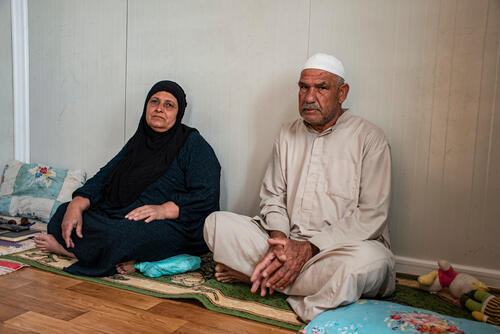
For women in particular, life in the camp is oppressive and isolating. In traditional Iraqi communities, women gather with their female neighbours and family members in the privacy of a house or garden, enjoying time together and sharing household chores. In the camp, there are no private spaces for women to gather outside their caravans meaning they spend most of their time inside, either with their immediate family members or alone.
“We get very bored and we feel trapped,” says Sabiha “We spend the whole day just staring at each other without a relative to visit or a place to go. Since we were displaced I don’t feel alright mentally, I have to take medications to be able to sleep but even then I don’t feel very good because the pills make me dizzy. When it gets bad, I feel very sad, it’s like I start to suffocate and I have to leave the container and stay outside, I can’t do any house work anymore even if the whole world comes and tries to comfort me, I still feel very sad.”
MSF in Diyala governorate
MSF has worked in Diyala governorate since 2014. We deliver mental healthcare, treatment for chronic diseases and sexual and reproductive health care to displaced families, people who have recently returned to the area, and the host community. Until recently, we were not only working not inside Alwand Camp 1, but also supporting the local Ministry of Health to provide care in Jalawla and Saadiya. As the situation has evolved, we have handed over our activities inside the Jalawla and Saadiya primary healthcare centres and are in the process of opening new projects, in collaboration with the Ministry of Health, in these areas to support the Iraqi people of Muqdadiya and Sinsil in Diyala governorate
So far this year, MSF teams have provided 2,915 mental health sessions, 12,250 consultations for non-communicable diseases, and reproductive and sexual healthcare for 6,647 women.
Coronavirus COVID-19 pandemic
MSF supports Iraqi hospitals responding to COVID-19
Project Update
14 Apr 2020