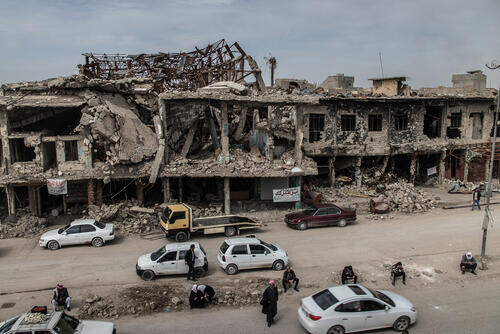
Iraqis who fled the Islamic State group’s iron grip and the US-led coalition’s bombing campaigns have all but lost hope in the future.
Their story is testament to the fact that, while the Islamic State group appears to have been defeated militarily, peace and prosperity remain a distant dream for many Iraqis.
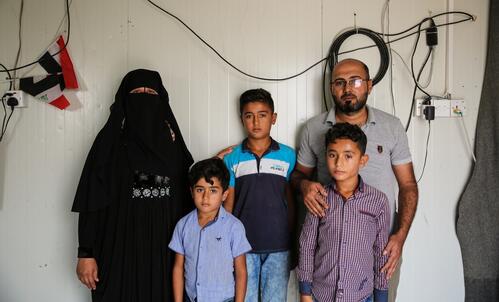
Mohammad and his wife, Umm Abdel Rahman, celebrated the defeat of the Islamic State group in their home town of Al-Qaim in November 2017. But over a year later, they and their three young sons continue to live in a container in a camp for displaced people in Amriyat al-Falluja, in central Iraq. Hundreds of kilometres from home, they rely entirely on aid to survive and have lost hope of returning home.
This family’s journey began three years ago. “The bombing and shelling of Al-Qaim, my town, made us flee to Baghdad in September 2015. We fled the town as a family, along with my elderly mother, my brother, his wife and their two daughters,” said Mohammad, aged 40.
Plagued by sectarianism and poverty, they couldn’t stay in Baghdad. So they hit the road again, heading this time for Erbil, the capital of Kurdistan governorate. There, Mohammad found work, but he was not paid enough to meet his family’s needs.
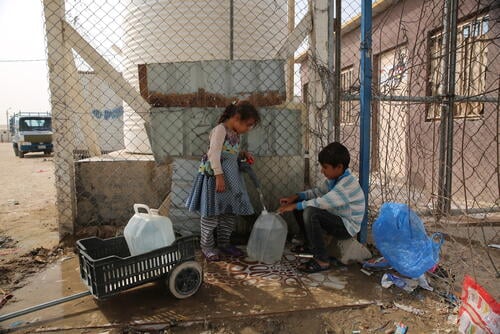
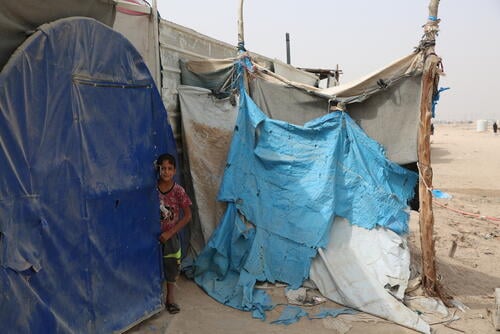
Since late 2017, they have been living in Amriyat al-Falluja camp, home to a sea of tents and containers in a desolate landscape of sand and scorching heat.
‘City of ghosts’
The family is destitute and relies entirely on charity to survive. As long as they remain here, there is little hope of that ever changing. But things are hardly better in their hometown, Al-Qaim, now a “city of ghosts”, according to Mohammad.
“We now live here, in this desert, with no hope of ever going anywhere good,” he adds.
Modammed’s wife, Umm Abdel Rahman, feels just as despondent. When the family saw on TV that the Islamic State group had been pushed out of Al-Qaim, “we felt a deep longing to return home,” she said. “I called my family there to arrange our return but they said the situation was miserable: even those who were once wealthy were now poor and only civil servants were now able to survive. Otherwise, you have to live on handouts.”
“I no longer think of returning to Al-Qaim,” she continued. “I want to leave Iraq altogether. We’ve been through so much – misery, horror, and poverty. We wonder, ‘What are we supposed to live off?’ We live in a trailer here in the camp, and we receive some aid. But that barely covers us for 10 days. Still, it is better than living in Al-Qaim.”
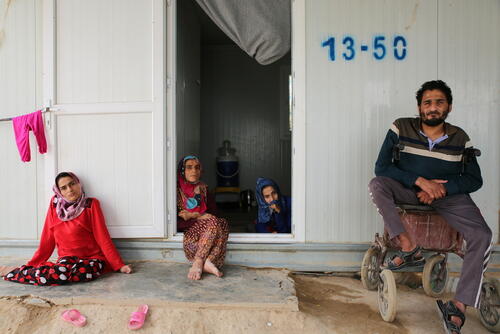
Others like Nadama, a 70-year-old mother of four disabled children, also fled Al-Qaim for Amriyat al-Falluja and rely on aid to survive. Nadama and her children lost their home in an air raid.
“I am living through hell here with my four disabled children. They were all born with congenital disabilities, and I have been trying to take care of them since my husband died of kidney failure in 2004. It was during the US-led invasion of Iraq, when there was a severe lack of medical services,” Nadama says.
Her 25-year-old son Marwan dreams of nothing more than an electric wheelchair, just so he can move freely through the camp. “That’s all I want from the world,” he says.
Like many other displaced people, Nadama is utterly exhausted, and enraged at the everyday anguish she and her family face. “We have nothing. I am an old, sick woman. I feed them and bathe them. I don’t get any help and I don’t know how long we will have to spend in this desert camp. I am tired all the time and sometimes I feel so angry I want to explode,” she says.
Anxiety, distress, depression
MSF’s Dr Amer Jasem, a psychiatrist working in the camp, says many of the displaced were already suffering from physiological and psychological problems when they arrived in Amriyat al-Falluja.
“MSF started assisting those in need directly by providing medicines and psychotherapy,” he says. “Children and teenagers are the most vulnerable in these circumstances, and many of them have learning disabilities, speech difficulties, neurosis and aggressive behaviour triggered by the horrors they have ‘survived’,” Jasem explains.
“Many of the displaced, regardless of their age or circumstance, suffer from sleep disorders and anxiety,” he adds.
In Nineveh and Kurdistan provinces, northern Iraq, some 30,000 people are living in rows of white and blue tents pitched in different camps. Their experience is similar to that of displaced people living elsewhere in north and central Iraq.
“Depression can appear sometime later,” explains Dr Wissam, an MSF psychiatrist who works in MSF’s clinic in Hasan Sham U2 camp, halfway between the Islamic State’s former bastion of Mosul and Erbil.
“A person might suffer from anxiety and distress to begin with, followed by depression,” he goes on. “To start with, people here were in survival mode. But as time has passed, stress levels have risen. Economic difficulties and anxiety about the future together can lead to depression.”
Like the families from Al-Qaim, many Mosul natives were happy to hear that the Islamic State had been pushed out of their ancient city in mid-2017. Among those living in the camp, many packed their bags and made their way home.
Fear of reprisals
But some who believed that they could simply pick up where they had left off after the armed group took over ended up returning to the camp.
“In Mosul, there was no electricity. People couldn’t find jobs and they had no money to rent a home. For some, at the end of the day, life is easier in the camps. That’s why they chose to return. Other families choose to stay in the camps for security reasons,” explains Dr Omar, also a psychiatrist with MSF.
Following years of violence, mistrust remains pervasive in Iraq, and people like Ali Manahel pay the price.
He, his wife and their four children live in Khazer camp, also on the road linking Mosul to Erbil. With his children gathered round, he tells the story of the six months and 13 days he spent in an Islamic State prison cell.
“I was tortured by the Islamic State. They used various methods, including electricity,” he says. One of his sons listens, sitting on his lap. One of his daughters is lying on the ground.
“I was strung up by the arms, and one of my shoulders still hurts. I was arrested because I was a police sergeant. They demanded ransom from my family. We had to pay them $20,000, followed by another $2,000 to secure my release,” he says.
They don’t plan to return home to Sinjar, a town to the west of Mosul that has become synonymous with the massacre of Yazidis at the hands of the Islamic State group. “There have been reprisals by Yazidis against Arabs,” Manahel says. “It would be too dangerous to return.”
Iraq
Rehabilitated hospital improves access to healthcare in Sinjar district
Press Release
8 Nov 2018