


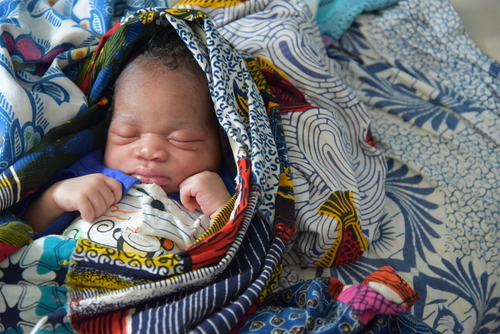

Clementine's baby is barely a day. She's a little girl, and her mom is still tired. This is her second child. She lives three kilometres from the Fronan health center in the Katiola district of northern Côte d'Ivoire and came by motorcycle when she felt the first contractions. In this region, Médecins Sans Frontieres (MSF) is supporting a maternal and child health program in partnership with the Ivorian Ministry of Health with a priority: managing complicated deliveries to reduce maternal and infant mortality.
That morning Mathilde, Clementine's sister-in-law, kept her company. She had 6 children, two of whom died. Like many communities, they spend certain periods of the year in camps, near the fields, at the pace of agricultural work. Women then give birth in the nearest hospital or health centre, which does not always facilitate ante-natal care.
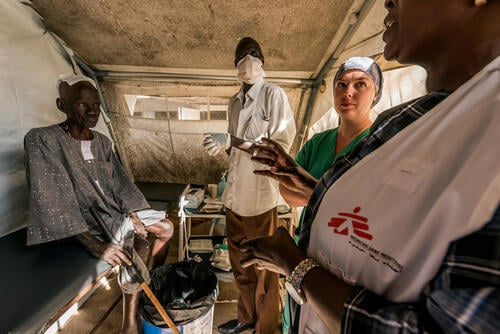
In the Fronan Centre, as well as in two other health centres, MSF supports the staff, including with telephone counselling for midwives if needed. The association also provides essential medicines and kits for the management of complicated deliveries and carries out renovation work on infrastructure, including to ensure regular access to drinking water. Eventually, since the cost of transport can be an obstacle for many families, MSF supports the referral for obstetric emergencies to the Katiola hospital. On average, midwives in the centres attend between thirty and fifty births each month in each health centre. The program is to be extended to three additional centres in 2017 to continue to improve the continuity of antenatal care, babies’ delivery and neo-natal care.

Le bébé de Clémentine a à peine un jour. C’est une petite fille, et sa maman est encore fatiguée. C’est son deuxième enfant. Elle habite à trois kilomètres du centre de santé de Fronan, dans le district de Katiola, au nord de la Côte d’Ivoire et elle est venue en mototaxi quand elle a senti les premières contractions. Dans cette région, Médecins Sans Frontieres (MSF) soutient un programme de santé maternelle et infantile en partenariat avec le ministère de la Santé ivoirien avec une priorité : la prise en charge des accouchements compliqués pour réduire la mortalité maternelle et infantile. 
Ce matin-là, Mathilde, la belle-sœur de Clémentine lui tient compagnie. Elle a eu 6 enfants dont deux sont décédés. Comme de nombreuses communautés, elles passent certaines périodes de l’année dans des campements, près des champs, au rythme des travaux agricoles. Les femmes accouchent alors dans l’hôpital ou le centre de santé le plus proche, ce qui ne facilite pas toujours le suivi avant la naissance.
Dans le centre de Fronan, ainsi que dans deux autres centres de santé, MSF accompagne le personnel, y compris par des conseils par téléphone pour les sages-femmes si besoin. L’association fournit également des médicaments essentiels ainsi que des kits pour la prise en charge des accouchements à complications et réalise des travaux de rénovation des infrastructures, notamment pour garantir un accès régulier à l’eau potable. Enfin, comme le coût du transport peut être un obstacle pour de nombreuses familles, MSF appuie la prise en charge des références pour les urgences obstétricales vers l’hôpital de Katiola. En moyenne, les sages-femmes des centres assistent de trente à cinquante naissances chaque mois dans chacun des centres de santé. Ce programme doit être étendu à trois autres centres en 2017 pour continuer à améliorer la continuité des soins anténatals, lors de l’accouchement et néo-natals.
International Activity Report 2018

Côte d'Ivoire

A newborn baby pictured in March 2017 in Fronan health centre, in Côte d’Ivoire’s Katiola district, where MSF supports a maternal and child health programme in partnership with the Ministry of Health.
© Jean-Christophe Nougaret/MSF
Ebola disease in DRC: find out how we're responding
Learn more
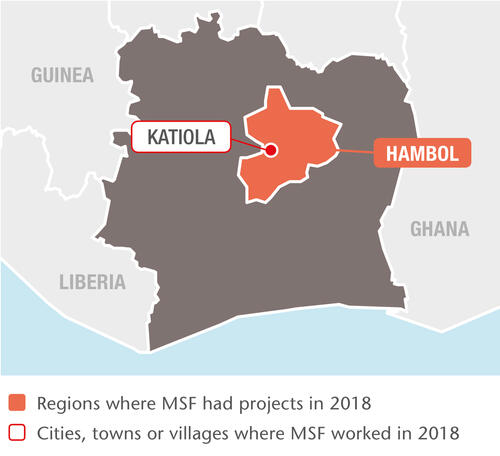
MSF in Côte d'Ivoire in 2018 Improving mother and child health remained the key focus for Médecins Sans Frontières in Côte d’Ivoire in 2018.
Map showing location of MSF projects in 2018.
© MSF

After decades of instability, the Ivorian health system is still recovering from the political and military crisis that engulfed the country from 2002 to 2010. The maternal mortality rate in Côte d'Ivoire is particularly high, with about 645 deaths for every 100,000 live births.<a href="http://apps.who.int/gho/data/node.country.country-CIV">World Health Organization</a>

The Ministry of Health has made maternal healthcare a priority, offering it free of charge to all pregnant women, but budget restrictions, drug stockouts and a lack of trained staff continue to hamper access to good-quality services for women and their newborns.

Needs are especially acute in rural areas such as Hambol, where we have been supporting the Ministry of Health since 2014. We have teams working in the maternity, neonatology ward and operating theatre at Katiola referral hospital, where we admitted 793 newborns for care in 2018.

We also provide medical supplies, staff, coaching and training to Dabakala hospital, Niakara hospital and six health centres, and support a referral system for obstetric and neonatal emergencies.  

In order to reduce mother-to-child transmission of hepatitis B, we started working with the Ministry of Health to introduce systematic vaccination immediately after birth in all MSF-supported facilities. Over 11,000 newborns were vaccinated against hepatitis B in 2018.   

We also respond to emergencies as required. In September, we distributed plastic sheets, cooking tools and blankets to some 100 families who had lost their homes in Attienhaka, 15 kilometres from Katiola, when parts of the village were burned down in an act of revenge following a crime.