


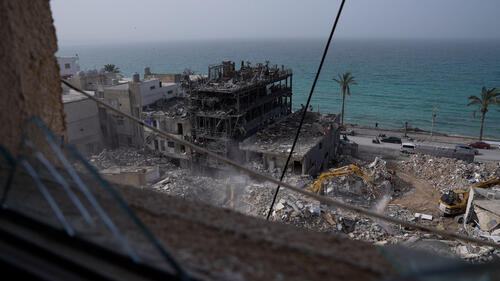
Traffic moves slowly towards the south of Lebanon, as displaced families cross the Qasmiyeh bridge, which was struck by Israeli forces, passing by the citrus and banana plantations stretching across the horizon. Some are making their way back to the UNESCO World Heritage coastal city of Sour, also known as Tyre, after 46 days of Israeli bombardment. Some families also never left the city.
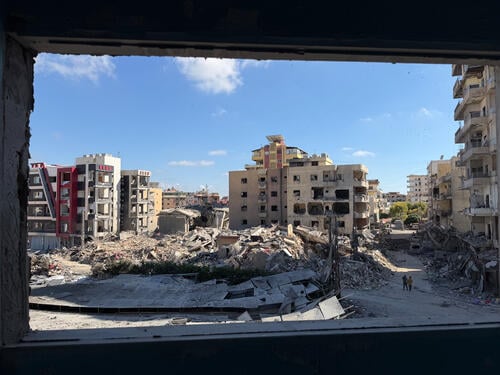
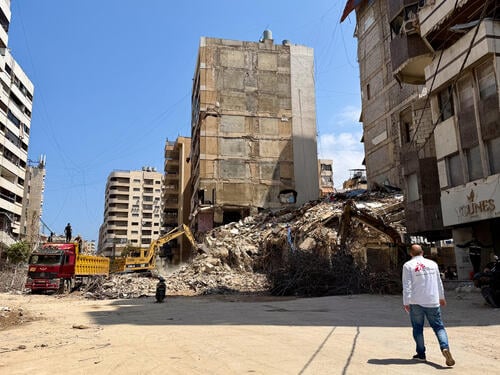
The scale of destruction from strikes has altered the city and the people living in it. While palm trees and fishing boats line the Mediterranean seafront, nearby 10-floor buildings have been ravaged. Homes and streets have been replaced by craters several metres deep, and cars sit abandoned, punctured by shrapnel.
During the escalation, most residents were forcibly displaced, while those who remained were largely cut off from the rest of the country after airstrikes destroyed key bridges. Humanitarian workers withdrew; healthcare staff faced near-daily attacks; and ongoing bombardment forced people to stay indoors.
While the 10-day ceasefire has brought some sense of relief, its fragility – including the sound of an Israeli drone overhead and echoes of explosions near the border – has not brought certainty. People question whether attacks will resume, whether they will have access to food, fuel, and medicine, and whether they can return if they need to leave again.
Isolated, bombed and cut off from healthcare
Throughout the 46 days of Israeli bombardments, people who stayed in the south did so because leaving was not possible due to costs, lack of shelter, fear of losing their homes, and the sense of indignity associated with forced displacement. In the last escalation, many in and around Sour were already displaced from nearby towns at the southern border due to Israeli incursions on their homes, and were unwilling, or simply unable, to go through it all again.
“We stayed here and didn’t leave, thank God,” says Hamad Darweesh, the secretary of the Jal El Bahr Palestinian community in Sour, where his family was displaced in 1948 because of the Nakba. “For 46 days, we were trapped without basic necessities to survive. We had no medical care or anything.”
For 46 days, we were trapped without basic necessities to survive. We had no medical care or anything.Hamad Darweesh, the secretary of the Jal El Bahr Palestinian community in Sour
Attacks on healthcare and continuous bombings by Israeli forces, cut off people’s access to healthcare. Israeli strikes occurred with and without warning, including on and near health facilities and ambulances. Most international organisations left the south due to insecurity, and local health facilities also had to close due to nearby strikes. People could not move outside and would avoid crowds or separate family members to reduce the risk of getting killed by bombings.
“Some patients stopped taking their medication because it wasn’t available,” says Aida Hassounch, Médecins Sans Frontières (MSF) general doctor. “They also wanted to prioritise food and water. At the same time, they have no sense of security for the coming days.”
Forcibly displaced by ground invasion of Israeli forces
The Israeli forces ground invasion in southern Lebanon, including the “yellow line” – a no-go zone where Israeli forces have occupied part of Lebanese territory – has cut people off from returning to their homes in some 55 villages. The destruction and demolition of entire villages and communities have left thousands forcibly displaced.
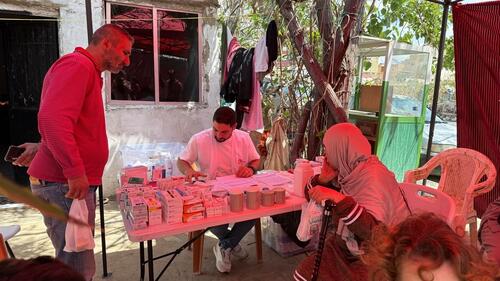
“Everyone is heartbroken and sad for the state of their village, and so are we,” says Salha Srour, an MSF patient. She was displaced multiple times, originally from her border town of Aita ash-Shaab.
“We hear the sound of explosions,” she says. “Why are our villages and homes being destroyed? Why is there a yellow, red and blue line? We used to eat from what grew around our houses: lettuce, mint, and parsley, everything we used to plant near the house. It isn’t right to live like this.”
While the local health workers have continued to work throughout the war, under immense pressure for almost two months, MSF teams in south Lebanon, including in Sour and Nabatyieh, are providing general healthcare, mental health support, and sexual and reproductive health services, and referring patients for specialised healthcare. We are also supporting hospitals with trauma and emergency care. MSF continues to call for an urgent scale-up of humanitarian aid and unhindered access to aid for people in need across the country.

Refugees, IDPs and people on the move
Military threats and forced displacement expose health risk for communities in southern Beirut
Project Update
5 Jun 2026