


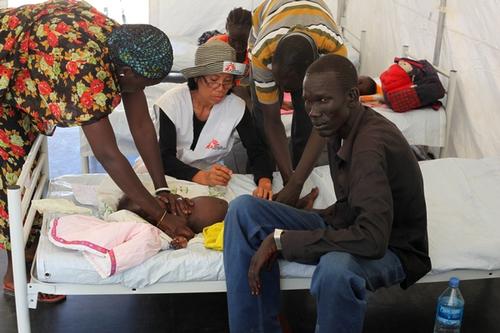
The situation in South Sudan is volatile and rapidly evolving, limiting the movement of Médecins Sans Frontières (MSF) teams and making it difficult for them to provide help to those who need it most. MSF calls on all parties to the conflict to respect our staff and facilities, as well as the right to medical assistance.
Malakal
On 24 December, heavy fighting broke out in Malakal, Upper Nile State. For two days, the MSF team was unable to safely access Malakal State Hospital, neither to treat the 49 kala azar* patients under care nor to deal with the more than 70 war-wounded that flooded into the hospital. Yesterday and today, the MSF team returned to the hospital amidst ongoing clashes and found that 30 of the kala azar patients have fled, while 17 war-wounded have so far been treated with pre-and post-operative care.
“We are extremely concerned about the war-wounded who cannot safely reach us, as well as for our kala azar patients because without treatment, this disease is fatal,” says Mike White, Head of Mission for MSF South Sudan. “We call on all actors to respect our presence here in Malakal so that we can move safely and freely to treat patients in need of urgent medical care."
Lankien
MSF teams in Lankien and Yuai, northern Jonglei State, have seen gunshot victims who have walked for 3 days from Bor in search of safe access to healthcare. Sixty-four gunshot victims have been treated in MSF’s Lankien hospital and Yuai in the past 2 days, with seven requiring evacuation by air for urgent surgery in Nasir.
Bentiu
A specialised emergency surgical team was deployed two days ago to reinforce the existing MSF team, to help treat gunshot victims at Bentiu State Hospital, Unity State. This morning, the MSF team was forced to evacuate amidst rumours of impending attacks on the city.
Leer
Yesterday MSF evacuated 14 international staff from Leer Hospital, where MSF has been working for 25 years, and has treated 64 000 malaria patients and 2000 children in need of nutritional feeding this year. The Leer hospital continues to run with 230 national staff and we endeavour to send our teams back as soon as security allows.
Juba
MSF teams have been providing medical care to about 40,000 people who have sought refuge in two UN bases following the last wave of violence. Over the past week, medical teams have carried out 1,100 consultations, treating a worrying proportion of diarrhea cases due to the bad sanitation in the camps.
“Despite our best efforts to keep our emergency teams on the ground, the chaos and rumours of impending insecurity forced us to put the safety of our staff first”, says Chris Lockyear, MSF Operational Manager for South Sudan. “We hope to return as soon as possible to Bentiu and Leer with full emergency teams, but firstly we need all parties to respect the safety of our staff.”
MSF reiterates its willingness to work on all sides of the conflict and commitment to providing assistance to people in distress, irrespective of race, religion, creed or political convictions.
In areas where the situation is relatively peaceful, MSF teams are continuing operations as usual. Even prior to the latest conflict, access to healthcare was limited in South Sudan and the enormous humanitarian needs are only further exacerbated by the current crisis.
MSF has been working in the region that today constitutes the Republic of South Sudan since 1983. MSF is present in eight of South Sudan’s ten states and responds to many emergencies, including large-scale displacement, refugee influxes, alarming nutrition situations and peaks of disease, such as malaria and kala azar, in addition to providing basic and specialist healthcare services.
*Kala azar, also known as viscera leishmanias, is a neglected tropical disease spread by the bite of a sandfly and is endemic to South Sudan. Kala azar is fatal if left untreated, although with treatment the disease has a cure rate of 100%
South Sudan
The clock is ticking for 80,000 people cut off from humanitarian aid
Voices from the Field
9 Sep 2013
South Sudan
Displaced People Dying of Preventable Diseases at Alarming Rate in Bentiu Camps
Press Release
19 Jun 2014