



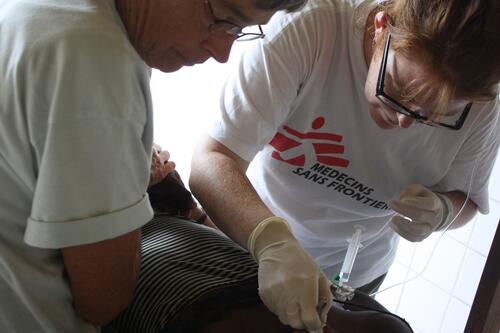
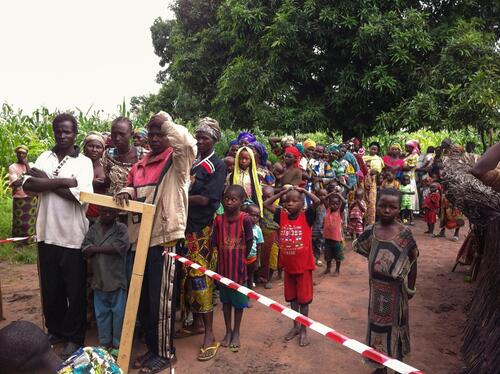
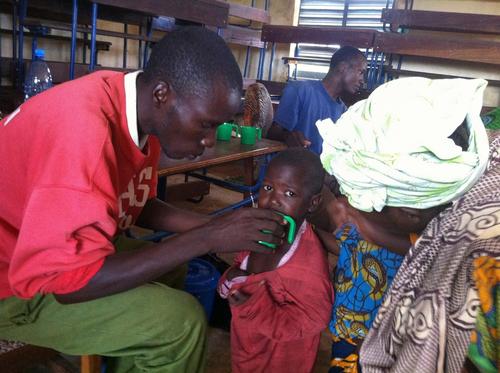

Ebola disease in DRC: find out how we're responding
Learn more
8003 Results
 
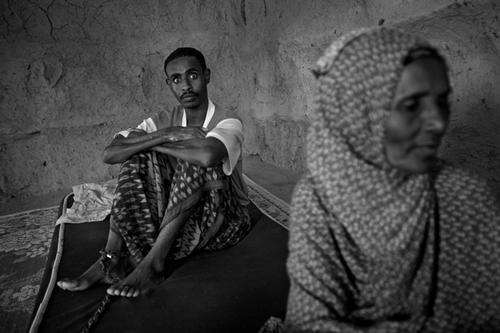
Siyad Abdi Ar, 24, was 16 when he was abused by gunmen. For 2 days they beat and tortured him. His arms have been left permanantly disabled and he cannot control his urine. His mother says that before the attack he was a normal teenager, but has not been the same since. She chains him to stop him from wandering away. They have been in Dadaab refugee camp for 6 months.   Dadaab is 100 km from the Somali border in eastern Kenya. It is the largest refugee camp in the world holding as many as 450,000 people. Most of the inhabitants have fled conflict in southern Somalia. The World Health Organisation says 1 in 3 Somali’s suffer from some kind of mental illness, the result of a war that has left a generation of Somalis who’ve only known fighting, famine, displacement, and loss.
Mental health

Bringing mental healthcare to people who need it

In the refugee camps of Kenya and beyond, psychologists are an integral part of the teams of MSF. Many of the refugees arriving at Dadaab are traumatised by their experiences in Somalia, where violence and drought led to them fleeing their homes. Since 2009, MSF has provided healthcare in Dadaab’s Dagahaley camp, where services on offer include much-needed mental healthcare and counselling. Project Update - 8 Oct 2012
 
msf-placeholder
Yemen

Shooting forces hospital closure

Patients at a surgical hospital in Aden had to be evacuated and staff were forced to shut down the facility following tensions and shooting that took place in and around the compound on 27 September, MSF said today. Press Release - 5 Oct 2012
 
msf-placeholder
Sri Lanka

MSF hands over last remaining project

MSF has handed over its last remaining activities in Mullaitivu district, Sri Lanka, having first worked in the country in 1986. The handover of the mental health programme in August 2012 to an established international NGO with a long-term operational plan for the north of the country follows a progressive transfer of medical activities to the Ministry of Health during the last 18 months. Project Update - 4 Oct 2012
 
Shanti (name changed) is a 38 year old semi-literate woman living in Mumbai. She has been living with HIV and multidrug resistant tuberculosis (MDR-TB) for the past 5 years.

Before coming to MSF, she had undergone TB treatment three times, but, instead of improving, each time her health had worsened.

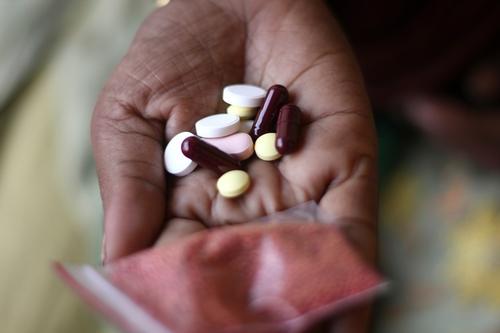
She started her treatment for MDR-TB from MSF Mumbai Project in November, 2010. Given the side effects of anti-Tb medicines and high pill burden, she finds it difficult to continue with the treatment. â??If pill burden is reduced it would be a great relief. It seems that it is the medicines which have become my food now. There are more medicines in my stomach than food. The doctor says that when my weight will increase, the amount of medicines will decrease.â?    

Her husband provides her hope and courage to continue with the treatment . â??If my husband were not there I would have left the treatment long ago. It is his courage and faith that keeps me going.â?
Access to medicines

MSF launches online resource for challenging unwarranted drug patents

A new online resource for civil society and patient groups in developing countries to challenge unwarranted drug patents was launched today by MSF. The Patent Opposition Database comes as many developing countries face dramatically high drug prices because patents block the production of lower-cost generic versions. Press Release - 2 Oct 2012
 
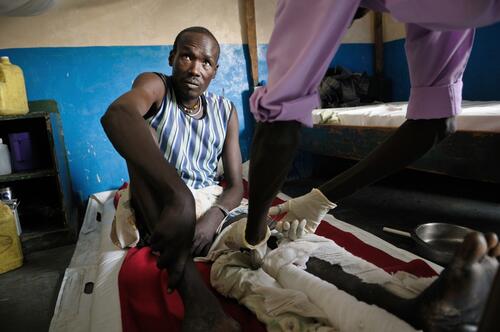
40-year-old Erogen Labarach in the MSF hospital in Pibor. "The bullet entered my leg, and then came out the other side. The place where I was shot was along the Kengen river. I have now been here for three weeks. At first I tried to bind my leg on my own. But when I came here the doctor, she cleaned everything and she dressed my leg properly, as you see it now. And they gave me medicines too." Full testimony available from OCB Cell 3 comms officer...

Jonglei State in South Sudan is in the grip of a cycle of extremely violent inter-communal fighting. Since 2008 MSF has witnessed in increase in intensity of the generations-old cattle-rustling between communities of different ethnicity. Over Christmas and New Year of 2011 a particularly violent attack in the area around Pibor and the outreach location of Lekwongole village displaced tens of thousands and left Lekwongole and some surrounding villages razed to the ground. MSF's hospital in Pibor was looted and the clinic in Lekwongole was largely destroyed. MSF treated 108 trauma victims in the following weeks, many women and children with gunshot wounds. But the consequences of fear and displacement in the bush continued long after, with malaria and malnutrition at very high levels in MSF's hospital.
South Sudan

90,000 deprived of care due to violence

Escalating violence has forced MSF to suspend medical services in two out of three of its facilities in Pibor county in Jonglei state, South Sudan, leaving up to 90,000 people deprived of essential medical care. Due to the insecurity, the populations of Lekwongole and Gumuruk, including all MSF staff and their families, have fled their homes to seek refuge in the bush. Project Update - 1 Oct 2012
 
msf-placeholder
Kenya

Médecins Sans Frontières calls for immediate action

This week, government leaders gather in Geneva for the 63rd UNHCR Executive Committee meeting, while in Dadaab, the world’s largest refugee camp, Somali refugees continue to live in extreme conditions and fear. MSF urges States Parties to the Refugee Convention to engage with the host Government of Kenya and UNHCR to fulfil their responsibilities towards the refugees. Press Release - 1 Oct 2012
 
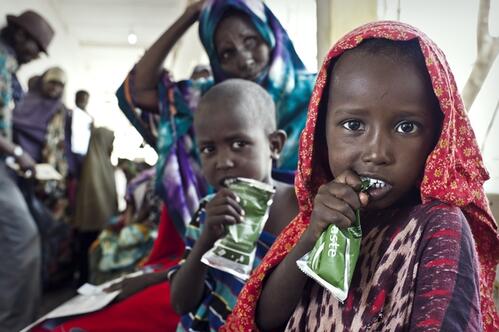
MSF staff distributing Plumpy Nut, or Eezee Paste, a nutritious paste for malnourished children. Ambulatory Therapeutic Feeding program at the hospital MSF runs in Galcayo South.
Somalia

Kismayo patients forced to flee fighting

The last children under treatment for severe malnutrition today left the Médecins Sans Frontières (MSF) feeding centre in the southern Somali city of Kismayo as parents fear the impact of imminent fighting on the city. Press Release - 28 Sep 2012
 
September 2012, MSF medical staff care for a war-wounded patient in Pinga, North Kivu province of the Democratic Republic of Congo
Democratic Republic of Congo

Aid workers flee conflict in North Kivu

The conflict in the east of DRC has worsened to such an extent that Congolese staff working for MSF in North Kivu province now fear for their safety. Most of the Congolese health workers and support staff employed by MSF in Pinga have fled following active fighting between armed groups in the area. People now no longer have access to critical medical services. Press Release - 27 Sep 2012
 
July 2012, in the health zone of Bouna, disctrict of Moïssala, Chad. 
For the first time, MSF is rolling out a large-scale in-situ strategy for the preventive treatment of malaria, called seasonal malaria chemoprevention (SMC), in a pilot projects in Chad.  Antimalarial treatments have been administered to some 10,000 children aged between 3 months and 5 years old. MSF teams saw a drop fluctuating between 72% and 86% in the number of simple malaria cases.
Malaria

'We may have found a real arm to fight malaria' in Mali and Chad

Since July, MSF has been employing seasonal malaria chemoprevention (SMC) for the first time in two Sahelian countries. The initial results are encouraging. Dr Estrella Lasry, malaria specialist at MSF, reflects on the different aspects and future prospects of this strategy. Voices from the Field - 24 Sep 2012
 
August 2012, in the village of Karangasso, district of Koutiala, Mali. For the first time, MSF is rolling out a large-scale in-situ strategy for the preventive treatment of malaria, called seasonal malaria chemoprevention (SMC), in a pilot projects in Mali.  Antimalarial treatments have been administered to some 165,000 children aged between 3 months and 5 years old. The initial results are highly encouraging, with a 65% drop in the number of malaria cases. Furthermore, the number of malaria-associated hospitalisations plummeted from 228 to 70 per week.
Malaria

A novel prevention programme has dramatically reduced malaria cases in Mali and Chad

A large-scale malaria prevention programme appears to be drastically reducing the number of new cases of the disease among young children during the peak transmission season. Preliminary results from the programme, known as seasonal malaria chemoprevention (SMC) show that the number of cases of simple malaria dropped by 65 per cent in the intervention area in Mali, and by up to 86 per cent in Chad. Press Release - 24 Sep 2012
Four mothers posing in a corridor of the Hospital in Bili. All four of them are staying in the hospital with their child, that's suffering from a severe case of malaria. Since the beginning of the project in 2016, the pediatric ward already treated more than 4.000 cases of complicated/severe form of malaria.
Médecins Sans Frontières (MSF)

Independent medical humanitarian assistance

We provide medical assistance to people affected by conflict, epidemics, disasters, or exclusion from healthcare. Our teams are made up of tens of thousands of health professionals, logistic and administrative staff - most of them hired locally. Our actions are guided by medical ethics and the principles of independence and impartiality. We are a non-profit, self-governed, member-based organisation.

Learn more