


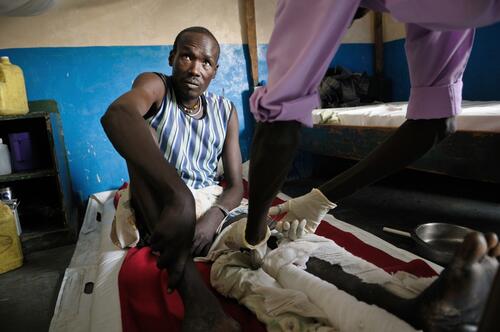
Escalating violence has forced international medical humanitarian organisation Médecins Sans Frontières (MSF) to suspend medical services in two out of three of its facilities in Pibor county in Jonglei state, South Sudan, leaving up to 90,000 people deprived of essential medical care.
Due to the insecurity, the populations of Lekwongole and Gumuruk, including all MSF staff and their families, have fled their homes to seek refuge in the bush. Without staff and unable to reach the two towns from Pibor, MSF has been forced to suspend its medical activities on 25 August in Lekwongole and 20 September in Gumuruk.
Evacuated staff
MSF has evacuated all international staff from Pibor county and despite significant difficulties, the organisation’s local staff continues to provide medical care at its facility in Pibor town.
“We are at the peak of the malaria season and in the midst of the heaviest flooding seen in this area in recent years,” says Stefano Zannini, MSF Head of Mission.“People have to walk for hours to access medical care in Pibor town as the MSF health centre is now the only medical facility providing free and quality medical care in the county.
"We fear we will have to suspend all our services due to security concerns. This will have a devastating impact on the community, leaving more than 160,000 residents of Pibor county without access to health care.”
Respect for medical facilities
MSF calls on all armed groups in and around Pibor to respect medical facilities and staff, to ensure we can continue our life-saving work.
“Our priority is to be able to safely continue to provide urgently-needed healthcare to the people of Pibor County,” says Zannini. “We remain fully committed to providing medical care to all people in Pibor County and we are ready to recommence full medical services as soon as the security situation allows.”
In 2011, MSF provided 35,075 consultations in Pibor, Lekwongole and Gumuruk. The teams also provided 6,635 antenatal consultations and delivered 521 babies, treated 3,598 patients with malaria, treated 1,037 severely malnourished children, and provided care for 496 people with violence-related injuries.
MSF has been providing medical assistance in Pibor since 2005. In addition to its activities in Pibor County, MSF also runs a clinic in Lankien, in northern Jonglei state, with outreach sites in Pieri and Yuai.