


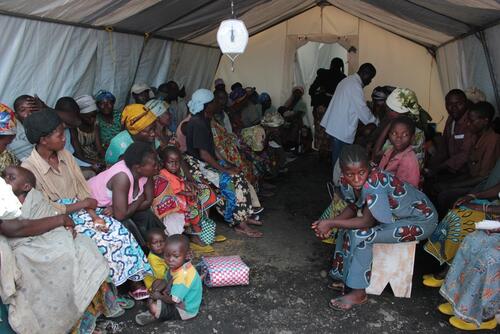

Ebola disease in DRC: find out how we're responding
Learn more
7999 Results
 
Yusuf, 25 years old from Bagega, has one wife and one son at home. He works at the Bagega gold processing site crushing stones.
Nigeria

Time is running out: Zamfara State Lead Poisoning crisis

Six-month progress report on the May 2012 International Conference on Lead Poisoning Report - 15 Nov 2012
 
The entrance of the inflatable surgical unit inside a MSF field hospital in northern Syria. This hospital was set up in a cave and provided medical and surgical care. Inside, there was a hermetic inflatable tent used as surgical unit and six emergency beds. The MSF field hospital was later entirely moved the cave to another location.
Syria

'A more oppressive type of danger'

British surgeon Paul McMaster is just back from Syria where he treated the wounded in an operating theatre set up in a cave and then a farm. Experienced in working in war zones, in Syria he found a ‘more oppressive type of danger’. Voices from the Field - 15 Nov 2012
 
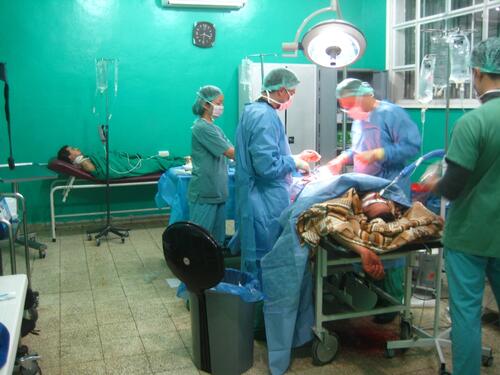
A wounded patient lies on the operating table at a MSF field hospital in northern Syria.
Syria

"In addition to many civilians, we treated both wounded rebel fighters and soldiers from the Syrian army"

Dr Martial Ledecq is a surgeon who is just back in Belgium from a one-month mission in one of the four makeshift medical facilities set up by MSF in the north of Syria. Since the end of June 2012, MSF teams have treated more than 2,500 patients and carried out some 550 surgical procedures. Voices from the Field - 15 Nov 2012
 
Housseni is 1 year and 5 months, he has a twin brother who is not at the clinic today. Both children are on chelation therapy. The mother has already lost one child and she didnâ??t know at the time it was because of lead poisoning. When Housseniâ??s twin brother, Hassan, started convulsing she was very scared so she took him to the clinic. Her husband slaughters animals for work. She used to grind rocks for gold processing before she found out about lead poisoning, she used to do this at home. When she found out her job harmed her children she stopped. She wishes that her sons will become Presidents. Duza clinic.
Nigeria

Time is running out for lead poisoning victims

Six months on from an International Lead Poisoning Conference, MSF warns that time is running out to solve the Zamfara crisis. In a progress report, MSF explains that very little action has been taken on any of the agreed action points from the conference and calls on the Nigerian government and president to immediately release earmarked funds to tackle the crisis. Press Release - 15 Nov 2012
 
Laboratory Technician Lucy Nyangua administers a nebuliser to Charity (4 yrs). Charity has been brought to the MSF Blue House HIV/TB clinic in Mathare slum, Nairobi, Kenya as her mother is co-infected with HIV and TB and doctors are worried that Charity might have caught TB from her mother. It can be very difficult to detect TB in children as they are unable to produce the sputum necessary for examination and confirmation of the TB bacilli, so sometimes  nebulisers are used to try to any mucus that they may have in their chests.
Tuberculosis

Out of the Dark: Meeting the needs of children with TB

This report outlines the current state of paediatric TB care, looking at current practices, new developments and research needs – in paediatric TB diagnosis, treatment and prevention. Report - 13 Nov 2012
 
MDR-TB patient Rohatay Abdullaeva at her home with a grandson Atabek and daughter Nadira, town of Hojeily, Karakalpakstan (Uzbekistan).
Tuberculosis

DR-TB Drugs Under the Microscope: 2nd Edition

This report focuses on just some of the many factors that hamper the scaling up of DR-TB treatment – the limited availability and high cost of quality-assured medicines for resistant strains of the disease, owing to an insecure market and insufficient demand; and the research questions that remain unsolved with existing medicines. Report - 13 Nov 2012
 
Xpert MTB/RIF laboratory test, used to diagnose tuberculosis (TB) and TB strains resistant against the primary TB drug rifampicin. Kibera South Health Center, Kenya.
Tuberculosis

Results from new TB test reveal urgent need to scale up treatment

Results from the largest multi-country implementation of the new rapid tuberculosis (TB) diagnostic test reveal an urgent need to address the growing global crisis of drug-resistant TB. The data was collected from 25 MSF projects in 14 countries over a nearly 18-month period. It shows an overall 50 per cent increase in the diagnosis of TB using Xpert MTB/RIF. Press Release - 13 Nov 2012
 
In Congo's rainforest, MSF cured 15.000 pygmies affected by Yaws, a neglected disease, in 3 months (Sept - Oct 2012) using a new therapeutic regime (single dose oral antibiotic)
Yaws is a neglected tropical disease caused by a bacterium that affects the skin, bone and cartilage. Lack of resources, it has never been completely eradicated. Humans are the only reservoir of this bacterial infection. A recent discovery that a single-dose of azithromycin (given orally) can cure the disease has raised the prospects of eradicating yaws altogether. 
It affects many isolated communities whose populations Congo Pigmy North, away from the health care system. 

MSF-Epicentre with OCP decided to launch a universal treatment with azithromycin that can eradicate this illness among Aboriginal people (Pygmies) in the Bétou and Enyellé districts. During two months (in september and october 2012), three MSF teams have traveled on the Ubangi River, which separates the two Congos and trails through the rainforest. 
A real human and logistical challenge to achieve these Pygmy communities in their villages in the rainy season because it is the only time during which they are sedentary.
Democratic Republic of Congo

Treating yaws in the Aka Pygmy population

The Aka Pygmy communities living in northern Congo have been ostracised in their home country for many years. They have almost no access to healthcare and, as a result, are still affected by the neglected disease known as yaws. MSF recently carried out a campaign for treating this disease, which turned out to be both a logistical feat and a world first in medical terms. Project Update - 13 Nov 2012
 
 *** Local Caption *** MSF has been providing surgical care to victims of violence, in a hospital set up in the north of Syria, since June 2012.
Syria

MSF increases medical activities

MSF is increasing its medical activities to help victims of the conflict in Syria. MSF is providing emergency and surgical treatment for the wounded, as well as medical care for people displaced from their homes within Syria and for refugees who have escaped to neighbouring countries. Project Update - 6 Nov 2012
 
Dr. Lucy Doyle, a physician with Doctors Without Borders, examines a patient in a makeshift medical clinic in a building at the Ocean Village housing complex in Rockaway, Queens, November 5, 2012.  Electrical power, heat and plumbing were cut in the entire five-building complex following Superstorm Sandy.  The organization established the clinic in a room normally used for Narcotics Anonymous meetings.
United States of America

MSF filling gaps in medical aid for people affected by Hurricane Sandy

MSF teams, working alongside local community groups, are providing medical and mental health care to Hurricane Sandy-affected communities in the New York City boroughs of Brooklyn, Queens, and Staten Island, as well as Hoboken, New Jersey. The vast majority of the patients treated by MSF in the shelters and underserved communities have been elderly, homeless, or physically or mentally impaired. Project Update - 5 Nov 2012
Four mothers posing in a corridor of the Hospital in Bili. All four of them are staying in the hospital with their child, that's suffering from a severe case of malaria. Since the beginning of the project in 2016, the pediatric ward already treated more than 4.000 cases of complicated/severe form of malaria.
Médecins Sans Frontières (MSF)

Independent medical humanitarian assistance

We provide medical assistance to people affected by conflict, epidemics, disasters, or exclusion from healthcare. Our teams are made up of tens of thousands of health professionals, logistic and administrative staff - most of them hired locally. Our actions are guided by medical ethics and the principles of independence and impartiality. We are a non-profit, self-governed, member-based organisation.

Learn more