



Ebola disease in DRC: find out how we're responding
Learn more
4638 Results
 
msf-placeholder
Afghanistan

MSF and other aid organisations evicted from Kabul

Press Release - 21 Jul 1998
 
msf-placeholder
Sudan

Fighting hinders humanitarian assistance

Press Release - 8 Jul 1998
 
msf-placeholder
Sierra Leone

Atrocities against civilians in Sierra Leone

From 6th April 1998, the surgical teams of the international medical aid agency Médecins Sans Frontières (MSF) at Connaught Hospital, Freetown, started recording an alarming increase in the number of patients suffering from severe mutilations. This report provides further details of the injuries inflicted on the people admitted to hospital, as well as a summary of in-depth interviews with over 70 survivors conducted by MSF medical staff. Report - 1 May 1998
 
msf-placeholder
Refugees, IDPs and people on the move

Refugee Health: An Approach to Emergency Situations

Relief workers face rapidly changing and complex environments, new disease patterns, enormous humanitarian needs and relatively limited resources. The authors of this book use their experience in the area to produce an operational manual of the issues involved in refugee health programs. refbooks.msf.org - 13 Jun 1997
 
msf-placeholder
Bosnia-Herzegovina

Eye-witness accounts of the evacuation from Srebenica and the fate of missing colleagues

This report is based on interviews with the staff of the Srebrenica hospital and the local MSF staff covering the events that occurred in the days following the fall of the enclave. They explain how they escaped to safety and what happened to the colleagues who are still missing today. Report - 15 Feb 1996
 
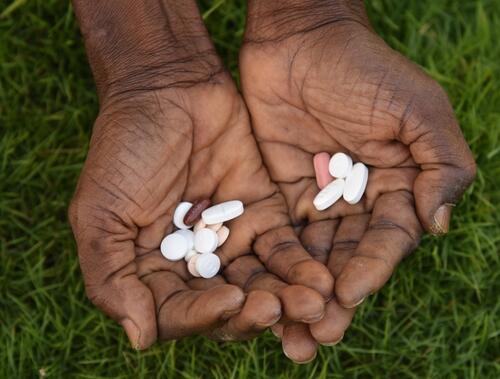
An MSF staff holding separate sets of the tuberculosis treatment medicine inside the Makeni Regional Hospital in Bombali District, Sierra Leone. The left hand contains pills from the BPaLM 6-month shorter regimen treatment and the right hand contains pills from the 18 months longer regimen treatment.  

MSF started rolling out the new BPaLM treatment in Bombali District, Sierra Leone, in November 2022, making this shorter treatment routinely available for patients diagnosed with drug-resistant tuberculosis (DR-TB).
Crisis settings

Access to medicines

Unaffordable, unavailable, not adapted - people around the world face these challenges in accessing lifesaving medicines. Topic
 
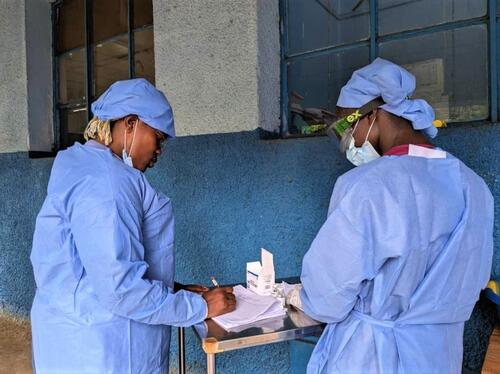
Two health workers talk at the Budjala general hospital, supported by MSF. MSF also deployed a team in the Budjala health zone in South Ubangi to support health authorities in the response against Mpox. Particular emphasis is also placed on mental health. In the community, health promoters intervene to ensure disease control and prevention. Thanks to their mobilization, more than 822 contact cases are being monitored for better epidemiological monitoring.
Crisis settings

Epidemics and pandemics

Millions of people still die each year from infectious diseases that are preventable or can be treated. Topic
 
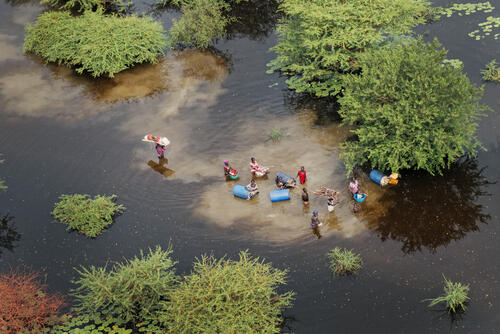
Families heading to dry land in Bentiu. 835,000 people have been directly affected by the flooding.

Across Unity state people’s homes and livelihoods (crops and cattle), as well as health facilities, schools, and markets, are completely submerged by floodwaters.
Crisis settings

Natural hazards

Within a matter of minutes, natural hazards can affect the lives of tens of thousands of people. Hundreds or even thousands of people can be injured, homes and livelihoods destroyed. Access to clean water, healthcare services and transport can also be disrupted. The impact of each event varies greatly and our response must adapt to each situation. Topic
Four mothers posing in a corridor of the Hospital in Bili. All four of them are staying in the hospital with their child, that's suffering from a severe case of malaria. Since the beginning of the project in 2016, the pediatric ward already treated more than 4.000 cases of complicated/severe form of malaria.
Médecins Sans Frontières (MSF)

Independent medical humanitarian assistance

We provide medical assistance to people affected by conflict, epidemics, disasters, or exclusion from healthcare. Our teams are made up of tens of thousands of health professionals, logistic and administrative staff - most of them hired locally. Our actions are guided by medical ethics and the principles of independence and impartiality. We are a non-profit, self-governed, member-based organisation.

Learn more