




Ebola disease in DRC: find out how we're responding
Learn more
8003 Results
 
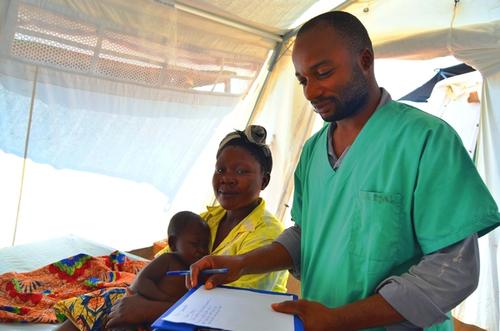
Cholera Treatment Center in a MSF intervention in Kamanyola in 2013. In Bukavu, the emergency intervention meant expanding the CTC capacity, strengthening the diagnosis and treatment of patients, ensuring the availability of all the material necessary for containing the disease and increasing awareness activities in the community to stop transmission.
Democratic Republic of Congo

MSF treats 690 people for cholera in Bukavu

MSF emergency team successfully treats outbreak of cholera in DRC Project Update - 28 Jan 2014
 
msf-placeholder
Mali

New MSF bacteriology laboratory will save lives of children

New MSF bacteriology laboratory will help prevent fatal malnourishment Voices from the Field - 28 Jan 2014
 
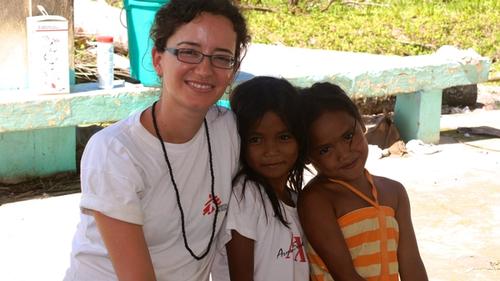
Ana Cecilia Weintraub, a psychologist from Brazil, pictured with two children after a play therapy session.
Philippines

Voices from MSF's mobile boat clinic

MSF teams describe the invaluable work of the mobile boat clinics Project Update - 27 Jan 2014
 
msf-placeholder
Refugees, IDPs and people on the move

MSF provides medical and humanitarian aid to South Sudanese refugees

MSF provides medical aid to South Sudanese refugees in Ethiopia, Kenya and Uganda. Project Update - 23 Jan 2014
 
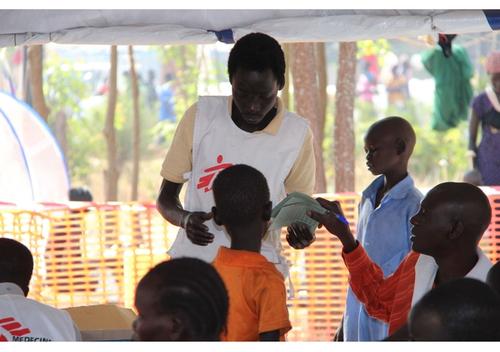
Waiting room and patient registration. *** Local Caption *** Since mid-december 2014, more than 40,000 South Sudanese refugees have arrived in northern Uganda to flee the violence in Jonglei and Unity states. And the influx of people has not stopped. From an average of 2,500 new arrivals per day, the number of new arrival has dropped early January to about 700 persons per day. Dzaipi transit camp, located at about 7km from the border - was initially set up for 3,000 persons and was rapidly overcrowded. Refugees lived under the trees or at best in the school building. The local health centre was overwhelmed by the number of patients coming in. Refugees were lacking the basics such as clean water, food and latrines. MSF has set up an emergency operation to respond to their needs : water and sanitation, outpatient and inpatient consultations, maternity, vaccination and screening for malnutrition. MSF teams currently work in the three refugee camps and will adapt their activities according to the evolution of the situation.
Uganda

"Conflict is part of these people's story"

Fredericke Dumont describes how MSF team in Uganda has got medical services for South Sudanese refugees up and running in the space of a week. Voices from the Field - 23 Jan 2014
 
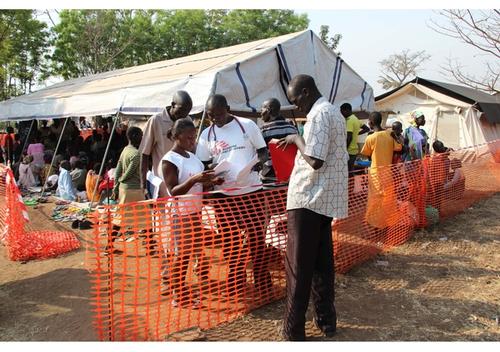
 *** Local Caption *** Since mid-december 2014, more than 40,000 South Sudanese refugees have arrived in northern Uganda to flee the violence in Jonglei and Unity states. And the influx of people has not stopped. From an average of 2,500 new arrivals per day, the number of new arrival has dropped early January to about 700 persons per day. Dzaipi transit camp, located at about 7km from the border - was initially set up for 3,000 persons and was rapidly overcrowded. Refugees lived under the trees or at best in the school building. The local health centre was overwhelmed by the number of patients coming in. Refugees were lacking the basics such as clean water, food and latrines. MSF has set up an emergency operation to respond to their needs : water and sanitation, outpatient and inpatient consultations, maternity, vaccination and screening for malnutrition. MSF teams currently work in the three refugee camps and will adapt their activities according to the evolution of the situation.
Uganda

Medical care for South Sudanese refugees

More than 45,000 South Sudanese have arrived in Uganda. MSF is providing medical care in the camps. Project Update - 23 Jan 2014
 
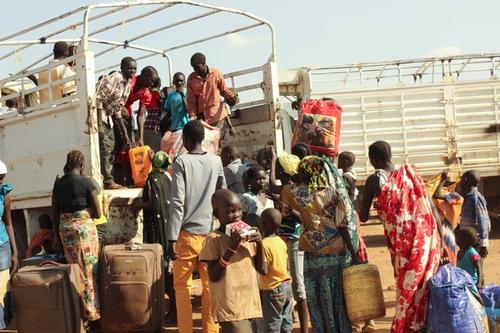
600-700 people have crossed the border from South Sudan into Kenya every day over the past two weeks. Crossing at Nadapal, en route to Kakuma refugee camp, they hope to find a safe haven from the month-long conflict in South Sudan.
Refugees, IDPs and people on the move

MSF provides medical and humanitarian aid to South Sudanese refugees

MSF teams are providing medical and humanitarian aid refugees in Kenya, Ethiopia and Uganda. Project Update - 23 Jan 2014
 
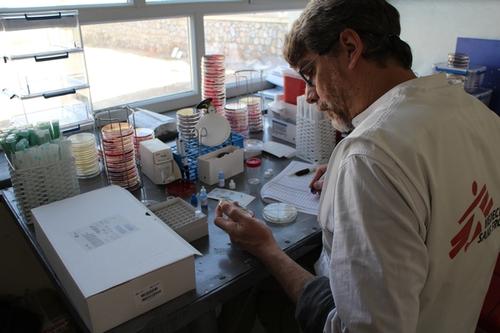
Expatriate microbiologist Olivier Courteille, assisted by Dr Wardak Abdul Qayoum, is leading a team of 3 technologists, supervises the implementation of the study and the recording of data.

MSF has launched for the first time an Antibiotic Resistance Study in Lashkar Gah, Helmand, Afghanistan. A laboratory has been set up in the Boost Hospital where MSF works to carry out the study. The study started in January 2013.
Access to Healthcare

MSF opens up its medical data to humanitarian ends

MSF opens up access to its medical data for the purpose of public health research Project Update - 23 Jan 2014
 
In Bouza district, Tahoua region, MSF is working to improve healthcare for children under five and pregnant women, focusing on early treatment and prevention, particularly in malnutrition and malaria; two of the main causes of child mortality in Niger.
Niger

“We are already getting ready for the next peak”

MSF project reduces child mortality in Bouza, Niger Voices from the Field - 22 Jan 2014
 
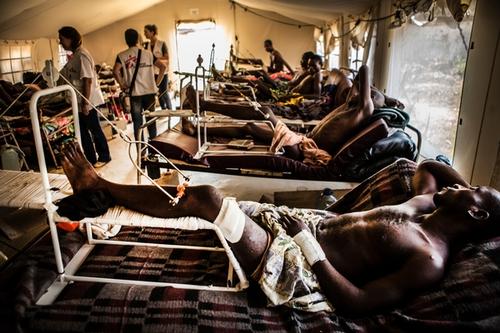
Wounded patients at the hospital Communautaire. Many of them require traction devices as they were shot in the leg. The healing period is 45 days minimum. Many of the patients, then, were injured during initial combats in Bangui between Anti-Balaka militias and ex-Séléka forces. MSF has treated around 800 patients of bullet, grenade or machete wounds since the beginning of December. Hospital capacity was increased by setting up several tents in the premises. Although the number of patients has decreased recently, until last week (1/2 January) the hospital admitted an average of between 10-20 wounded per day.
Central African Republic

"The violence is relentless" in Bangui

MSF has treated hundreds of patients in Bangui since violence erupted in December 2013 Project Update - 21 Jan 2014
Four mothers posing in a corridor of the Hospital in Bili. All four of them are staying in the hospital with their child, that's suffering from a severe case of malaria. Since the beginning of the project in 2016, the pediatric ward already treated more than 4.000 cases of complicated/severe form of malaria.
Médecins Sans Frontières (MSF)

Independent medical humanitarian assistance

We provide medical assistance to people affected by conflict, epidemics, disasters, or exclusion from healthcare. Our teams are made up of tens of thousands of health professionals, logistic and administrative staff - most of them hired locally. Our actions are guided by medical ethics and the principles of independence and impartiality. We are a non-profit, self-governed, member-based organisation.

Learn more