



Ebola disease in DRC: find out how we're responding
Learn more
7999 Results
 
Stefano Di Carlo Italy
Mediterranean migration

Interview with Stefano Di Carlo, MSF Italy Head of Mission

MSF has started to work inside the CPSA (first reception centre) in Pozzallo, Sicily to provides medical care to the migrants upon their landing. Voices from the Field - 11 Feb 2015
 
The rescue boat arriving at port with mainly Syrian refugees on board was the 100th landing in Augusta.
Refugees, IDPs and people on the move

MSF calls on European Union to take its responsibility to stop putting migrants’ lives at risk

Calling on the European Union (EU) to immediately reassess its policies on migrants, asylum seekers and refugees, and those on border controls, and to stop putting thousands of lives at stake. Press Release - 11 Feb 2015
 
A nurse changes the dressing on a patient whose leg was amputated.
Syria

Ambulance drivers' lives at stake as they struggle to respond to bombing in Ghouta

Two paramedics from besieged East Ghouta describe their struggle to respond after the bombing of a public square on January 23, 2015. Voices from the Field - 11 Feb 2015
 
msf-placeholder
Syria

Doctors strive to cope with shelling in East Ghouta besieged areas

An MSF-supported hospital director describes the medical response to the horrific bombing of a crowded square on 23 January. Voices from the Field - 11 Feb 2015
 
Nearly 700 people have been living for ten months in a church, the last refuge for the Muslims of Carnot - third largest city of the country. They came to shelter reprisals targeting Muslims (following the atrocities committed by the rebels Seleka, a predominantly Muslim coalition). Men, women and children are condemned to live within four walls until the situation resolves. Almost all have lost family members and / or been victim of violence. The entrance to the church is guarded by armed soldiers.
Every Sunday, the Muslim refugees who live in the nave of the church move their luggage into the yard to allow Christians to pray. The inter-communal conflict that continues to tear the country apart is not a religious war but a struggle for power.
There are over 50 enclaves like this one in the country.
Central African Republic

“There’s not one single Muslim left in Bocaranga”

MSF logistician Djamilou speaks of the violence and the plight of his family scattered among three different countries after fleeing from Central Africa. His testimony illustrates only too well the suffering endured by our Central African teams. Voices from the Field - 11 Feb 2015
 
msf-placeholder
Central African Republic

Jailed in the enclave of Berbérati

The Muslim population was almost completely expelled from the West of CAR. In Berbérati, the second city of the country, they are 350 living within the walls of the diocese, without being able to walk more than 200 meters from the portal without risking an attack. Project Update - 11 Feb 2015
 
msf-placeholder
Ukraine

War Torn Minds

Irina is staying with her four children at a centre for displaced people in the town of Konstantinovka. The centre, formerly a shelter for homeless people, was under reconstruction when the conflict started in eastern Ukraine. Although it wasn’t yet finished, the local authorities decided to open the centre for people who had to flee the fighting in nearby areas. It’s now run by local people and eight families live in the centre, sharing the small kitchen and old bathroom.
Irina shares her story and MSF’s psychologist Elena talks about the enormous emotional impact of the violence.
Project Update - 10 Feb 2015
 
 *** Local Caption *** Since May 2011, MSF runs a gynecology and obstetrics 30-beds hospital in Peshawar. The neonatology unit now has 15 inpatients beds for newborns with serious medical complications. The care offered by MSF are totally free. If there are many private maternity hospitals in the district of Peshawar, specialist obstetric services are not very accessible to the most vulnerable women (refugees, displaced, poor) or from FATA (Federal Administration Tribal Areas) as often expensive or of poor quality when they exist in public structures.
In 2013, 374 new born and 3 717 women were admitted to the MSF hospital in Peshawar, nearly 40% with complications during pregnancy. Every week, an average of 62 deliveries were attended (the figure has doubled since 2012), 10 by caesarean section.<br/>
Depuis mai 2011, MSF gère un hôpital gynéco-obstétrique de 30 lits à Peshawar. L’unité de néonatalogie dispose désormais de 15 lits d’hospitalisation pour les nouveau-nés présentant de graves complications médicales. Les soins offerts par MSF sont totalement gratuits. S’il existe de nombreuses maternités privées dans le district de Peshawar, les services obstétriques spécialisés sont très peu accessibles aux femmes les plus vulnérables (réfugiées, déplacées, démunies) ou originaires des FATA (zones tribales sous administration fédérale), car souvent coûteux ou de mauvaise qualité quand ils existent dans les structures publiques.
En 2013, 374 nouveau-nés et 3717 femmes ont été admises à l’hôpital MSF de Peshawar, dont près de 40% présentant des complications lors de la grossesse. Chaque semaine, 62 accouchements ont été assistés en moyenne (le chiffre a doublé par rapport à 2012), dont 10 par césarienne.
Pakistan

Six months at Peshawar’s neonatal unit

A look back at Dr Ley's experience heading up the neonatal unit at MSF’s obstetrics and gynaecology hospital. Voices from the Field - 9 Feb 2015
 
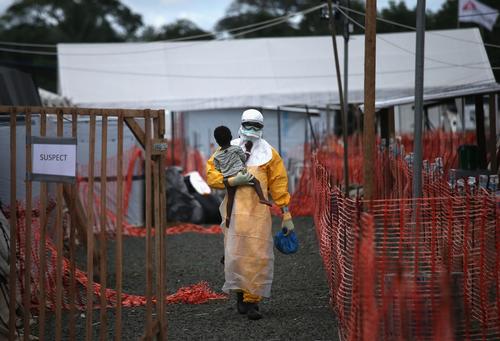
Ebola is finally declining in Liberia, although gaps remain in infection control and prevention, surveillance, case investigation and contact tracing. Access to medical care for non-Ebola patients is still a major issue due to the collapse public health system.
Ebola and haemorrhagic fevers

“We need to make sure that no one slips through the cracks”

Numbers of Ebola patients may be going down, but epidemiologist Amanda Tiffany, who works for MSF’s Epicentre, explains why every last contact needs to be traced to help bring the epidemic to an end. Project Update - 9 Feb 2015
Four mothers posing in a corridor of the Hospital in Bili. All four of them are staying in the hospital with their child, that's suffering from a severe case of malaria. Since the beginning of the project in 2016, the pediatric ward already treated more than 4.000 cases of complicated/severe form of malaria.
Médecins Sans Frontières (MSF)

Independent medical humanitarian assistance

We provide medical assistance to people affected by conflict, epidemics, disasters, or exclusion from healthcare. Our teams are made up of tens of thousands of health professionals, logistic and administrative staff - most of them hired locally. Our actions are guided by medical ethics and the principles of independence and impartiality. We are a non-profit, self-governed, member-based organisation.

Learn more