



Ebola disease in DRC: find out how we're responding
Learn more
2094 Results
 
View of mobile clinic run by MSF in the Regional stadium in Kaya, Burkina Faso, that became an open-air camp for people who fled insecurity and violence.
Burkina Faso

Violence and severe supply shortages leave people across Burkina Faso in dire need

As the security situation in Burkina Faso deteriorates, people's access to food, water and healthcare is becoming ever-more limited. Relief efforts need to be ramped up now more than ever. Interview - 17 Oct 2022
 
A mother feeds her child using therepeutic food (milk) during her visit to MSF's OTP facility in Shabellow IDP camp, Baidoa
Somalia

An alarming cycle of drought, malnutrition and disease in Baidoa

Here are five things to know about the brutal cycle of drought, malnutrition and disease outbreaks in Baidoa, Somalia. Project Update - 12 Oct 2022
 
Aura Ramírez, MSF’s mental health activities manager comforting Sanaa*. 
Sanaa*, 30 years old: “I got married when I was very young, I was 14 years old, I didn’t know what marriage was, and a few years later I got pregnant. Since day one I faced a lot of challenges, I left school, and I had a lot of problems with my husband until we divorced. They took my son away from me, and I was not able to see him for 3 years, not even to visit him, nor to contact him by phone. During “Eid” I used to look at the children playing and enjoying their family time, and think about my son, is he happy? Is he safe?
I didn’t know what to do, as a young woman I lacked experience, and I didn’t have any support, I had no one to advise me on how I can take my son back. I used to cry a lot, and had depressive episodes, I felt empty, as if something is missing, and I didn’t know where my son was. I was in a desperate situation. I felt powerless, and never felt safe. Then I learned about MSF services in Hajjah. I came here and they offered me psychological care, and I’m following up with them for 3 months now. Now I feel stronger, they also engaged the Mental health activity manager who learned about my situation with my son. In collaboration with the local authorities, they helped me reunite with my son. They also referred us to other organizations that provided us with shelter and social assistance. Today I’m back to work, and my son is back to school. He understood that I’m his mother despite everything, whatever the situation is. No child should be separated from his mother. 
*Name changed for confidentiality.
Yemen

Rebuilding people's lives in Yemen through mental health support

After years of war and insecurity, our teams in Hajjah, Yemen, are focusing on rebuilding people's lives through comprehensive mental health support. Project Update - 10 Oct 2022
 
In Mumane, a community near the city of Montepuez, more than 500 newly displaced families received MSF’s relief items kits.

Since June, it is estimated that violence has driven over 80,000 (according to OCHA) people out of their homes in the northern Mozambican province of Cabo Delgado. People fleeing violence have been on the move and often settle near communities with little to no means of livelihood.  MSF is providing emergency assistance to new arrivals by distributing kits with essential relief items. MSF logistics and supply teams work around the clock to coordinate with multiple actors, organize the kits and provide a timely and comprehensive response. To this date, more than 4,000 families that have been displaced form heavy-hit locations in the province, such as Ancuabe, have benefitted from the kits in 9 localities in the province, such as Montepuez, Metuge and Meluco.
Mozambique

People struggling to survive after five years of conflict in Cabo Delgado

Since conflict has erupted in Cabo Delgado, nearly one million people have been displaced. They often live in fear, without basic means of survival. Project Update - 5 Oct 2022
 
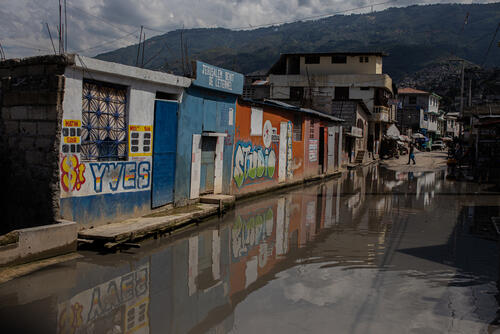
Cholera in Haiti
Haiti

MSF responds to a resurgence of cholera cases amid insecurity and violence

MSF responds to a resurgence of cholera cases in Haiti in collaboration with the authorities. Statement - 4 Oct 2022
 
The MSF medical train evacuates 210 patients with psychiatric and neurological disorders from an overcrowded hospital in Kharkiv city, eastern Ukraine, to Kyiv.  

Before their evacuation, patients faced extremely challenging conditions, with some having to sleep on the floor, with insufficient access to quality of care and hygiene.
Ukraine

Over 200 psychiatric patients evacuated from overcrowded hospital in Kharkiv

MSF medically evacuated over 200 patients with neurological and psychiatric conditions from an overcrowded hospital in Kharkiv to facilities in Kyiv by our medical train over 36 hours, beginning on 23 September. Project Update - 29 Sep 2022
 
Arrival of MSF medical supplies at the Hervé Farm IDP site in Kwamouth
Democratic Republic of Congo

Thousands affected by inter-communal violence in Maï-Ndombe province

In Mai-Ndombe province, Democratic Republic of Congo, recent inter-communal violence has affected thousands. MSF has been in Kwamouth, providing much needed medical and mental healthcare to those affected, since 24 August. Project Update - 26 Sep 2022
 
“We left our home together with children. We had friends here who sheltered us. 14 people lived in their house,” says Yevhenia Koval, an IDP from the Kherson region. 
 
Now Yevhenia and her husband live in an IDP center in Kryvyi Rih that shelters more than a hundred people fleeing the war. 
 
“These are people who lived in the villages of the Kherson region. They were attached to their land and their animals. They had a house. They had some family ties. Due to the fact that these people had to move, they lost it all,” says an MSF psychologist Natalia Polovynko. 
 
She visits people in this center together with a health promoter. Natalia conducts psychological consultations – individual and in groups. 
“He was wounded and stayed in the basement for a month and a half. We had nothing – no medicines, nothing... Everything was already destroyed at the time. On April 3 we learned that my son died,” says Yevhenia from Kherson region, Ukraine. 

She and her husband managed to get to the city of Kryvyi Rih. Now they live in an IDP centre. MSF team provides assistance there: our psychologists conduct individual and group sessions. We also distribute free medicines.
War in Ukraine

The enormous mental health needs for displaced people in Ukraine

The war in Ukraine has lasted more than six months, and has left behind a trail of destruction. Our teams are working to respond to the enormous mental health needs in the country that has left millions of people displaced and traumatised. Voices from the Field - 13 Sep 2022
 
MSF-supported construction of a new triage room at Dedougou health centre
Burkina Faso

Thousands displaced after escalating violence in Boucle du Mouhoun region

MSF has been supporting a health centre in Dédougou after some 6,700 people fled violence, providing basic healthcare, referrals to the regional hospital, and mental health counselling. Project Update - 26 Aug 2022
 
At an MSF organised mental health group session for women, the participants sing and dance, as a means of relieving stress, and finding some joy despite the crisis they have all endured, and the uncertainty of their futures.
South Sudan

Meeting mental health needs in the aftermath of violence

MSF ran an emergency intervention in Tambura, South Sudan from December 2021 until June 2022 to respond to the needs of 80,000 displaced people after conflict erupted in the area. While we provided essential care like vaccinations and maternal health, there was a clear need for mental healthcare activities. Project Update - 24 Aug 2022
Four mothers posing in a corridor of the Hospital in Bili. All four of them are staying in the hospital with their child, that's suffering from a severe case of malaria. Since the beginning of the project in 2016, the pediatric ward already treated more than 4.000 cases of complicated/severe form of malaria.
Médecins Sans Frontières (MSF)

Independent medical humanitarian assistance

We provide medical assistance to people affected by conflict, epidemics, disasters, or exclusion from healthcare. Our teams are made up of tens of thousands of health professionals, logistic and administrative staff - most of them hired locally. Our actions are guided by medical ethics and the principles of independence and impartiality. We are a non-profit, self-governed, member-based organisation.

Learn more